
How to Identify Palm-nut Vulture Feathers
A guide to identifying the mostly white body and black flight feathers of the Palm-nut Vulture, Africa's unusual fruit-eating raptor, and telling it apart from other African raptors.
Read the full Palm-nut Vulture encyclopedia entry →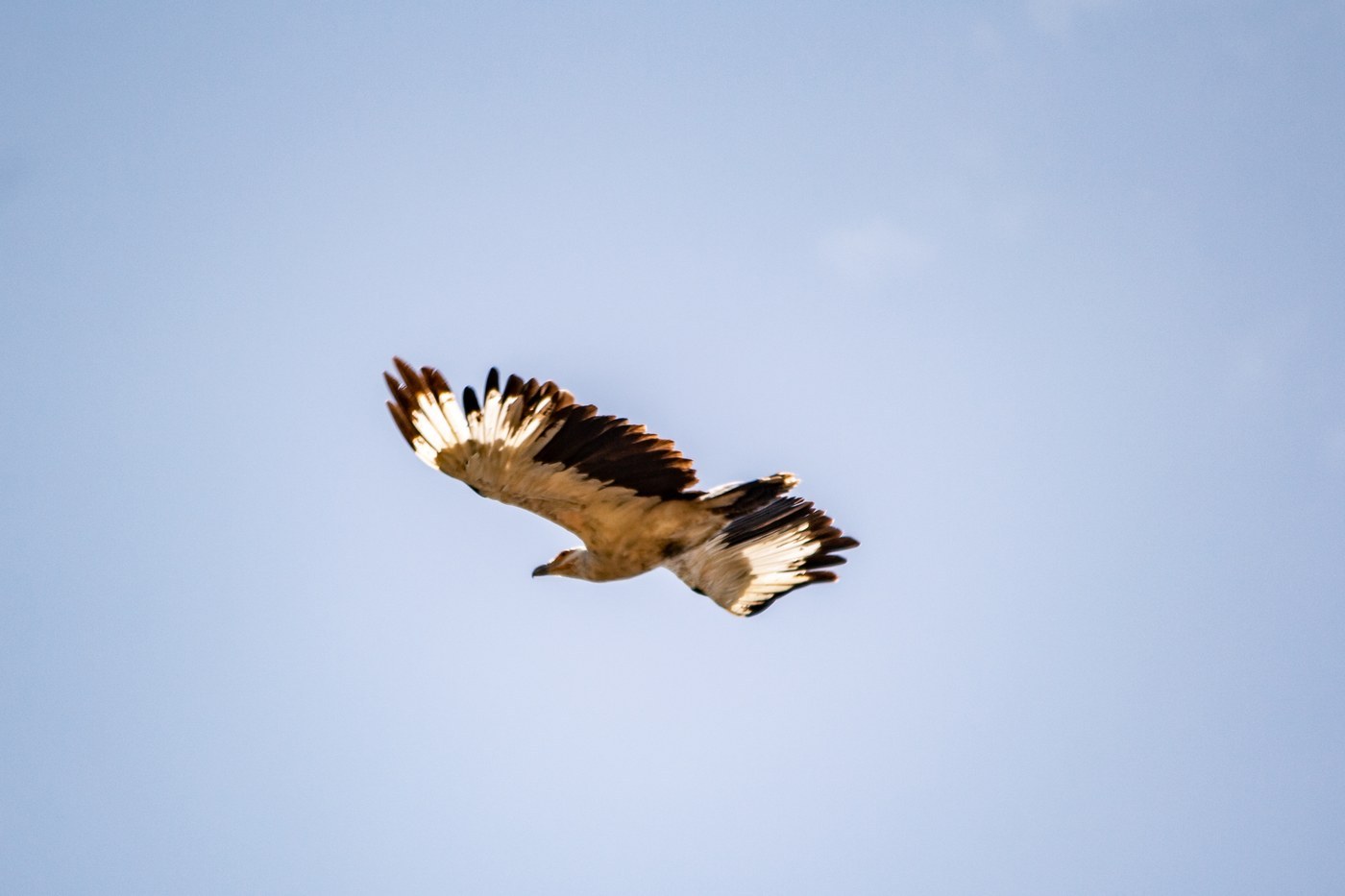
What Palm-nut Vulture's Feathers Look Like
Palm-nut Vulture feathers reflect an unusual raptor — largely fruit-eating rather than a true carrion specialist — and its feathers show a clean, bold pattern unlike most vultures. Body feathers are predominantly pure white to creamy white, covering the head, neck, breast, and much of the back and tail, giving adults a strikingly pale overall look for a vulture. In sharp contrast, the flight feathers (primaries and secondaries) are solid glossy black, creating a bold white-body/black-wing pattern visible even from a single dropped feather. Some individuals show a black tail band near the tip of otherwise white tail feathers. Flight feathers are large, broad, and strong, typically 20–30 cm, reflecting a mid-to-large raptor built for soaring. Immatures are notably different — mostly brown overall rather than white, so juvenile feathers lack the crisp white-black contrast and instead show a duller, streaky brown appearance. Shafts on adult flight feathers are thick and pale, while body feathers have a soft, dense texture.
Step-by-Step: Is This Feather From a Palm-nut Vulture?
- Check for the white-black split. A clean division between white body feathers and solid black flight feathers is the strongest positive sign for an adult of this species.
- Look at the tail. A white tail feather with a black band near the tip supports this identification.
- Consider age. If the feather is a dull, streaky brown rather than crisp white or black, it may be an immature bird rather than a different species.
- Measure size. Flight feathers in the 20–30 cm range fit a mid-sized raptor.
- Match habitat. A white-and-black raptor feather found near oil palms, coastal forest, or rivers in sub-Saharan Africa strongly supports this species, since it's unusually tied to palm fruit as a food source.
Similar Species & How to Tell Them Apart
Palm-nut Vulture's white-and-black adult pattern is fairly distinctive among African raptors, but it can be confused with the Egyptian Vulture, which also shows white body plumage with black flight feathers. Egyptian Vulture, however, is smaller overall with more slender flight feathers and a distinctly wedge-shaped tail (visible in the shape of individual tail feathers, which taper more), plus yellowish facial skin rather than the reddish-orange facial skin of Palm-nut Vulture (a clue if any facial feather fragments are attached). Other large white-bodied African raptors, like some storks or the African Fish Eagle (which has a white head and chestnut body, not white body with black wings), have quite different color distributions once you compare body versus wing color carefully. Fish Eagle in particular has chestnut-brown body feathers, not white, immediately ruling it out if the body feather in hand is truly white.
Where & When You'll Find Them
Palm-nut Vultures are unusual among vultures for their partly vegetarian diet, centered on the fleshy husks of oil palm and raffia palm fruits, and they're found near coastal forest, rivers, mangroves, and oil palm plantations across much of sub-Saharan Africa. As a largely resident, non-migratory species, feathers can be found year-round within suitable habitat. The best time to search is during the breeding season, which varies by region but often centers on the drier months, when adults are actively nesting in tall trees and more likely to lose feathers during nest-building and incubation. Search beneath tall trees near oil palm groves, coastal or riverine forest, and mangrove edges, since this species rarely strays far from a reliable palm fruit food source.
Frequently asked questions
What is the clearest diagnostic feature for this species?
A sharp contrast between white body feathers and solid glossy black flight feathers, visible even on a single dropped feather from an adult bird.
How do immature Palm-nut Vulture feathers differ?
Immatures are mostly brown overall, so their feathers look duller and streaky rather than showing the crisp white-and-black pattern of adults.
How is this different from an Egyptian Vulture feather?
Egyptian Vulture is smaller with more slender flight feathers and a more wedge-shaped tail, plus yellowish (not reddish-orange) facial skin, compared to Palm-nut Vulture.
Could this be an African Fish Eagle feather instead?
No — African Fish Eagle has a chestnut-brown body, not white, so a genuinely white body feather rules out Fish Eagle immediately.
Where should I look for these feathers?
Beneath tall trees near oil palm groves, coastal or riverine forest, and mangroves across sub-Saharan Africa, where this species feeds on palm fruit year-round.