
How to Identify Painted Redstart Feathers
A guide to identifying the bold black, white, and red feathers of the Painted Redstart, a striking warbler of southwestern canyons, and telling it apart from similar warblers.
Read the full Painted Redstart encyclopedia entry →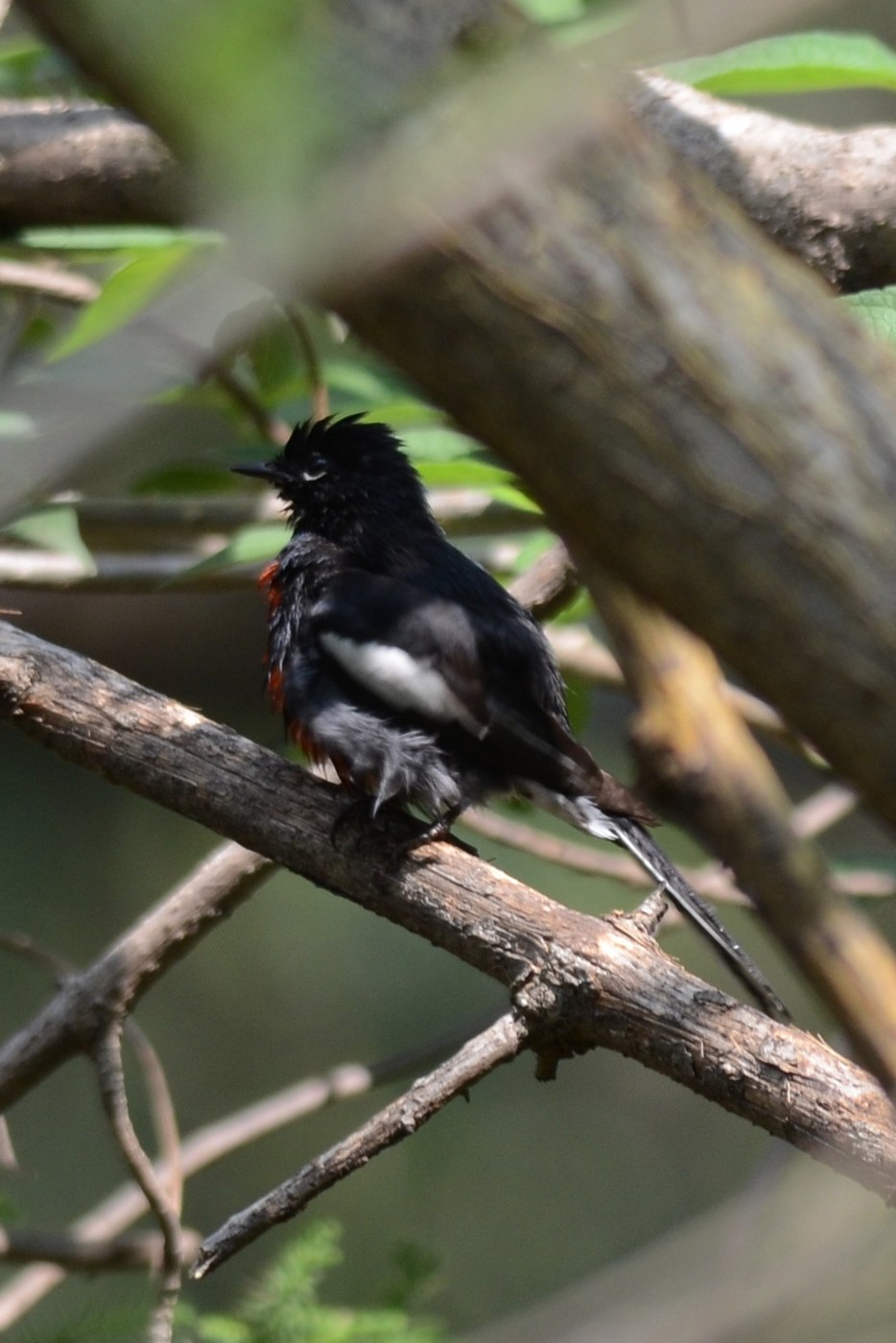
What Painted Redstart Feathers Look Like
Painted Redstart feathers are strikingly patterned for a warbler-sized bird. Most body feathers are glossy jet black, with a sharply defined bright crimson-red patch on the breast and belly — a color combination that stands out immediately against the muted tones of most small songbirds. Wing feathers show a large, bold white patch formed by white bases on the primary coverts and inner flight feathers, visible as a solid white flash rather than thin bars, and the outer tail feathers are extensively white on the underside, contrasting with black elsewhere on the tail. Feathers are small, typically 4–7 cm for flight and tail feathers, with a soft but slightly glossy texture on the black body feathers. Shafts are dark, nearly black, blending with the vane. Unlike many warblers, there is no yellow anywhere in this plumage — the palette is strictly black, white, and red.
Step-by-Step: Is This Feather From a Painted Redstart?
- Check for the black-white-red combination. A glossy black feather with a crimson patch, or a mostly white outer tail feather bordered in black, is very distinctive and rules out most other warblers.
- Look for a solid white wing patch. This should appear as one bold block of white rather than a thin double wing bar.
- Confirm there's no yellow. Ruling out yellow immediately separates this species from the great majority of North American warblers.
- Measure the feather. A 4–7 cm range fits a warbler-sized bird; much larger feathers point elsewhere.
- Match the habitat. Feathers found in shaded oak-pine canyons of the Southwest borderlands strongly support this identification over other habitats.
Similar Species & How to Tell Them Apart
The closest look-alike is the American Redstart, which shares the "redstart" flash-and-flush foraging habit but has a completely different color scheme: American Redstart males show orange-red patches (not crimson) on a black body, with the patches positioned on the sides of the breast, wings, and tail base rather than the belly, and importantly lack the bold solid white wing patch of the Painted Redstart. Slate-throated Redstart, found in similar canyon habitat farther south, has an all-red belly like the Painted Redstart but lacks the white wing patch and has a gray (not black) throat and upperparts, making the wing patch the single best separator between these two. Common Black-Hawk or other black-bodied birds are far larger and have completely different feather shapes. If you find a feather that is glossy black with white confined to a solid wing block and red confined to the belly, Painted Redstart is very likely the answer.
Where & When You'll Find Them
Painted Redstarts breed in shaded oak and pine-oak canyons of the mountains of southeastern Arizona, southwestern New Mexico, and northern Mexico, foraging actively on tree trunks and branches while flicking their tail and wings to flush insects. Most of the population is migratory, present from March through September, though some individuals overwinter in the warmer parts of their range. The best time to find molted feathers is during the post-breeding molt in July and August, when adults refresh their plumage before fall movements. Search along shaded canyon bottoms, near sycamore- and oak-lined streams, and around nest sites tucked into steep, vegetated banks, since this species favors cool, wooded canyon habitat over open desert or high conifer forest.
Frequently asked questions
What color combination should I look for?
Glossy black feathers with a sharply defined crimson-red patch, plus a bold solid white wing patch and extensively white outer tail feathers — no yellow anywhere in the plumage.
How is this different from an American Redstart feather?
American Redstart shows orange-red (not crimson) patches positioned on the sides of the breast and wing/tail base, and lacks the Painted Redstart's bold solid white wing patch.
What about Slate-throated Redstart, which also has a red belly?
Slate-throated Redstart lacks the white wing patch and has gray upperparts and throat rather than glossy black, making the wing patch the key differentiator.
Where in the U.S. would I find these feathers?
In shaded oak and pine-oak canyons of the mountains of southeastern Arizona and southwestern New Mexico, near streams and canyon-bottom woodland.
When do these birds molt?
Adults undergo a post-breeding molt in July and August before fall migration, making that window the best time to find dropped feathers.