
How to Identify Pacific Black Duck Feathers
How to identify the double-striped face and white-bordered speculum of the Pacific Black Duck, a common dabbling duck of Australia and the Pacific.
Read the full Pacific Black Duck encyclopedia entry →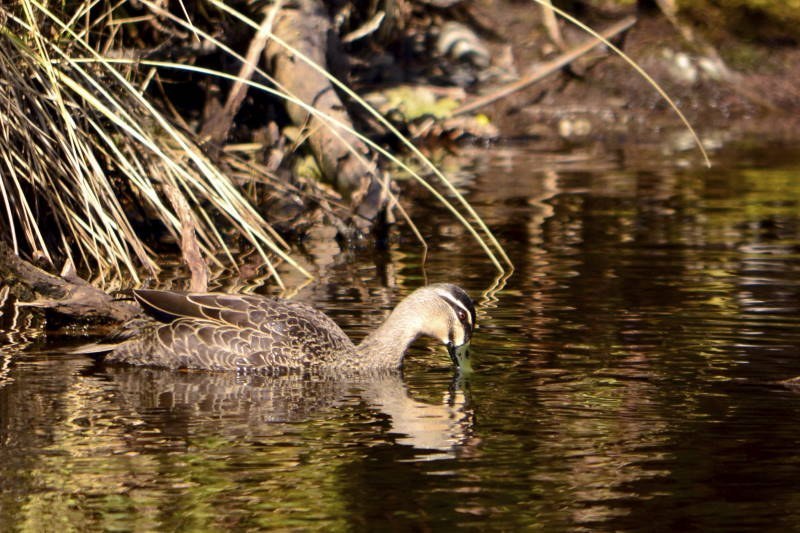
What Pacific Black Duck's Feathers Look Like
The Pacific Black Duck is a common dabbling duck across Australia, New Zealand, and the wider Pacific, and its feathers show a distinctive facial pattern worth checking first. Body and back feathers are dark brown, each edged with a paler buff border that creates an overall mottled, scaled appearance. The face is pale buff to cream, crossed by two bold blackish-brown stripes — one running through the eye and another along the crown — giving the head a striped look unlike most other dabbling ducks. The wing carries a glossy green-to-blue speculum (a patch on the secondary feathers), bordered by black, but notably lacking the bright white trailing edge that many other dabbling ducks show on the same feathers — a speculum feather with color but no white border is a useful clue. Underwing feathers are whitish. Feather size fits a medium-sized duck.
Step-by-Step: Is This Feather From a Pacific Black Duck?
- Check a face feather for double striping. Two dark stripes — one through the eye, one along the crown — on a pale buff face is the strongest first clue.
- Look at a speculum feather. Glossy green-blue color bordered by black, but without a bright white edge, fits this species.
- Judge body feather pattern. Dark brown with paler buff edging, creating a mottled or scaled look, supports Pacific Black Duck.
- Check underwing color. Whitish underwing covert feathers match this species.
- Factor in range. Feathers found in Australia, New Zealand, or the Pacific islands support this identification over similar Northern Hemisphere ducks.
Similar Species & How to Tell Them Apart
The female Mallard is a close look-alike in overall mottled brown tone, but its face is comparatively plain, without the bold double dark stripes of Pacific Black Duck, and its speculum is bordered by white bars on both edges, a feature reduced or absent in Pacific Black Duck. The Chestnut Teal female is smaller, with a plainer, less strongly striped face and a speculum that leans more uniformly green without the same blue tint. The Grey Duck, the New Zealand form closely related to (and sometimes treated as part of) this species, is essentially identical in feather pattern, with range being the main point of reference rather than a structural feather difference.
Where & When You'll Find Them
Pacific Black Ducks inhabit wetlands, rivers, lakes, and coastal lagoons across Australia, New Zealand, and much of the southwestern Pacific, and are largely non-migratory, though some local movement follows water availability. Molt occurs after breeding, with a flightless period during which large numbers of body and flight feathers are shed together, making late in the breeding season the most productive time to find feathers near wetland margins and favored loafing sites.
Frequently asked questions
What is the clearest identifying feature for Pacific Black Duck feathers?
A face feather showing two bold dark stripes — one through the eye, one along the crown — on an otherwise pale buff face, a pattern most other dabbling ducks lack.
How do I tell this apart from a female Mallard feather?
Female Mallard has a plainer face without the bold double stripes, and its speculum feather shows white bars on both edges, which are reduced or absent in Pacific Black Duck.
Why doesn't the speculum feather I found have a white edge?
Pacific Black Duck's speculum lacks the bright white trailing edge that many other dabbling ducks show, so a colored speculum feather without white borders fits this species well.
Is the Grey Duck a different species?
It's the New Zealand form of the same species complex and essentially identical in feather pattern, so range is the main distinguishing consideration rather than feather structure.
When are Pacific Black Duck feathers most likely to be found?
After the breeding season, during the flightless molt period, near wetland margins and favored loafing sites across Australia, New Zealand, and the Pacific.