
How to Identify Oriental Magpie-Robin Feathers
A guide to the glossy black-and-white feathers and habitually cocked tail of the Oriental Magpie-Robin, a familiar garden bird across South and Southeast Asia.
Read the full Oriental Magpie-Robin encyclopedia entry →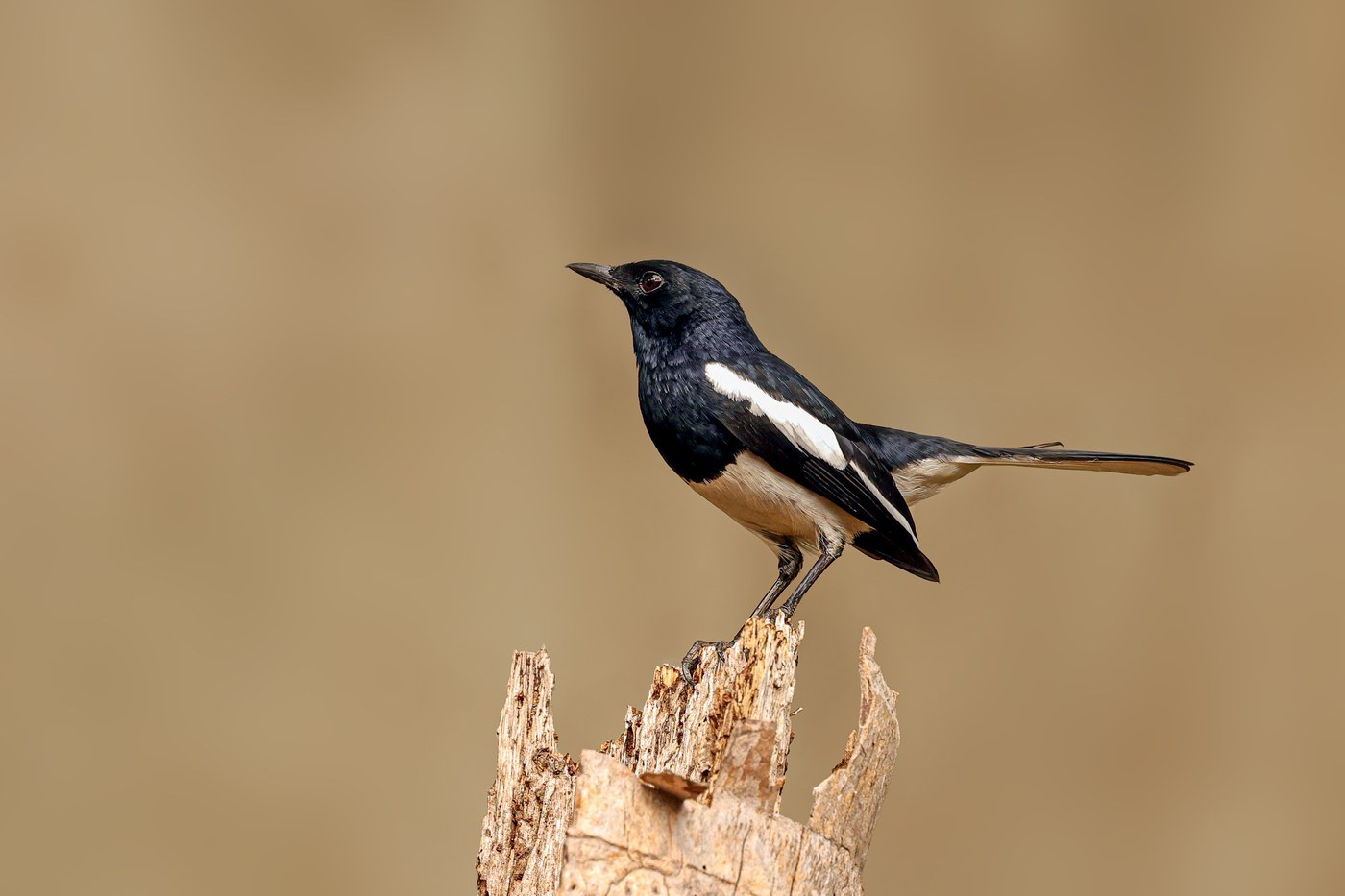
What Oriental Magpie-Robin's Feathers Look Like
The Oriental Magpie-Robin is a common, confiding garden bird across South and Southeast Asia, and its feathers make for one of the more reliable identifications in this guide. Males show a glossy blue-black head, throat, breast, and upperparts, sharply set against a clean white belly. On the wing, a bold white patch forms a conspicuous stripe visible even on a folded wing, and the tail shows a striking pattern: the central feathers are black, while the outer tail feathers are white, and the whole tail is long, graduated, and habitually held cocked upward over the back. Females share the identical pattern but in gray-slate rather than black tones. Feather size fits a bird around 8-9 inches, larger and more robust than many similarly patterned songbirds.
Step-by-Step: Is This Feather From an Oriental Magpie-Robin?
- Check underparts color. A clean white belly feather paired with a glossy black (or slate-gray) breast feather is a strong starting clue.
- Look for a bold white wing patch. A distinct white stripe on the wing coverts, rather than a small spot, fits this species.
- Sort tail feathers by position. Black central feathers versus white outer feathers, on a long, graduated tail, is highly characteristic.
- Judge overall gloss. A blue-black sheen (male) or plain slate-gray (female) rather than matte brown-black supports this identification.
- Factor in habitat. Feathers found in gardens, parks, and open woodland edges across South or Southeast Asia support this call.
Similar Species & How to Tell Them Apart
The Indian Robin, found in overlapping range, is much smaller, shows only a small white shoulder patch rather than a full wing stripe, has no white at all in the tail, and instead carries bright rufous-chestnut undertail coverts — a feature Oriental Magpie-Robin lacks entirely. The Pied Bushchat male is also black-and-white, but its white is arranged as a wing patch and white rump rather than a white belly plus white outer tail feathers, and its tail is short, not long, graduated, or habitually cocked. The White-rumped Shama, a close relative, shares the general black-white-pattern idea but has a chestnut, not white, belly and a considerably longer tail. The specific combination of white belly, white wing stripe, and white outer tail feathers on a bird that habitually cocks its tail points clearly to Oriental Magpie-Robin.
Where & When You'll Find Them
Oriental Magpie-Robins are common residents of gardens, parks, open woodland, and cultivated land across South and Southeast Asia, frequently seen foraging on lawns and low perches close to human habitation. They are non-migratory, and molt follows the breeding season; feathers are most likely to be found year-round in gardens and park settings, since the species is closely tied to these human-modified habitats throughout its range.
Frequently asked questions
What is the clearest diagnostic combination for this species?
A clean white belly feather, a bold white wing-stripe feather, and a tail with black central feathers but white outer feathers, from a bird with a habitually cocked tail.
How do I tell this apart from an Indian Robin feather?
Indian Robin is much smaller, shows only a small white shoulder patch rather than a full wing stripe, has no white in the tail, and instead has rufous undertail coverts, which Oriental Magpie-Robin lacks.
Why is my feather gray instead of black?
Female Oriental Magpie-Robins show the identical pattern in slate-gray tones rather than the glossy blue-black of males.
What separates this from a White-rumped Shama feather?
White-rumped Shama has a chestnut (not white) belly and a much longer tail, while Oriental Magpie-Robin has a clean white belly and a shorter, though still graduated, tail.
Where should I look for these feathers?
Gardens, parks, and open woodland edges across South and Southeast Asia, since the species is closely associated with human-modified habitats year-round.