
How to Identify Northwestern Crow Feathers
A guide to identifying the glossy black feathers of the Northwestern Crow and separating them from American Crow and Common Raven along the Pacific coast.
Read the full Northwestern Crow encyclopedia entry →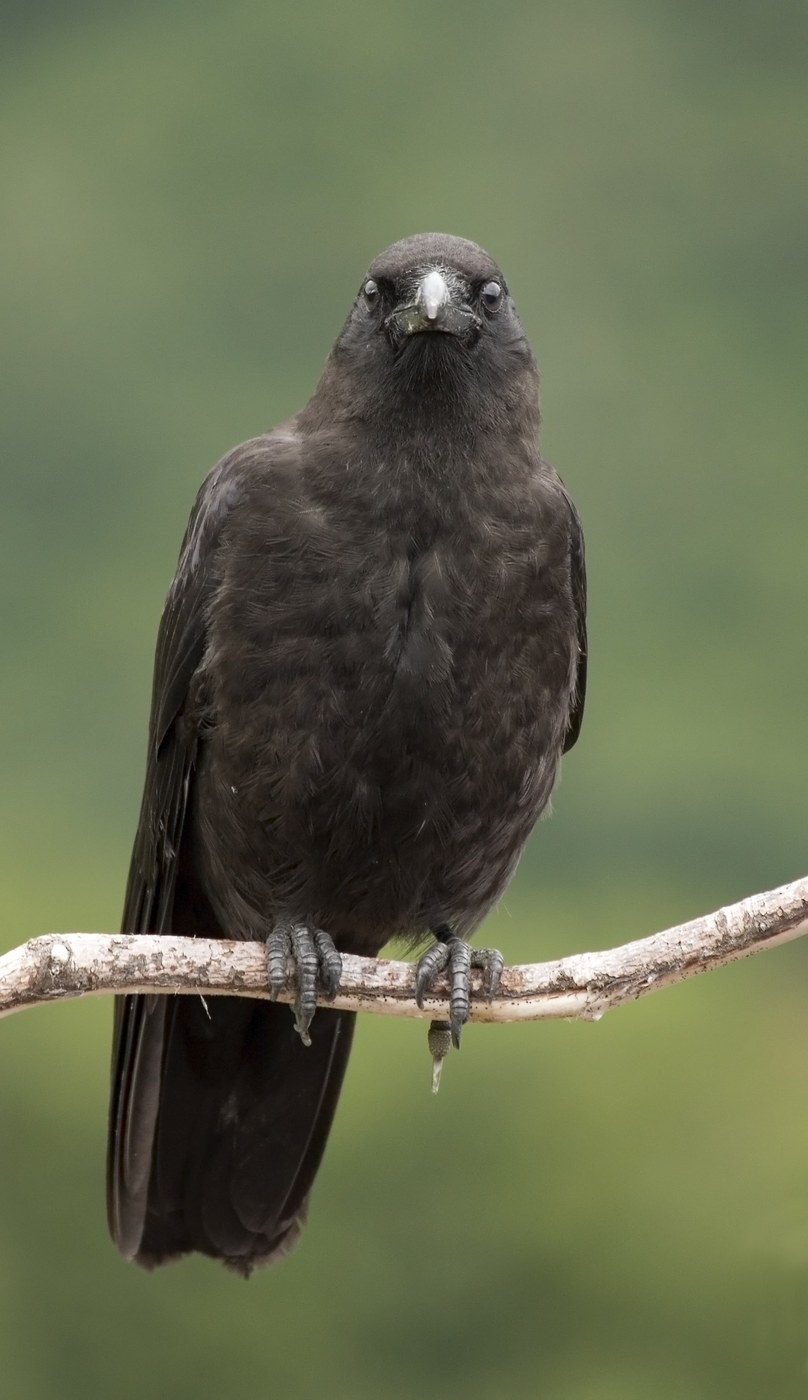
What Northwestern Crow Feathers Look Like
The Northwestern Crow is a coastal specialist so similar to the American Crow that the two are known to interbreed where their ranges meet, making feather identification genuinely challenging — but a few general clues still apply.
- Body feathers: solid black overall with a somewhat duller, less richly iridescent sheen than a raven, typically showing a blue-black gloss in good light rather than strong purple-green tones
- Throat feathers: short, smooth, and sleek — not shaggy or elongated the way a raven's throat hackles are
- Tail feathers: relatively short and, when fanned, form a rounded or fan shape rather than a wedge
- Overall size: on average slightly smaller and more compact than American Crow, though the size difference is subtle and overlaps considerably — not something to rely on alone
- Wing feathers: broad and evenly rounded at the tip, without the deep "fingered" primary spread of a soaring raven
Step-by-Step: Is This Feather From a Northwestern Crow?
- Rule out raven first. Check size (much smaller than raven), tail shape (rounded, not wedge-shaped), and throat feather texture (smooth, not shaggy) — if the feather is raven-sized or shaggy-throated, it's not a crow.
- Consider location carefully. This is the single most useful clue in practice: feathers found directly along the immediate Pacific coastline of the Pacific Northwest, especially on beaches, tidal flats, or rocky shorelines, are more likely to be Northwestern Crow, since the species rarely strays far from saltwater.
- Compare size to American Crow if you have reference material. Northwestern Crow tends to run slightly smaller on average, though this overlaps enough that it should be treated as a soft clue only.
- Look for uniform blue-black gloss rather than the more purple-toned sheen typical of ravens.
- Accept the limits of feather-only ID. Because Northwestern Crow and American Crow hybridize extensively where their ranges meet and some authorities now treat them as a single species, confident separation by feather alone is often not possible — location and behavior (tideline foraging) are your best supporting evidence.
Similar Species & How to Tell Them Apart
- American Crow: essentially identical in feather structure and color; Northwestern Crow averages slightly smaller and sticks closer to shorelines, but where ranges overlap along the coast the two hybridize, and feather-only separation is not reliable — treat any coastal crow feather from this region as "American/Northwestern Crow" unless you have strong location or behavioral context.
- Common Raven: notably larger, with a wedge-shaped tail, shaggy throat hackle feathers, and a more purple-green iridescent cast — size and throat texture are the most reliable separators from either crow.
- Fish Crow: found in the eastern U.S. rather than the Pacific Northwest, so range alone rules it out in this species' territory.
Where & When You'll Find Them
Northwestern Crows are tightly tied to the immediate Pacific coastline of British Columbia, southeastern Alaska, and parts of northern Washington, foraging extensively along tidelines, mudflats, and rocky shores for shellfish, carrion, and other coastal food, and rarely venturing far inland. The species is non-migratory, remaining resident on territory year-round, so feathers can be found in any season, with the heaviest turnover following the complete post-breeding molt in mid-to-late summer. Because of this species' close association with beaches and tidal zones, feathers found scattered among shells, driftwood, and intertidal debris right at the coast are a good contextual match, whereas crow feathers found well inland in the same general region are more likely to belong to American Crow.
Frequently asked questions
Can feather features alone reliably separate this from American Crow?
Not confidently — the two species are extremely similar and hybridize where their ranges meet, so feather-only identification is limited; location right along the immediate coastline is your best supporting clue.
What's the best way to rule out Common Raven?
Check for a much larger size, a wedge-shaped rather than rounded tail, and shaggy throat hackle feathers — all present in raven and absent in either crow species.
Why does habitat matter so much for this species' identification?
Northwestern Crow rarely strays from the immediate coastline and forages heavily on tidal flats and beaches, so a crow feather found right at the shoreline in its range is more consistent with this species than one found further inland.
Does this species migrate seasonally?
No, it's a year-round resident that stays on territory throughout the year, so feathers can be found in any season near coastal habitat.
When is feather turnover highest?
Mid-to-late summer, following the annual post-breeding molt, though feathers can be encountered at any time given the species' non-migratory habits.
Northwestern Crow identified by the community
Recent Northwestern Crow feathers identified with Feather Identifier.
