
How to Identify Northern Parula Feathers
A guide to identifying the tiny blue-gray, yellow-throated feathers of the Northern Parula and telling them apart from similarly small warblers.
Read the full Northern Parula encyclopedia entry →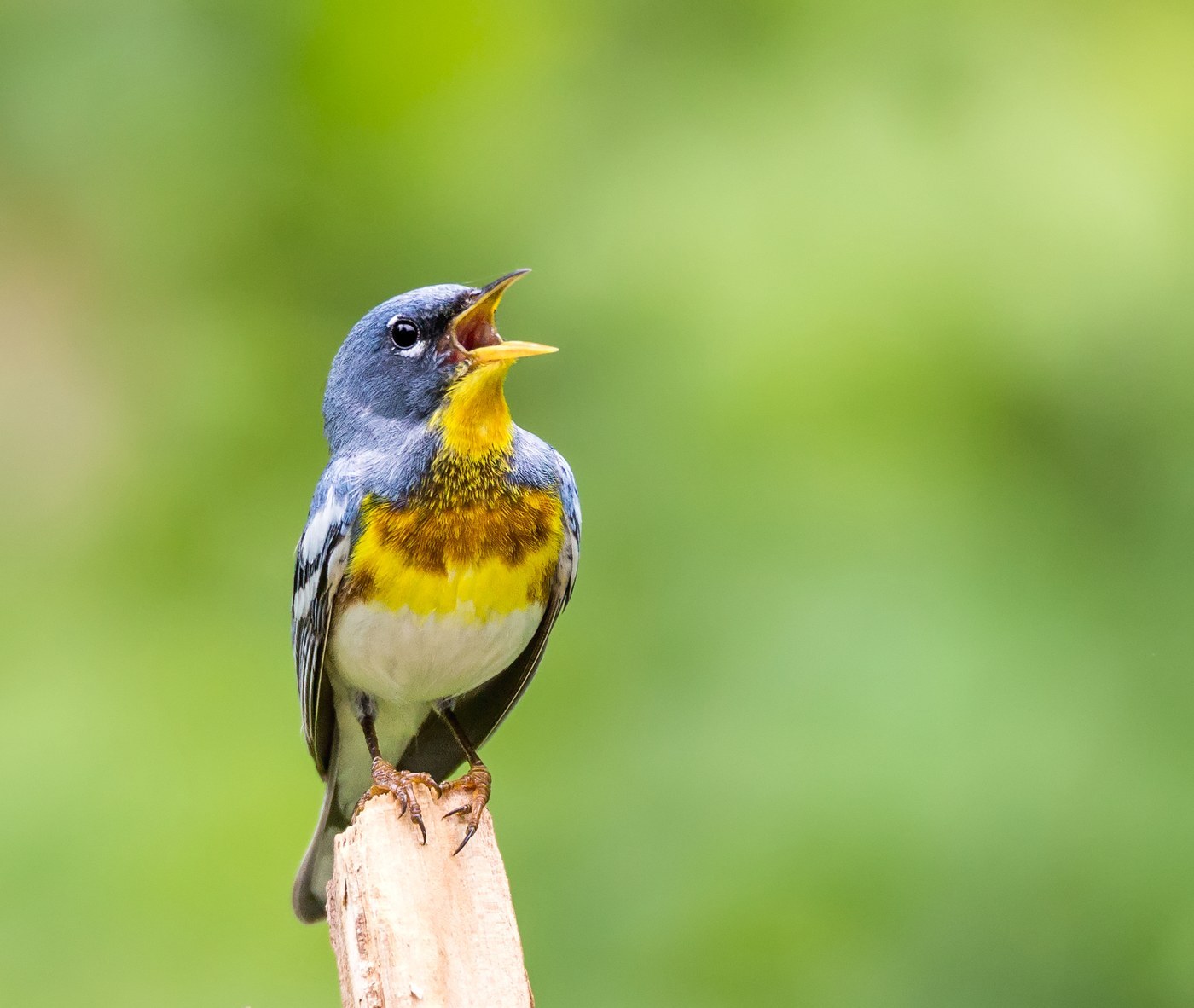
What Northern Parula Feathers Look Like
The Northern Parula is one of the smallest wood-warblers in North America, and its feathers are correspondingly tiny — expect to be working with feathers just a few centimeters long.
- Upperpart feathers: blue-gray overall with a distinctive yellow-green patch across the back (mantle) — this two-toned back is one of the most diagnostic features of the species and unusual among blue-gray warblers
- Throat and breast: bright yellow, with males showing a dark chestnut-and-black breast band across the yellow (a "necklace" band) — females and immatures show this band faintly or not at all, but retain the yellow throat
- Belly: clean white, contrasting with the yellow chest
- Wing feathers: blue-gray edged in white, forming two bold white wing bars
- Eye area feathers: white crescents above and below the eye rather than a solid eye-ring — look for two separate white arcs rather than a full circle
- Tail feathers: blue-gray with small white spots near the tips of the outer feathers, visible as a flash from below in flight
Step-by-Step: Is This Feather From a Northern Parula?
- Check the size first. If the feather is only 4-6 cm and clearly songbird-shaped, you're in the right size range — this rules out anything larger than a small warbler or kinglet immediately.
- Look for a two-toned back feather. A blue-gray feather with a yellow-green wash or patch is very distinctive and points strongly to this species.
- Check for yellow on a throat/breast feather, ideally with a hint of chestnut banding — combined with white wing bars this is close to diagnostic.
- Look for white eye crescents rather than a complete ring if facial feathers are present.
- Confirm white wing bars on blue-gray wing covert feathers; two crisp white bars support the ID.
Similar Species & How to Tell Them Apart
- Tropical Parula: very similar but lacks the white eye crescents (its face is more uniformly blue-gray with just a dark eye-mark) and typically shows a more solid, unbroken chestnut breast wash rather than a distinct banded "necklace." Ranges barely overlap in southern Texas.
- Black-throated Blue Warbler: also blue-gray above, but underparts are white or black, never yellow, and it lacks the yellow-green back patch entirely.
- Cerulean Warbler: blue above but paler, streaked flanks, and no yellow-green mantle patch or yellow throat.
- Blue-winged Warbler: yellow below like Parula, but solidly blue-gray wings with white wing bars and a plain gray-green back without the sharply demarcated two-tone mantle patch, and a black eye-line rather than crescents.
Where & When You'll Find Them
Northern Parulas breed in mature forests across the eastern United States and southern Canada, with a strong habitat association with hanging epiphytes — Spanish moss in the South and old-man's-beard lichen in the North — which they use almost exclusively for nest material and cover. They are long-distance Neotropical migrants, wintering from Mexico through Central America and the Caribbean, so feathers found in the U.S. and Canada will most likely turn up during the breeding season (May through August) or during spring and fall migration stopovers, particularly in wooded areas along coastlines and river corridors. The complete molt happens on or near the breeding grounds in late summer before birds depart south.
Frequently asked questions
What is the single best clue for such a small feather?
A blue-gray back feather with a contrasting yellow-green patch is one of the most distinctive features among small blue-and-yellow warblers and is a strong first check.
How do I tell Northern Parula from Tropical Parula?
Look for white crescents above and below the eye — Northern Parula has them clearly, while Tropical Parula's face is more solidly blue-gray without distinct white eye marks. Range also helps, since Tropical Parula is largely confined to south Texas and southward.
Do female Parula feathers look different from males?
Females and immatures lack or show only a faint version of the male's chestnut breast band, but they retain the yellow throat, two-toned back, and white wing bars, so those features remain useful for ID.
Why might I find one of these feathers far from typical warbler habitat?
Because Parulas are long-distance migrants, feathers can turn up at migration stopover sites like coastal thickets or riverside trees that aren't breeding habitat at all, especially in spring and fall.
When is the best time of year to find this species' feathers?
Late spring through summer on breeding territories, or during spring and fall migration windows at stopover sites along the eastern flyways.