
How to Identify Northern Lapwing Feathers
A guide to spotting the iridescent, crested feathers of the Northern Lapwing, including the wispy head plume that no other shorebird shares.
Read the full Northern Lapwing encyclopedia entry →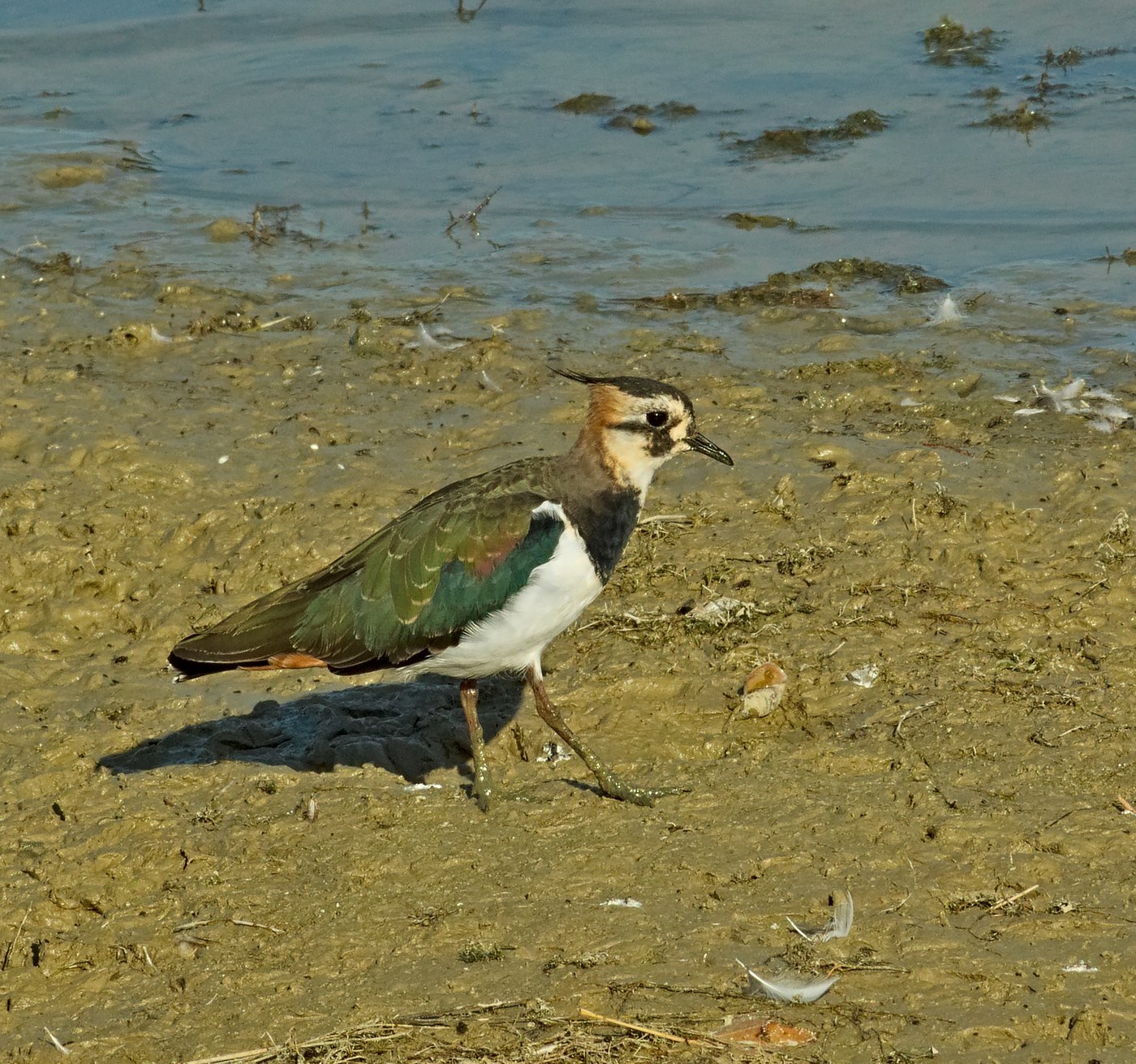
What Northern Lapwing Feathers Look Like
The Northern Lapwing is one of the easiest shorebirds to confirm from feathers alone thanks to one unmistakable feature: a thin, wire-like crest plume that grows from the back of the crown. No other common shorebird in its range grows anything like it.
- Crest feathers: a handful of very narrow, elongated black plumes, 5-9 cm long, curving slightly upward — unmistakable if you find one still attached to a bit of scalp or find several shed together
- Upperpart feathers: glossy black with strong iridescent green, bronze, and purple sheen that shifts with the light — a true structural, oily-looking iridescence rather than flat black or brown
- Underparts: clean white, with a solid black breast band separating the white throat from the white belly
- Flight feathers: primaries blackish, broadly rounded and blunt-tipped rather than pointed — lapwings have notably broad, "floppy" wings compared to sandpipers and plovers
- Tail: white with a broad black terminal band and rufous-orange undertail covert feathers
Step-by-Step: Is This Feather From a Northern Lapwing?
- Look for the crest plume first. If your feather is a single narrow black filament several centimeters long, distinctly different from every other feather you'd expect on a shorebird, that's close to diagnostic on its own.
- Check for iridescence. Hold a dark body feather at different angles to the light. Genuine green-purple-bronze shimmer over black points strongly to Lapwing; flat matte black or brown does not.
- Assess wing shape. A broad, rounded, blunt primary feather (rather than a narrow, pointed one) fits this species' distinctive floppy flight style.
- Check for a black breast band on a body feather transitioning sharply to white — this contrast is bold and clean-edged, not mottled.
- Note any rufous-orange under the tail. Warm orange undertail coverts combined with a black-and-white tail band confirm the ID.
Similar Species & How to Tell Them Apart
- European Golden-Plover: shares open farmland habitat but has spangled gold-and-black upperparts with no iridescent sheen, no crest, and narrower, more pointed wings.
- Grey Plover (Black-bellied Plover): black axillaries ("wingpit" patch) in breeding birds, but no crest and no green-purple iridescence — feathers are duller gray overall.
- Other Vanellus lapwings (e.g., Sociable Lapwing, White-tailed Lapwing) found in parts of Asia: differ in head pattern and lack the extreme wire-thin single crest plume of the Northern Lapwing, or lack the black breast band.
- Rooks and crows: also glossy black, but their feathers are far larger, symmetrical flight feathers with no white or iridescent green cast, and no crest plume exists in corvids.
Where & When You'll Find Them
Northern Lapwings breed across open farmland, wet grassland, and moorland from the British Isles across temperate Europe into Russia and Central Asia, favoring bare or short-cropped fields near water. Most populations are migratory, moving to milder lowlands and coastal areas of western and southern Europe, the Mediterranean, and parts of South Asia in winter, though some populations are resident where winters stay mild. Feathers are most likely to turn up on breeding grounds after the complete post-nuptial molt in July and August, and again in wintering fields where large flocks gather from autumn through early spring.
Frequently asked questions
Is the crest plume always present on molted feathers?
Not necessarily — crest plumes are shed less often than body feathers, but when you do find one it is essentially diagnostic for this species within its range.
How can I tell iridescence from just a wet or oily-looking feather?
Genuine structural iridescence shifts through distinct colors (green, purple, bronze) as you rotate the feather in light, rather than just looking shiny or slick in one uniform sheen.
Do juvenile Lapwings have the same iridescent feathers?
Juveniles show duller, browner upperparts with less obvious iridescence and pale-edged feathers, but they already have the same broad wing shape and black breast band pattern, just less crisp.
Why are the wings so broad and rounded compared to other shorebirds?
Lapwings use a slow, floppy, almost butterfly-like flight for aerial display and predator-mobbing, which favors broader, more rounded wings than the fast, pointed wings of typical sandpipers.
When is peak feather-finding season?
Late summer on breeding fields after the post-breeding molt, and again in winter roosting/feeding fields where large flocks concentrate.
Northern Lapwing identified by the community
Recent Northern Lapwing feathers identified with Feather Identifier.

