
How to Identify Meyer's Parrot Feathers
A guide to the olive-brown body feathers with yellow shoulder and crown patches that identify Meyer's Parrot, an African savanna parrot.
Read the full Meyer's Parrot encyclopedia entry →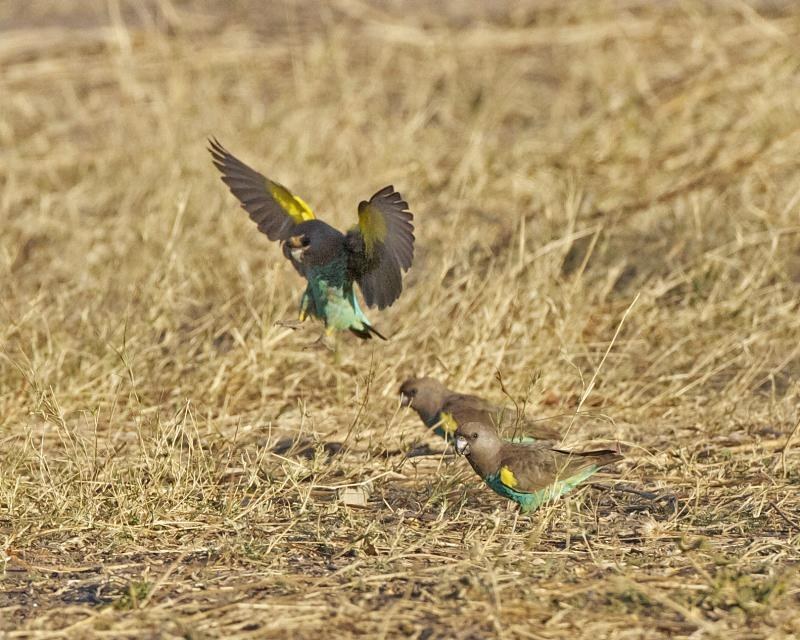
What Meyer's Parrot Feathers Look Like
Meyer's Parrot feathers are mostly understated brown and olive, punctuated by small but bright patches of yellow that serve as the best diagnostic clues. Body feathers on the head, nape, and back are a dull brownish-olive, without bold patterning, giving the bird excellent camouflage in dry woodland. The most useful feathers to find are the small yellow patch feathers at the bend of the wing (carpal area/shoulder) — bright lemon-yellow, contrasting sharply with the surrounding drab brown covert feathers, and often present even in feather fragments recovered from a molt site. Some individuals also show a variable patch of yellow feathers on the crown, though this is less consistent than the wing patch and varies by subspecies. Belly and rump feathers are a contrasting blue-green to turquoise, notably brighter and cooler-toned than the drab brown of the upperparts — this rump/belly color break is a second strong diagnostic when present. Flight feathers are blackish-brown, moderately broad and rounded, typical of parrot wings built for quick, direct flight rather than soaring.
Step-by-Step: Is This Feather From a Meyer's Parrot?
- Look for a small bright yellow feather from the wing bend/shoulder area contrasting against otherwise drab brown covert feathers — a strong first clue.
- Check for blue-green belly/rump feathers. A cooler turquoise tone breaking up the brown body plumage supports the ID.
- Assess crown color. Some individuals show yellow crown feathers, but treat this as supporting rather than required evidence since it's variable.
- Confirm overall drab brown-olive body tone, since this species lacks bold patterning elsewhere.
- Consider size. A medium-sized parrot feather, body length around 21–24 cm, with rounded flight feather tips typical of Poicephalus parrots.
Similar Species & How to Tell Them Apart
- Brown-headed Parrot: Very similar overall structure, but typically shows less or no yellow on the shoulder and a more uniformly brown head without the blue-green belly contrast as pronounced.
- Red-fronted Parrot / Jardine's Parrot: Shows an orange-red patch on the crown/shoulder rather than yellow, and often more extensive green in the body plumage.
- Senegal Parrot: Has a gray head and a bold yellow-and-orange "V" on the chest, a much more contrasting head-and-chest pattern than Meyer's more uniformly brown head.
- Feral/escaped parrot feathers from aviculture: Because parrots of many origins are commonly kept in captivity, a yellow-shouldered brown parrot feather found far outside Africa should be considered with that possibility in mind, since exact species confirmation depends on matching the specific pattern described above.
Where & When You'll Find Them
Meyer's Parrots inhabit dry savanna woodland, riverine forest edges, and wooded grassland across a broad swath of sub-Saharan Africa, often nesting in tree cavities and remaining resident year-round in most of their range. Feathers are most likely to be found near fruiting or flowering trees and roost/nest cavity sites in these woodland habitats. Molt is not tightly seasonal in many parrot species and can occur gradually across much of the year, but feather loss often increases somewhat around the local breeding season, which varies regionally across the species' wide African range.
Frequently asked questions
What is the standout feather clue for Meyer's Parrot?
A small, bright yellow feather from the bend of the wing (shoulder/carpal area), contrasting against otherwise drab brown covert feathers.
Does the belly color help with identification?
Yes, a contrasting blue-green to turquoise rump/belly feather against brown upperparts is a second useful clue.
Is yellow on the crown always present?
No, crown yellow is variable by individual and subspecies, so treat it as supporting evidence rather than a requirement.
How do I rule out Brown-headed Parrot?
Brown-headed Parrot typically shows less or no yellow on the shoulder and a less pronounced blue-green belly contrast.
Could a similar feather be from a pet parrot rather than a wild bird?
Yes — because parrots are widely kept in captivity, a matching feather found far from Africa may well be from an aviary bird rather than a wild individual.