
How to Identify Mexican Jay Feathers
A guide to the plain blue-and-gray feathers of the Mexican Jay and how to separate them from scrub-jays and other blue corvids of the American Southwest.
Read the full Mexican Jay encyclopedia entry →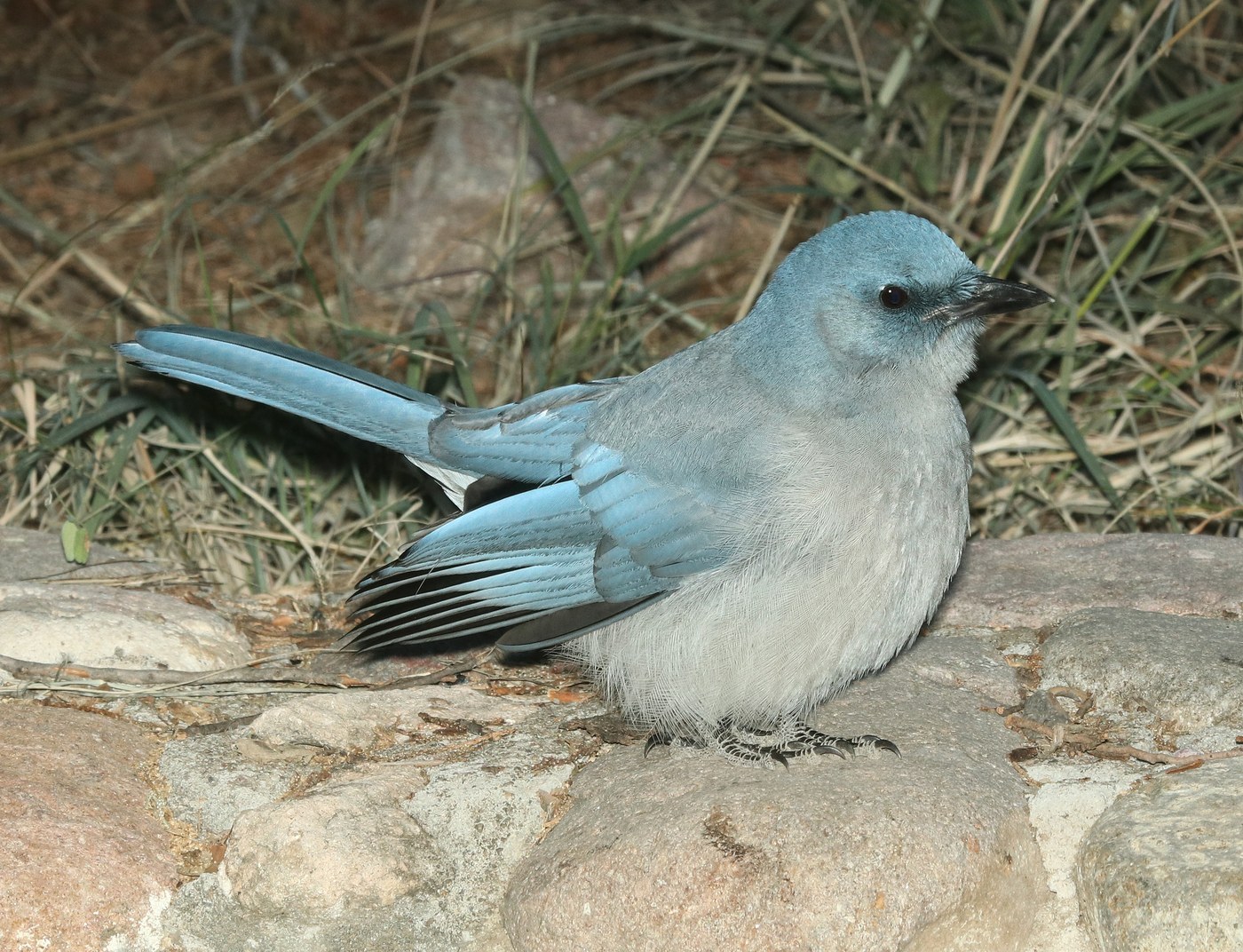
What Mexican Jay Feathers Look Like
Mexican Jay feathers show a soft, muted blue-and-gray combination rather than the bold, high-contrast patterns of many other jays. Head, wing, and tail feathers are a fairly uniform pale to medium blue, without any black facial mask or streaking on the throat — a genuinely plain, unmarked blue face and crown, unlike the streaked throat patterns of scrub-jays. Back and mantle feathers are gray, providing a clear contrast between the blue head/wings/tail and the grayer body — but without a sharply demarcated "hooded" look. Underparts (breast and belly) feathers are pale gray, unstreaked and unmarked, again reinforcing the overall plain appearance. Tail feathers are moderately long (14–17 cm), blue, and lack white tail-corner spots. There's no crest — feathers from the crown lie relatively flat rather than forming a peaked structure, distinguishing them from crested jays.
Step-by-Step: Is This Feather From a Mexican Jay?
- Check for streaking on throat/breast feathers. Mexican Jay feathers here are plain and unstreaked; streaking suggests a scrub-jay instead.
- Look at overall contrast. A relatively soft transition between blue head/wing feathers and gray back/belly feathers, without bold white eyebrow or throat markings.
- Confirm no crest. Crown feathers lie flat; a peaked or crested feather structure points to a different species (e.g., Steller's Jay).
- Assess tail feather color. Plain blue without white corner spots or bold barring.
- Consider range and habitat. Feathers found in oak and pine-oak woodland of the southwestern US borderlands or Mexican highlands support this ID.
Similar Species & How to Tell Them Apart
- Woodhouse's Scrub-Jay: Shows a whitish throat with fine dark streaking and a more contrasting white eyebrow, plus a more sharply demarcated blue "necklace" across the breast — all patterns Mexican Jay lacks.
- California Scrub-Jay: Similarly patterned to Woodhouse's, with bold white throat streaking and stronger blue/gray contrast than the uniformly plain Mexican Jay.
- Steller's Jay: Has a prominent black crest and much darker, blackish-blue head and back feathers, quite different from Mexican Jay's plain pale blue-and-gray combination.
- Pinyon Jay: More uniformly blue-gray overall (less contrast between head and body) and lacks the grayer back/paler belly split of Mexican Jay, plus a shorter tail relative to body.
Where & When You'll Find Them
Mexican Jays live in oak and pine-oak woodland of the "Sky Island" mountain ranges of southeastern Arizona, southwestern New Mexico, and trans-Pecos Texas, extending south through the Mexican highlands, typically in cooperative family groups that forage and roost together year-round. Because this species is non-migratory and highly social, feathers can accumulate around communal roost sites and acorn-caching areas at any time of year. Molt generally follows the summer breeding season, so the freshest feathers are most often found from late summer into early fall, though worn feathers from year-round territorial and foraging activity can turn up throughout the year in oak woodland habitat.
Frequently asked questions
What's the biggest difference between Mexican Jay and scrub-jay feathers?
Mexican Jay throat and breast feathers are plain and unstreaked, while scrub-jays show streaking on a whitish throat and a more defined blue breast band.
Does Mexican Jay have a crest?
No, its crown feathers lie flat, unlike the prominent crest of Steller's Jay.
How does the back feather color compare to the head?
The back is grayer than the pale-to-medium blue head, wings, and tail, giving a soft two-tone look without sharp demarcation.
Where would I find Mexican Jay feathers in the US?
Oak and pine-oak woodland in the Sky Island mountains of southeastern Arizona, southwestern New Mexico, and trans-Pecos Texas.
When are fresh feathers most likely to be found?
Late summer into early fall, following the post-breeding molt.