
How to Identify Little Bunting Feathers
A guide to identifying Little Bunting feathers by their chestnut-rufous ear coverts bordered in black, white eye-ring, and finely streaked underparts.
Read the full Little Bunting encyclopedia entry →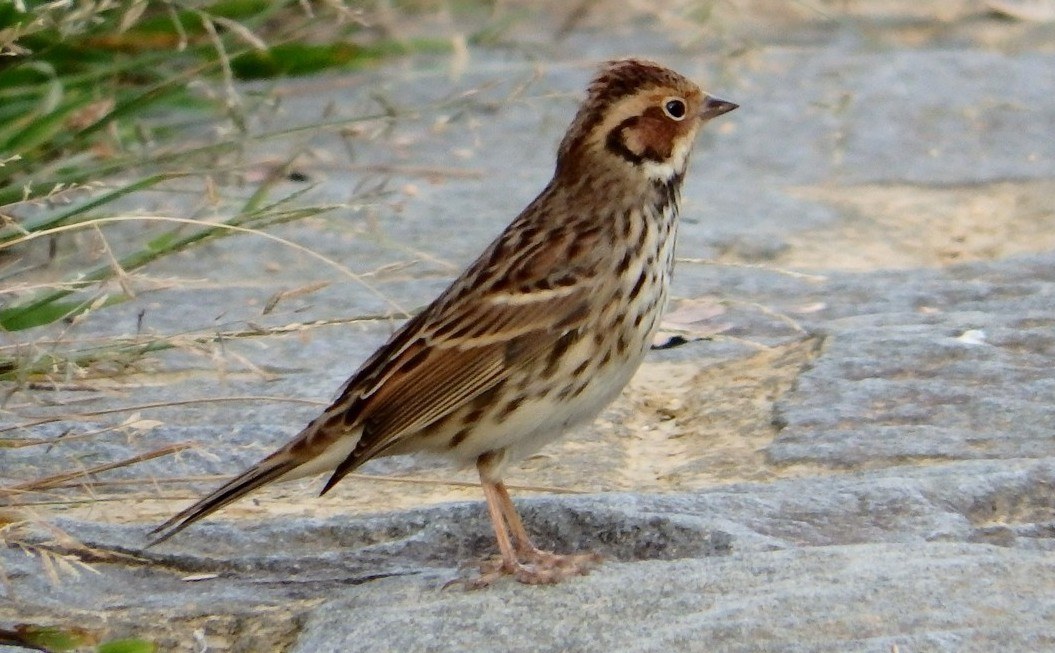
What Little Bunting Feathers Look Like
The Little Bunting is a small, compact Eurasian bunting, and its feathers carry a distinctive warm-and-crisp head pattern that stands out even in a single feather find. The crown and ear-covert (cheek) feathers are a rich chestnut to rufous color, bordered by narrow black lines framing the crown sides and outlining the rear edge of the ear coverts — this black-bordered chestnut patch is the species' most recognizable feature. A thin but crisp white eye-ring surrounds the eye, distinct against the rufous face. The back and mantle feathers are streaked brown and black on a buffy background, typical sparrow-like bunting camouflage. Underparts are white to buffy-white with fine, crisp black streaking concentrated on the flanks and breast sides, while the central breast and belly remain cleaner and less marked. Wing feathers are brown with two narrow whitish wingbars formed by pale feather tips on the coverts. The tail is dark brown with white outer edges on the outermost feathers, a common bunting trait used in flight signaling.
Step-by-Step: Is This Feather From a Little Bunting?
- Check for chestnut-rufous crown or ear-covert feathers bordered by black lines — the single most reliable diagnostic if head feathers are present.
- Look for a white eye-ring feather trace, distinct against the warm face color.
- Assess underpart streaking. Fine, crisp black streaks on white-to-buffy flanks, with a cleaner central breast, fits this species.
- Check wing feathers for narrow whitish double wingbars.
- Measure size. Small, consistent with a compact bunting slightly smaller than a typical sparrow.
- Confirm habitat and range — a find in Europe or Asia along wetland edges, scrub, or open grassy areas during migration or winter supports this species over similar New World sparrows.
Similar Species & How to Tell Them Apart
The Rustic Bunting is a similar look-alike but is larger, shows a small crest, and its head pattern includes more white and a differently shaped chestnut band, plus a chestnut breast-band absent in Little Bunting. The Reed Bunting shows a much bolder black-and-white head pattern (especially breeding males with a solid black head and white collar) rather than the chestnut-and-black bordered pattern of Little Bunting. Yellow-browed Bunting shows a pale yellowish supercilium (eyebrow) rather than the plain whitish eye-ring of Little Bunting, an easy separator when facial feathers are available for comparison.
Where & When You'll Find Them
Little Buntings breed in subarctic and boreal scrub, birch, and willow thickets across northern Russia and Siberia, migrating to winter in open grassy areas, scrub, and wetland edges across South and Southeast Asia, with occasional vagrants appearing further west in Europe. Feathers are most likely to be found on the wintering grounds throughout the colder months, when the species forms small flocks in weedy fields and marsh edges, or along migration routes during spring and autumn passage through East Asia, when birds pass through in greater concentrations at stopover sites.
Frequently asked questions
What is the most distinctive feather feature of a Little Bunting?
A chestnut-rufous crown or ear-covert feather bordered by narrow black lines, paired with a crisp white eye-ring.
How is this different from a Rustic Bunting feather?
Rustic Bunting is larger, shows a small crest, and has a chestnut breast-band, none of which appear on the more simply patterned Little Bunting.
What does the underpart streaking look like?
Fine, crisp black streaks concentrated on the flanks and breast sides, with a cleaner central breast and belly.
Where does this species spend the winter?
Open grassy areas, scrub, and wetland edges across South and Southeast Asia, where small flocks gather in weedy fields.
When is the best time to find migration feathers?
During spring and autumn passage through East Asia, when birds concentrate at stopover sites along their migration route.