
How to Identify Keel-billed Toucan Feathers
A guide to the glossy black body feathers, yellow bib, and red vent feathers of the Keel-billed Toucan and how to distinguish them from other toucan species.
Read the full Keel-billed Toucan encyclopedia entry →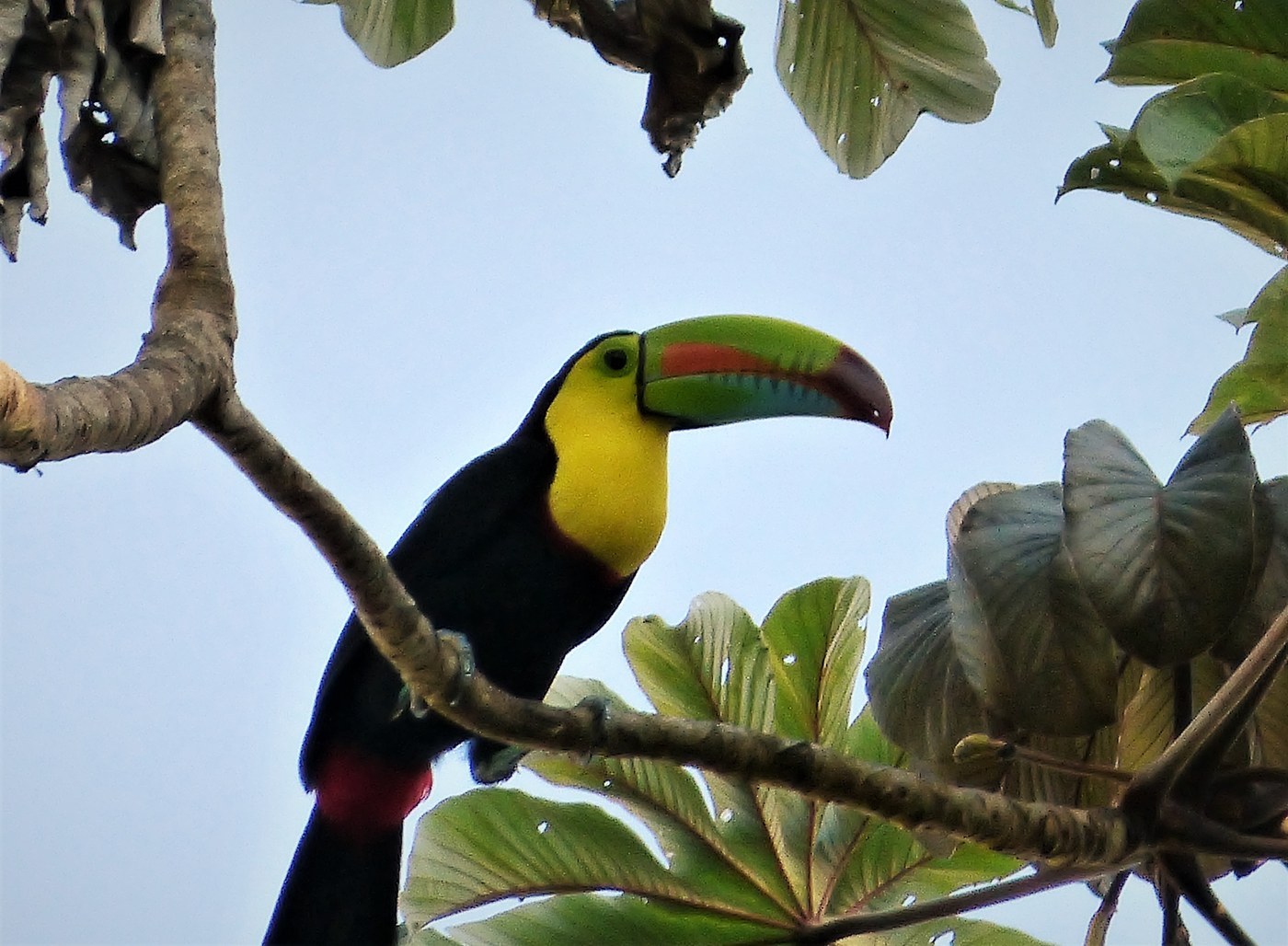
What Keel-billed Toucan Feathers Look Like
Keel-billed Toucan body feathers are mostly a deep, glossy jet black, covering the back, wings, crown, and tail, providing a strong dark backdrop for the bird's much more famous rainbow bill (not feathered, so not relevant to a feather find). The standout feather feature is the bib: chest and upper breast feathers are a bright, clean lemon-yellow, sharply demarcated from the surrounding black, with a narrow band of red feathers separating the yellow bib from the black belly below — a thin but distinctive color break worth checking for on any chest-area feather. Undertail covert feathers are a vivid red, another strong diagnostic patch distinct from the yellow chest. The tail itself is black, fairly long, and slightly rounded at the tip, with some individuals showing a faint blue sheen in certain light. Flight feathers are black and broad, built for the toucan's characteristic short, undulating flights between forest trees rather than sustained flight. Overall feather texture is fairly soft and full-bodied, typical of a fruit-eating forest bird rather than a sleek aerial hunter.
Step-by-Step: Is This Feather From a Keel-billed Toucan?
- Check for solid glossy black first. Most of this bird's plumage is black, so a plain black contour or flight feather is consistent but not yet diagnostic on its own.
- Look for lemon-yellow chest feathers. A clean, bright yellow feather (not orange, not pale cream) supports this species strongly.
- Look for a red band or red vent feather. A thin red feather bordering yellow, or a fuller red feather from the undertail covert area, is a strong secondary confirmation.
- Rule out orange or white bib tones. Other toucans show orange, white, or blue bibs instead of clean yellow — a mismatched bib color points elsewhere.
- Match size and range. Large black feathers found in Central American lowland/foothill forest support this species over smaller toucanets.
Similar Species & How to Tell Them Apart
- Chestnut-mandibled Toucan (Yellow-throated Toucan) shows a similar yellow bib but the yellow is often described as slightly more orange-tinged and the two species' ranges overlap only partially, so range and the precise bib shade both help.
- Toco Toucan has a mostly white, not yellow, throat and chest bib, immediately ruling it out if the feather in hand is clearly yellow.
- Collared Aracari and other aracaris are smaller overall, with yellow underparts often marked by a black breast band and belly spotting, a busier pattern than the Keel-billed's clean yellow-to-red-to-black transition.
- Emerald Toucanet shows an overall green body rather than black, making confusion unlikely once color is compared.
Where & When You'll Find Them
Keel-billed Toucans inhabit lowland and foothill tropical forest from southern Mexico through Central America into northern South America, favoring canopy and forest edge where fruiting trees are abundant. As non-migratory residents, feathers can be found in any season, though the molt following the breeding season (timing varies regionally but often falls in the latter half of the wet season) tends to produce the most loose feathers. Look beneath fruiting fig and other canopy trees, along forest edges and clearings, and near roost sites where small family groups gather in the evening.
Frequently asked questions
What's the most diagnostic single feather feature?
A clean lemon-yellow chest feather bordered by a thin red band is very distinctive and quickly narrows the field to Keel-billed or its close relative Chestnut-mandibled Toucan.
How do I rule out Toco Toucan?
Toco Toucan shows a white, not yellow, throat and chest bib, so any clearly yellow bib feather rules it out immediately.
Are the red undertail feathers unique to this species?
Not entirely unique among toucans, but combined with a yellow (not white) chest bib, red undertail coverts strongly support Keel-billed Toucan specifically.
Does the black body feather help identify the species on its own?
Not by itself — most large toucans and aracaris show extensive black plumage, so the yellow/red accent feathers are needed for a confident call.
When are Keel-billed Toucan feathers most likely to be found?
Year-round as residents, with somewhat more loose feathers turning up after the breeding-season molt, timing of which varies by region within its Central American range.
Keel-billed Toucan identified by the community
Recent Keel-billed Toucan feathers identified with Feather Identifier.


