
How to Identify Kaka Feathers
A guide to the olive-brown scalloped body feathers and crimson underwing feathers of the New Zealand Kaka, distinguishing them from Kea feathers.
Read the full Kaka encyclopedia entry →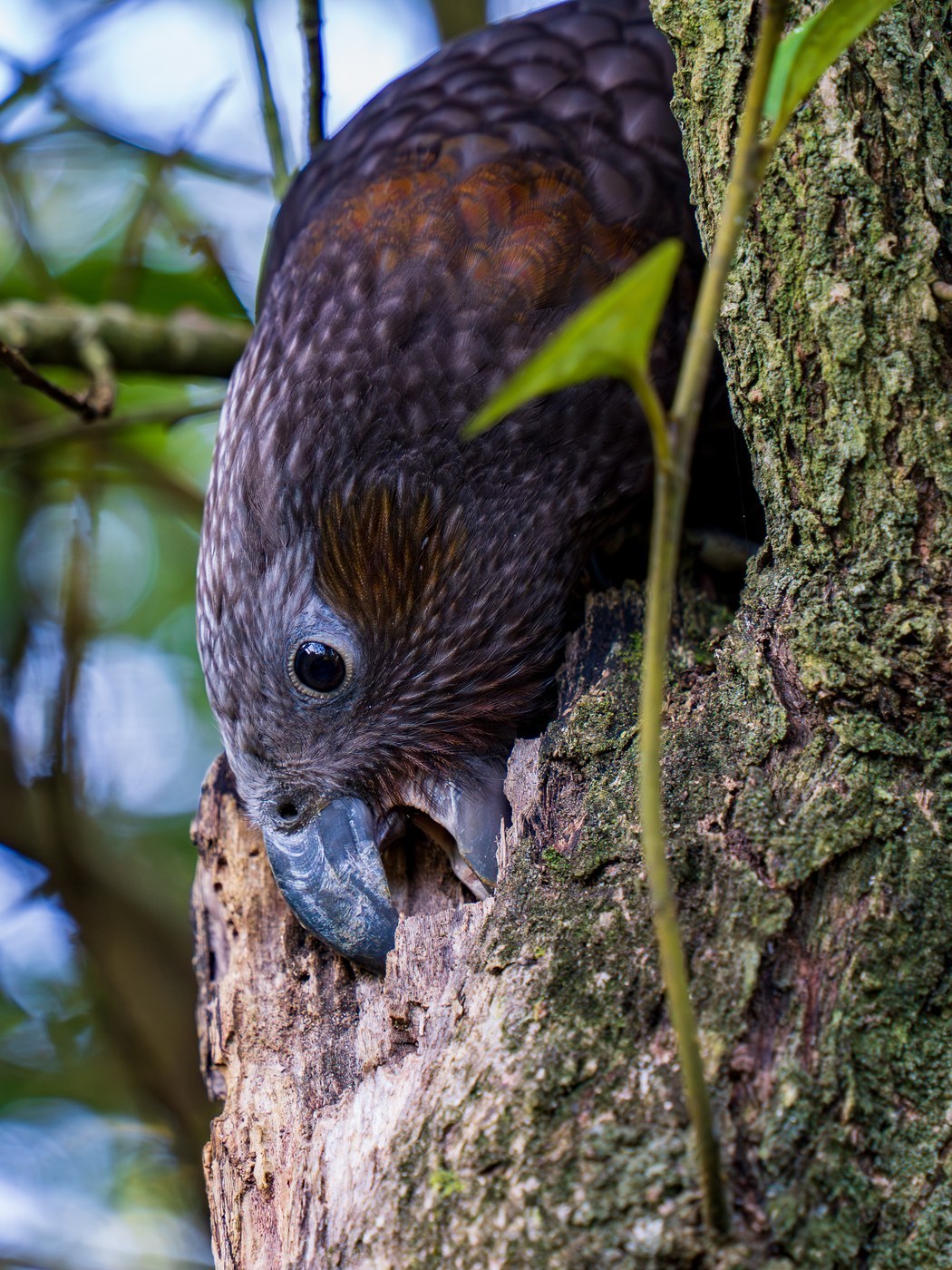
What Kaka Feathers Look Like
New Zealand Kaka feathers are dominated by a rich, dark olive-brown to grayish-brown tone on the back, wings, and crown, with each body feather showing a subtly darker crescent or scalloped edge that gives the plumage a scaly, textured look up close. The crown and nape feathers are notably paler, often a soft grayish-white, creating a contrast with the darker face and back that's visible even on isolated crown feathers. Cheek and ear-covert feathers carry a warm orange-red wash. The real showstopper, though, is underneath: underwing coverts and belly/vent feathers are a vivid crimson-red, hidden in a perched bird but unmistakable if you find one of these feathers on the ground. Flight feathers are brownish-olive on top with duller reddish tones on the inner webs. The bill-adjacent feathering and overall feather structure is heavy and strong, typical of a large, powerful parrot that pries into wood, and the feathers have a slightly loose, shaggy texture compared to smaller parrots.
Step-by-Step: Is This Feather From a Kaka?
- Check for scalloping. Body feathers with a darker crescent-shaped edge on an olive-brown background is the Kaka's signature contour feather pattern.
- Look at the crown color. A pale grayish-white feather from the crown/nape against darker surrounding feathers fits Kaka's head pattern.
- Search for crimson. Any bright crimson-red feather, especially if it looks like underwing covert or belly down, strongly supports Kaka over most other New Zealand parrots.
- Note feather size and strength. Large, sturdy feathers with a heavy shaft fit this powerful, wood-tearing parrot rather than a smaller parakeet.
- Rule out bright green. No Kaka feather is grass-green; a green feather points elsewhere, most likely Kakariki.
Similar Species & How to Tell Them Apart
- Kea shares the crimson underwing coloring but has an overall olive-green (not brown) body plumage and a bright orange-red rump patch barred with black — a green-toned scalloped feather points to Kea, a brown-toned one to Kaka.
- Kakariki (New Zealand parakeets) are bright green overall with red crown patches in some species, entirely lacking the brown scalloped body pattern and crimson underwing of Kaka.
- Australian King-Parrot (where escapees might be confused) shows solid red on the head/underparts in males rather than Kaka's brown-scalloped body with crimson hidden only underneath.
- Kakapo feathers are moss-green and heavily mottled/barred with black and yellow, quite different from the smoother brown scalloping of Kaka.
Where & When You'll Find Them
Kaka are forest parrots found in native New Zealand forest on both the North and South Islands, as well as on some offshore predator-free islands where conservation populations thrive, favoring beech and podocarp forest with mature trees for nesting cavities and foraging. As non-migratory residents, feathers can be found year-round, though the post-breeding molt in late summer to autumn (roughly February through April in the Southern Hemisphere) tends to produce the most loose body feathers. Look near old nest cavities in large trees, feeding stations in reserves and sanctuaries where Kaka are known to visit, and beneath favored foraging trees showing bark-stripping damage.
Frequently asked questions
What's the easiest way to tell Kaka from Kea feathers?
Body tone — Kaka feathers are olive-brown with dark scalloping, while Kea feathers are olive-green; both can show crimson underwing feathers, so body color rather than the red is the key split.
Why is the crimson underwing feather so distinctive?
It's a vivid, saturated red rarely matched by other New Zealand birds, and finding one narrows the field almost immediately to Kaka or Kea.
Are Kaka feathers likely to be found outside New Zealand?
No — Kaka are endemic to New Zealand and its nearby islands, so a genuine find would be within that range or from captive birds in zoos/aviaries elsewhere.
What does the scalloped feather pattern actually look like?
Each contour feather has a subtly darker, crescent-shaped edge on an olive-brown base, giving a scaly, layered texture across the back and wing coverts.
Is there a season with more Kaka feather finds?
Late summer to autumn (roughly February-April in New Zealand) during the post-breeding molt typically yields the most loose feathers, though residents shed some year-round.