
How to Identify Hyacinth Macaw Feathers
Identify the entirely cobalt-blue plumage and huge, long flight and tail feathers of the world's largest macaw species.
Read the full Hyacinth Macaw encyclopedia entry →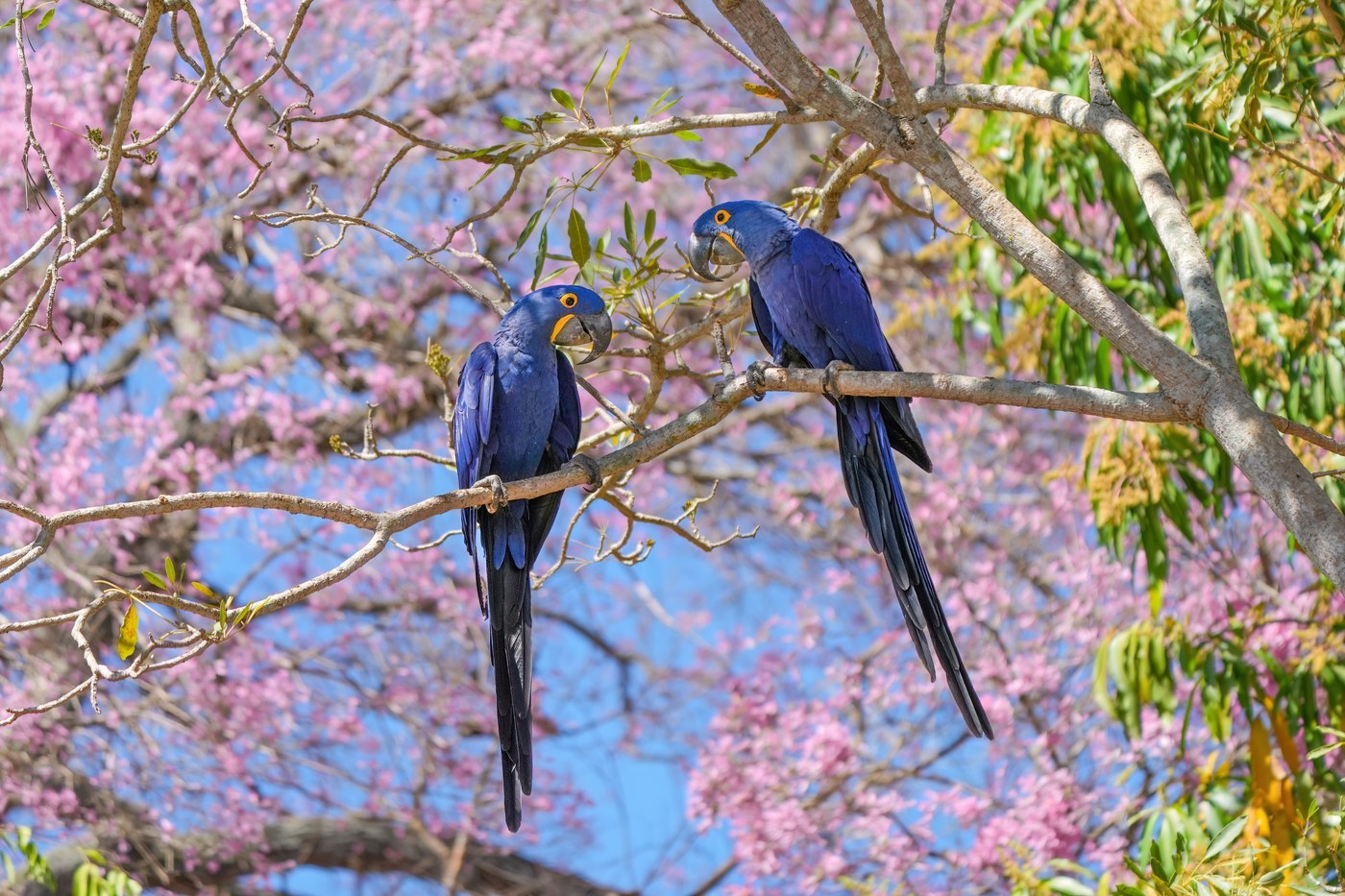
What Hyacinth Macaw Feathers Look Like
The Hyacinth Macaw, the largest parrot species in the world by length, has one of the most immediately recognizable plumages of any bird: an entirely deep cobalt-blue coloring covering the whole body, wings, and tail, with no other color present in the feathers at all (the only non-blue coloring on the bird is bare bright yellow skin around the eye and at the base of the lower mandible, which is skin, not feather). Body and covert feathers are a rich, fairly uniform blue with a subtly darker blue-black tone along the shaft and central vane, and they have a notably soft, dense, almost velvety texture reflecting the bird's large body size and the insulating underdown beneath the contour feathers.
Flight feathers (primaries and secondaries) are exceptionally large for any parrot — often 25-35+ cm long — a reflection of this being the longest of all parrot species, with a wingspan approaching 1.2-1.5 meters. The tail feathers are also elongated, long and graduated, contributing to the bird's long overall silhouette in flight. Both flight and tail feathers show the same cobalt-blue color as the body, only slightly darker/duller on the underside compared to the more vivid upper surface.
Step-by-Step: Is This Feather From a Hyacinth Macaw?
- Check for uniform cobalt-blue color with no other color mixed in — this simplicity (no green, red, or yellow anywhere in the feather) is itself a clue, since most large macaws are multicolored.
- Measure size. Flight and tail feathers are exceptionally large; a primary or tail feather approaching 30 cm or more strongly suggests this species over smaller blue-plumaged parrots.
- Feel the texture. Feathers should feel dense, soft, and well-insulated at the base, consistent with a very large-bodied bird.
- Check for a subtly darker blue-black tone along the shaft, distinct from the slightly brighter blue of the rest of the vane.
- Consider that yellow "feathers" reported near the eye are actually bare skin, not true plumage, so a feather sample from this species will always be blue, never yellow.
Similar Species & How to Tell Them Apart
Lear's Macaw and Glaucous Macaw are the closest relatives sharing an all-blue plumage, but both are considerably smaller-bodied with correspondingly shorter flight and tail feathers, and Lear's Macaw shows a slightly greener-blue cast compared to the purer cobalt of Hyacinth Macaw. Feather size is the most practical distinguishing factor, since Hyacinth Macaw's are markedly larger than either relative's. Other blue parrots, such as Blue-and-yellow Macaw, have obvious yellow underparts and green crown feathers mixed with the blue, making them easy to rule out — no genuinely all-blue large macaw feather is likely to be anything other than Hyacinth, Lear's, or Glaucous Macaw, and size favors Hyacinth for the largest examples.
Where & When You'll Find Them
Hyacinth Macaws are found in a few disjunct regions of South America, most notably the Pantanal wetlands, and drier woodland/palm-savanna areas of central and eastern Brazil, plus small populations in Bolivia and Paraguay. They are non-migratory residents strongly tied to specific palm species for both nesting cavities and food (palm nuts), so feathers are most likely found near stands of manduvi and other large palms used for nesting and feeding, without a strong migratory season — though feather turnover may increase somewhat around the regional breeding season.
Frequently asked questions
What is the simplest clue for identifying a Hyacinth Macaw feather?
The feather will be entirely cobalt-blue with no other color mixed in, and unusually large for a parrot feather — often approaching or exceeding 25-30 cm for flight and tail feathers.
Is the yellow skin around the eye part of the feathers?
No, that yellow coloring is bare skin, not plumage, so it will never appear on an actual feather from this species.
How is this different from Lear's Macaw?
Lear's Macaw is smaller-bodied with correspondingly shorter feathers and a slightly greener-blue tone compared to Hyacinth Macaw's purer cobalt-blue.
Could a Blue-and-yellow Macaw feather be confused with this species?
Not easily — Blue-and-yellow Macaw shows obvious yellow underparts and green crown feathers, whereas Hyacinth Macaw is blue throughout with no other color.
Where in the wild are feathers most likely to be found?
Near stands of large palm trees, especially in the Pantanal wetlands and palm savanna regions of central Brazil, where this species nests and feeds.