
How to Identify Hoatzin Feathers
Learn to recognize the spiky rufous crest, chestnut-and-buff tail, and broad weak-flying wing feathers of this odd Amazonian folivore.
Read the full Hoatzin encyclopedia entry →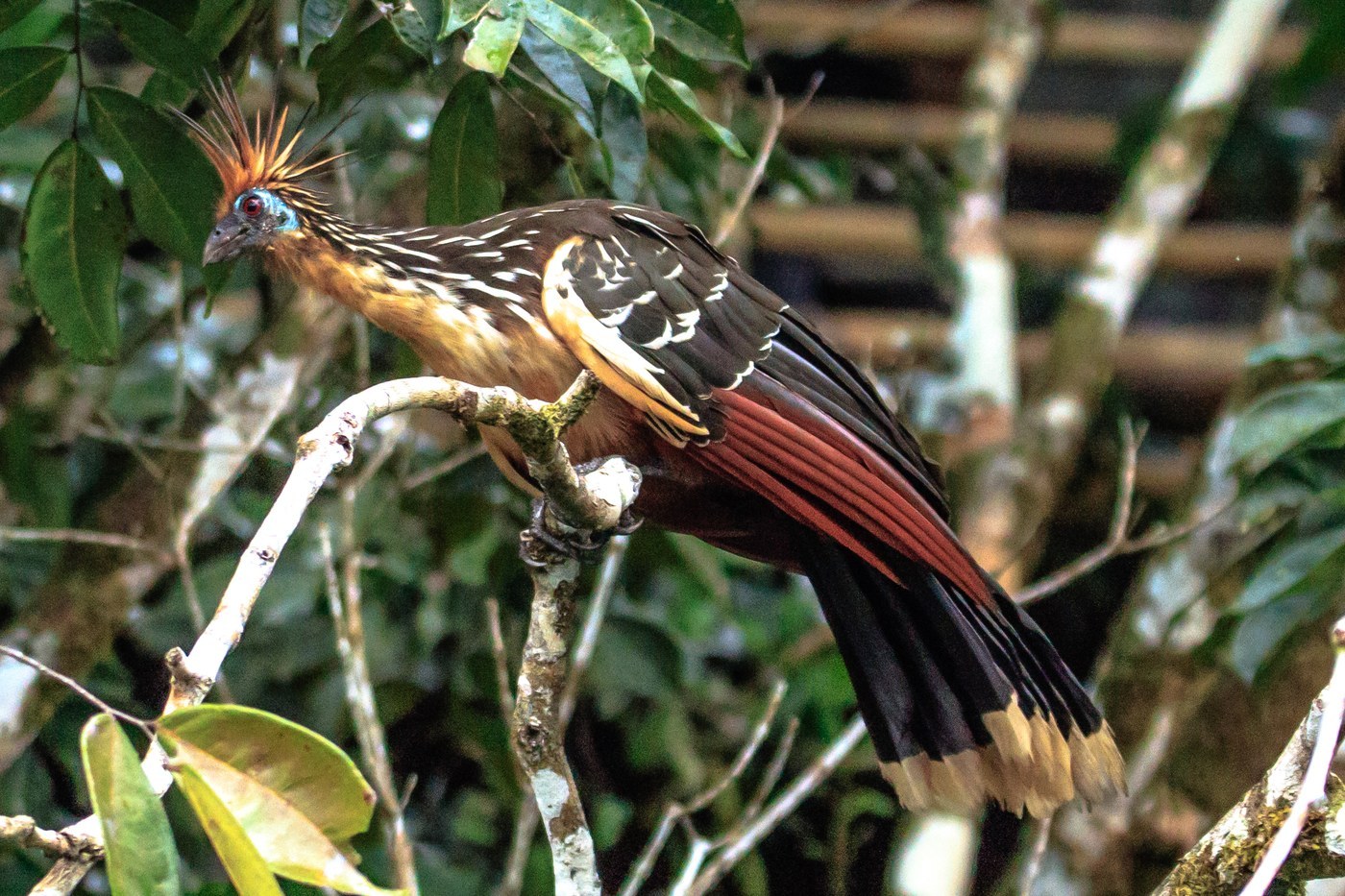
What Hoatzin Feathers Look Like
The Hoatzin is an unmistakable, chicken-sized bird of Amazon and Orinoco swamp forests, and its feathers are just as distinctive as the live bird. Body and contour feathers are a warm rufous-brown on the back and wing coverts, streaked and spotted with buffy-cream edging that gives the bird a scruffy, mottled look up close. The crest feathers on the crown are long, thin, and spiky, standing up in an untidy fan — unlike the smooth crests of most crested songbirds, these are ragged and loosely webbed.
The tail feathers are the single best clue: long, broad, and chestnut-brown with a wide, sharply defined pale buff or cream terminal band. This two-tone tip is bold and clean-edged, not a gradual fade. Flight feathers (primaries and secondaries) are broad, rounded at the tip, and relatively short and cupped compared to strong-flying birds — a reflection of the Hoatzin's poor, gliding-and-crashing flight style. Wing coverts show buffy streaking similar to the back. Shafts are pale tan to whitish on most feathers, darker chestnut on the tail.
Step-by-Step: Is This Feather From a Hoatzin?
- Check the location first. Hoatzins live only in swampy, seasonally flooded forest, oxbow lakes, and mangroves along Amazon and Orinoco tributaries in South America. A feather found outside lowland tropical South America is not from this species.
- Measure the feather. Tail feathers run roughly 20-28 cm; body/contour feathers are smaller, 5-10 cm.
- Look for the buff tail tip. A broad, sharply demarcated cream-buff band across an otherwise chestnut-brown tail feather is highly diagnostic.
- Check the barb texture. Hoatzin feathers are somewhat loose and downy-based compared to the tight vanes of strong-flying birds, matching its weak flight muscles.
- Look for buffy streaking on any brown body feather — clean solid brown without pale streaking suggests a different species.
Similar Species & How to Tell Them Apart
The main confusion species are Amazonian guans and curassows (Cracidae), which share rufous-brown plumage in some species and overlapping habitat. Female Speckled Chachalaca and immature curassows can show streaky brown body feathers, but they lack the Hoatzin's sharply banded buff tail tip and its ragged, wiry crest feathers. Chachalaca tail feathers are more uniformly dark with a duller, less contrasting pale tip, and their body feathers lack the same dense buffy speckling. If the feather shows a crisp, well-defined pale terminal band on a chestnut tail feather, Hoatzin is far more likely than any cracid.
Where & When You'll Find Them
Hoatzins are non-migratory residents of humid lowland swamp forest, riverine thickets, and mangrove edges from Colombia and Venezuela south through the Amazon Basin to Bolivia and Brazil. Because they don't migrate and molt gradually through the year rather than in one synchronized event, feathers can turn up near breeding colonies (they nest colonially over water) at almost any time, though shed feathers are most concentrated near communal roosts and nest trees along quiet backwaters and lake margins.
Frequently asked questions
Why do Hoatzin feathers look scruffy compared to other birds?
Hoatzins are weak, clumsy fliers with reduced flight muscles, so their feathers have looser barbs and a more disheveled structure than feathers built for sustained flight.
Are Hoatzin feathers brightly colored?
No. They are earth-toned — rufous-brown and buff — which camouflages the bird in dense swamp vegetation; there is no bright color in the plumage.
Can I find Hoatzin feathers far from water?
Unlikely. Hoatzins rarely leave the immediate vicinity of rivers, oxbow lakes, and flooded forest, so feathers are almost always found near water.
What is the single fastest way to rule in a Hoatzin feather?
Look for a chestnut-brown tail feather with a bold, clean buff or cream band across the tip — this pattern is rare among co-occurring species.
Do Hoatzin chicks have different feathers than adults?
Chicks are downy and blackish with less developed plumage, and famously retain claws on their wings for climbing — but loose feathers found on the ground are almost always from adults or well-grown juveniles.