
How to Identify Hoary Redpoll Feathers
How to use the clean, unstreaked white rump feathers of the Hoary Redpoll to separate it from the very similar Common Redpoll, plus other frosty plumage clues.
Read the full Hoary Redpoll encyclopedia entry →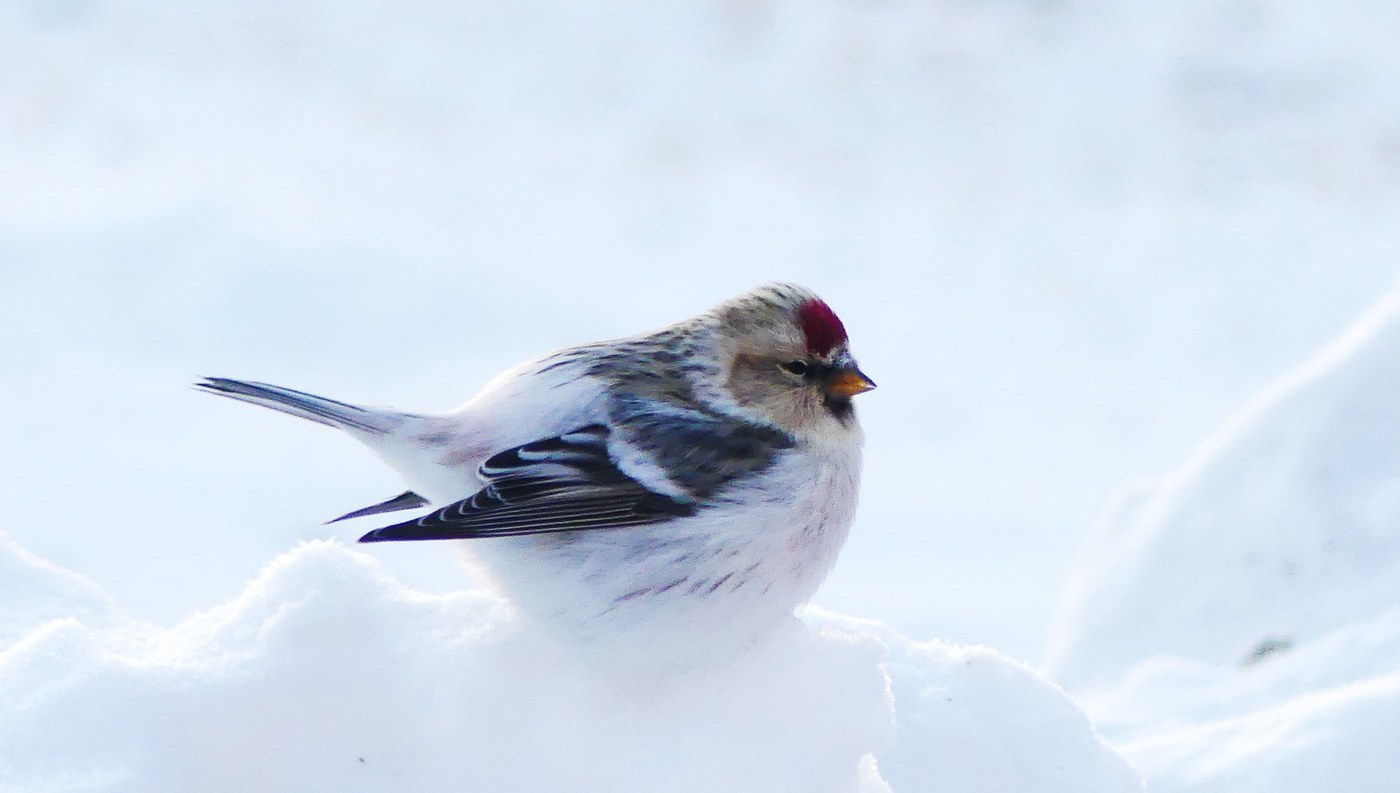
What Hoary Redpoll Feathers Look Like
The Hoary Redpoll is a small Arctic finch so similar to the Common Redpoll that telling them apart is one of the classic identification challenges in birding — but the feathers do offer real clues.
- Rump feathers: largely unstreaked, clean white — this is the single most reliable diagnostic feature separating Hoary from Common Redpoll, whose rump is streaked.
- Back feathers: pale grey-brown with less dark streaking than Common Redpoll, giving an overall frostier, paler look.
- Underparts: whiter overall, with minimal flank streaking compared to the more heavily streaked flanks of Common Redpoll.
- Crown feathers: small red "poll" patch on the forehead, shared with Common Redpoll.
- Chin feathers: black, also shared with Common Redpoll.
- Overall texture: feathers tend to look somewhat fluffier or frostier due to being adapted for extreme Arctic cold.
Step-by-Step: Is This Feather From a Hoary Redpoll?
- Check the rump feather first, if you have one. Clean white with little to no streaking strongly favors Hoary Redpoll; visible dark streaking there points to Common Redpoll instead.
- Assess overall paleness. A frostier, paler grey-brown back with reduced streaking supports Hoary Redpoll.
- Look at flank/undertail feathers. Minimal streaking on the sides and undertail coverts is more consistent with Hoary than Common Redpoll.
- Note bill-related context if available. Hoary Redpolls tend to have a stubbier bill than Common Redpoll, though this isn't a feather feature itself.
- Consider that intermediate birds exist. Because the two species overlap in appearance and sometimes interbreed, some individuals show mixed features that resist a clean-cut call — treat close calls as reasonable uncertainty rather than a forced ID.
Similar Species & How to Tell Them Apart
- Common Redpoll: extremely similar overall, but shows a streaked rump (versus Hoary's clean white rump) and generally more streaking on the back and flanks.
- Pine Siskin: heavily streaked overall with yellow in the wings and tail, lacking the red poll patch and black chin of redpolls.
- American Goldfinch (winter plumage): duller than breeding plumage but lacks the red cap and black chin patch of redpolls entirely.
Where & When You'll Find Them
Hoary Redpolls breed across high Arctic tundra in a circumpolar range spanning Canada, Greenland, Scandinavia, and Siberia, wintering somewhat south into boreal regions and occasionally irrupting further south in large numbers alongside Common Redpoll flocks during food-shortage years. Molt occurs on the Arctic breeding grounds in summer, so feathers are most likely to be found at winter feeders and in birch-alder thickets during irruption winters, often mixed in with the more common and more heavily streaked Common Redpoll.
Frequently asked questions
What's the single best feather clue for telling Hoary Redpoll from Common Redpoll?
Check the rump feathers: Hoary Redpoll's rump is largely clean white and unstreaked, while Common Redpoll's rump shows visible dark streaking.
Why is this species pair considered such a difficult identification challenge?
Hoary and Common Redpoll overlap heavily in appearance and range, and some individuals show intermediate features, making a confident call genuinely difficult even for experienced birders.
When are Hoary Redpoll feathers most likely to turn up away from the Arctic?
During irruption winters, when redpoll flocks (including both species) move unusually far south in search of food, sometimes reaching winter feeders well outside their normal range.
Do Hoary Redpolls have the same red cap and black chin as Common Redpoll?
Yes, both features are shared between the two species, which is part of why the rump pattern and overall paleness are more useful separators than the cap or chin alone.