
How to Identify Henslow's Sparrow Feathers
A guide to the greenish-tinged head, chestnut-and-black streaked back, and short pointed tail feathers that identify the secretive grassland Henslow's Sparrow.
Read the full Henslow's Sparrow encyclopedia entry →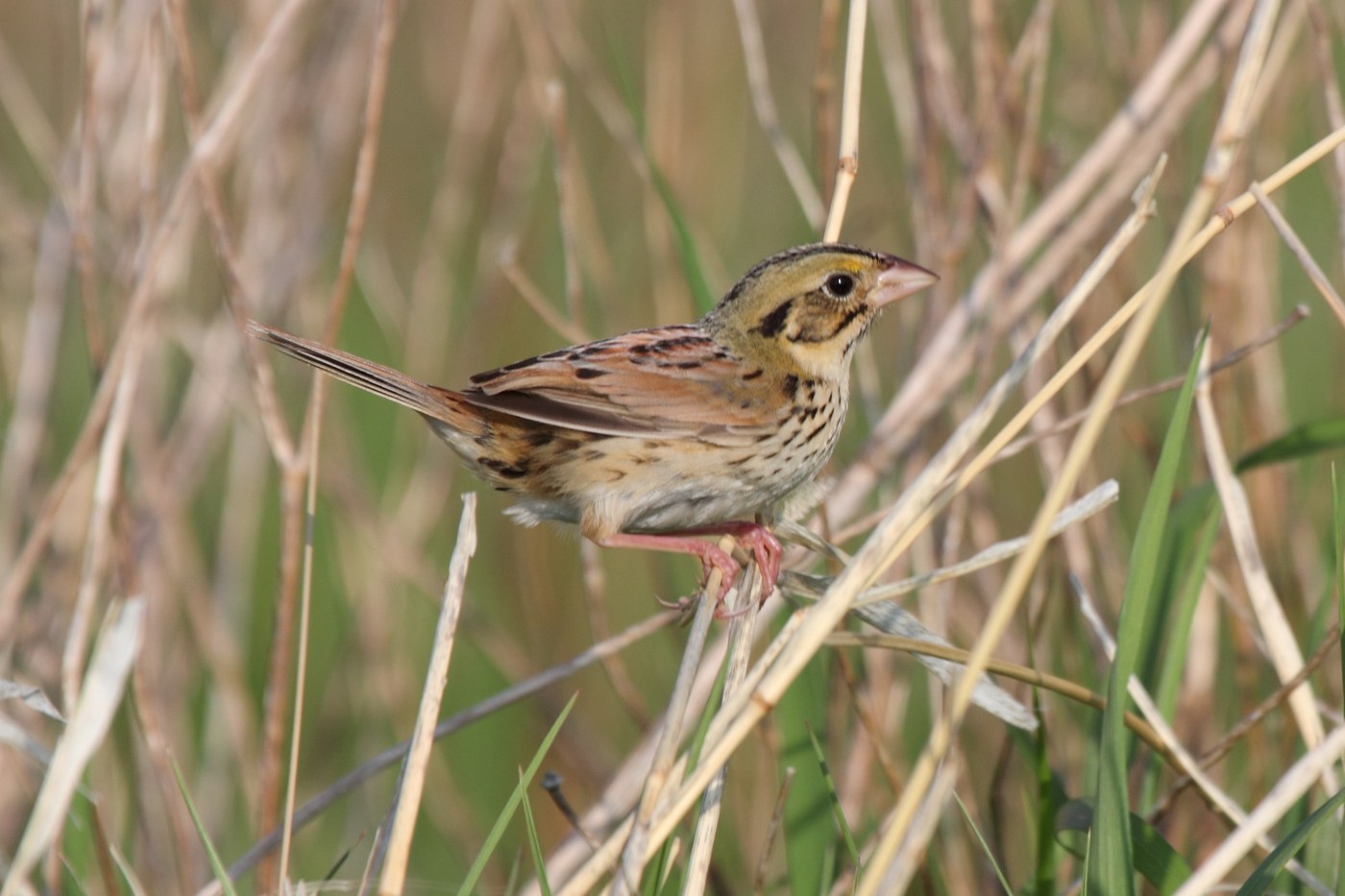
What Henslow's Sparrow Feathers Look Like
Henslow's Sparrow is a small, notoriously secretive grassland sparrow, and its feathers combine a few distinctive colors with a characteristic tail shape shared by its close relatives.
- Head feathers: tinged with an unusual flat olive-green cast, unlike the plainer brown or grey heads of many sparrows.
- Back feathers: rich chestnut/rufous edged in black, creating a bold, contrasting streaked pattern.
- Breast feathers: finely streaked on a buffy background.
- Tail feathers: short and distinctly pointed/spiky at the tips — a shape shared with other members of its genus, adapted for skulking through dense grass rather than for sustained flight.
- Size: small overall (about 12–13 cm), so feathers are correspondingly modest in size.
- Overall impression: the combination of an olive head, richly patterned back, and fine breast streaking gives this species a more "painted" look than the plainer, buffier grassland sparrows it shares habitat with.
Step-by-Step: Is This Feather From a Henslow's Sparrow?
- Check for a greenish head tint. A small sparrow feather from the head/face area with an olive-green cast rather than plain brown or grey is a strong lead.
- Look at the back pattern. Bold chestnut coloring edged in black stripes, rather than a more uniform brown streaking, supports this species.
- Examine the tail feather tip. Short and distinctly pointed/spiky tips (rather than rounded or square) indicate a grassland sparrow of this general type.
- Measure the feather. Small size overall, consistent with one of the smaller grassland sparrows.
- Consider the habitat. Dense tallgrass prairie, weedy fields, or reclaimed grassland in the eastern/midwestern US fits this secretive, ground-dwelling species.
Similar Species & How to Tell Them Apart
- Grasshopper Sparrow: buffier and plainer-faced, lacking the strong chestnut-and-black back contrast and green head tint of Henslow's Sparrow.
- LeConte's Sparrow: shows a more orange-tinged face and breast, without the flat olive-green head cast.
- Savannah Sparrow: larger overall with more distinct breast streaking and a notched (not spiky) tail shape, plus no olive head tint.
Where & When You'll Find Them
Henslow's Sparrows breed in dense tallgrass prairie, weedy fields, and reclaimed grassland habitats across parts of the eastern and midwestern United States, though the species has become increasingly uncommon due to grassland habitat loss. They're notoriously secretive and rarely flush into the open, preferring to run through dense cover rather than fly even when closely approached, so feather finds are uncommon; look in dense grass cover during the late-summer post-breeding molt period, shortly before birds migrate south for the winter to the southeastern United States.
Frequently asked questions
What's the most distinctive color feature of a Henslow's Sparrow feather?
An unusual flat olive-green tint on the head feathers, combined with a chestnut-and-black streaked back — a combination not shared by most other grassland sparrows.
Why is finding a Henslow's Sparrow feather relatively uncommon?
The species is notoriously secretive, staying hidden in dense grass and rarely flushing into the open, and its populations have declined due to grassland habitat loss.
How does Henslow's Sparrow differ from Grasshopper Sparrow in feather pattern?
Henslow's shows a stronger chestnut-and-black back contrast and a green-tinged head, while Grasshopper Sparrow is buffier and plainer overall.
What tail feather shape should I look for?
Short, spiky, pointed tail feather tips — a shape typical of this genus of grassland sparrows, adapted for moving through dense grass rather than sustained flight.