
How to Identify Grey-headed Woodpecker Feathers
Recognizing this Eurasian woodpecker's grey head, greenish back feathers, black moustache stripe, and stiff, pointed tail feathers.
Read the full Grey-headed Woodpecker encyclopedia entry →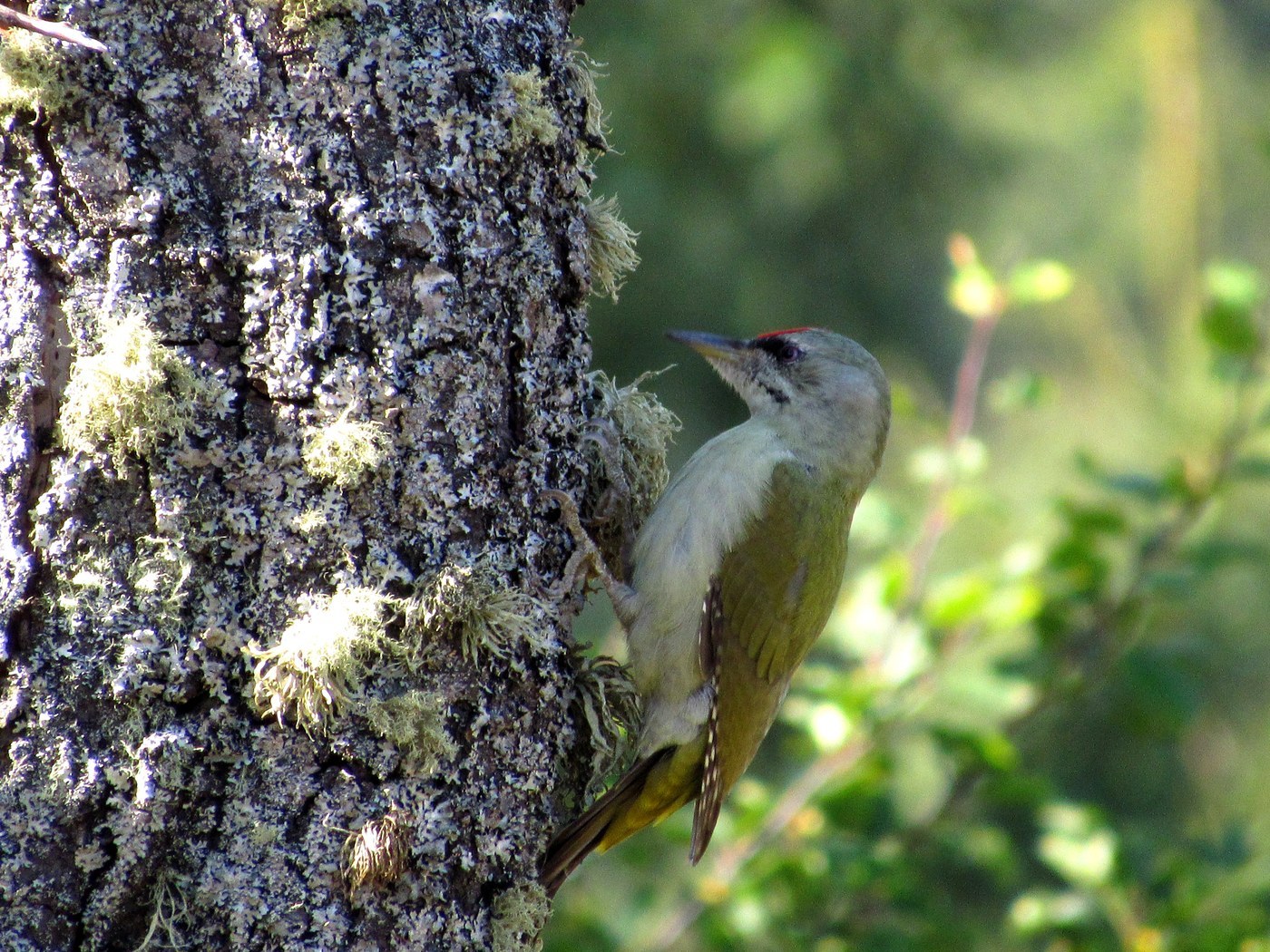
What Grey-headed Woodpecker Feathers Look Like
This medium-sized woodpecker combines a soft ash-grey head and underparts with a greenish-yellow back and rump, a distinctive two-tone pattern that carries clearly into individual feathers. A grey feather from the face or breast will look plain and unmarked, while a back or rump feather shows an olive-green to yellowish-green wash, sometimes brighter on the rump than the back — a classic "green woodpecker" family trait. Males show a small red patch confined to the forecrown, so a tiny red feather from the very top of the head, surrounded by grey rather than black, points to a male of this species specifically.
A black moustache stripe runs from the bill area, so narrow blackish feathers from that specific facial region are diagnostic when found alongside the grey face feathers. Flight feathers are blackish, barred with white or pale spots, typical of true woodpeckers, running 12-18 cm. The most functionally distinctive feathers, though, are the tail feathers: stiff, strongly pointed, with reinforced shafts, because woodpeckers use their tail as a brace against tree trunks — a genuine structural difference from the softer tail feathers of perching birds, easily felt by running a finger along the shaft.
Step-by-Step: Is This Feather From a Grey-headed Woodpecker?
- Check for the grey-and-green split. Plain grey feathers (head/underparts) alongside olive-green feathers (back/rump) from the same bird strongly support this species.
- Look for a small red crown feather. Red confined to a small forecrown patch, bordered by grey (not black), suggests a male.
- Feel the tail feather shaft. A stiff, reinforced, pointed tail feather confirms a woodpecker rather than a similarly colored songbird.
- Check flight feather pattern. Blackish feathers with white or pale spotting/barring fit true woodpeckers.
- Note the black moustache stripe feathers. Narrow black feathers from the malar area, next to grey face feathers, add further support.
Similar Species & How to Tell Them Apart
The closest look-alike across much of its range is the Eurasian Green Woodpecker, but that species shows a black face mask and largely red crown, not the clean grey head of the Grey-headed Woodpecker — a face or crown feather comparison quickly separates the two. Other green-backed woodpeckers in different regions typically show more extensive red on the head or a different underpart color, lacking the specific grey head combined with olive back. The stiff, pointed tail feather structure rules out non-woodpecker species entirely, regardless of color.
Where & When You'll Find Them
Look in mature deciduous and mixed forest, forest edges, and orchards across its Eurasian range, particularly around old trees used for nesting cavities and ant-rich clearings where the bird forages on the ground. Feathers accumulate near nest holes, favored foraging logs, and preening perches on exposed branches. Molt follows the breeding season, so the freshest feathers with crisp white spotting on the flight feathers are most likely to be found in late summer and autumn.
Frequently asked questions
What's the clearest sign this is a Grey-headed Woodpecker feather and not a Green Woodpecker?
A plain grey face feather without a black mask; Green Woodpecker shows a black face and more extensive red crown, while this species keeps grey on the face with only a small red forecrown patch on males.
How do I know a feather is from a woodpecker at all?
Check the tail feathers for a stiff, reinforced, pointed shaft — a structural adaptation for bracing against tree trunks that soft-tailed perching birds don't have.
Does the amount of red tell me the sex of the bird?
Yes — a small red patch confined to the forecrown, bordered by grey, indicates a male; females typically lack red on the crown.
Where around a forest should I look for feathers?
Near old nest cavities, foraging logs on the forest floor, and exposed preening perches on branches.
When are feathers freshest and easiest to identify?
Late summer through autumn, after the post-breeding molt, when white spotting on the flight feathers is crisp rather than worn.