
How to Identify Green Peafowl Feathers
How to tell the scaled emerald-bronze neck feathers and upright crest of this Southeast Asian peafowl from the familiar Indian Peafowl.
Read the full Green Peafowl encyclopedia entry →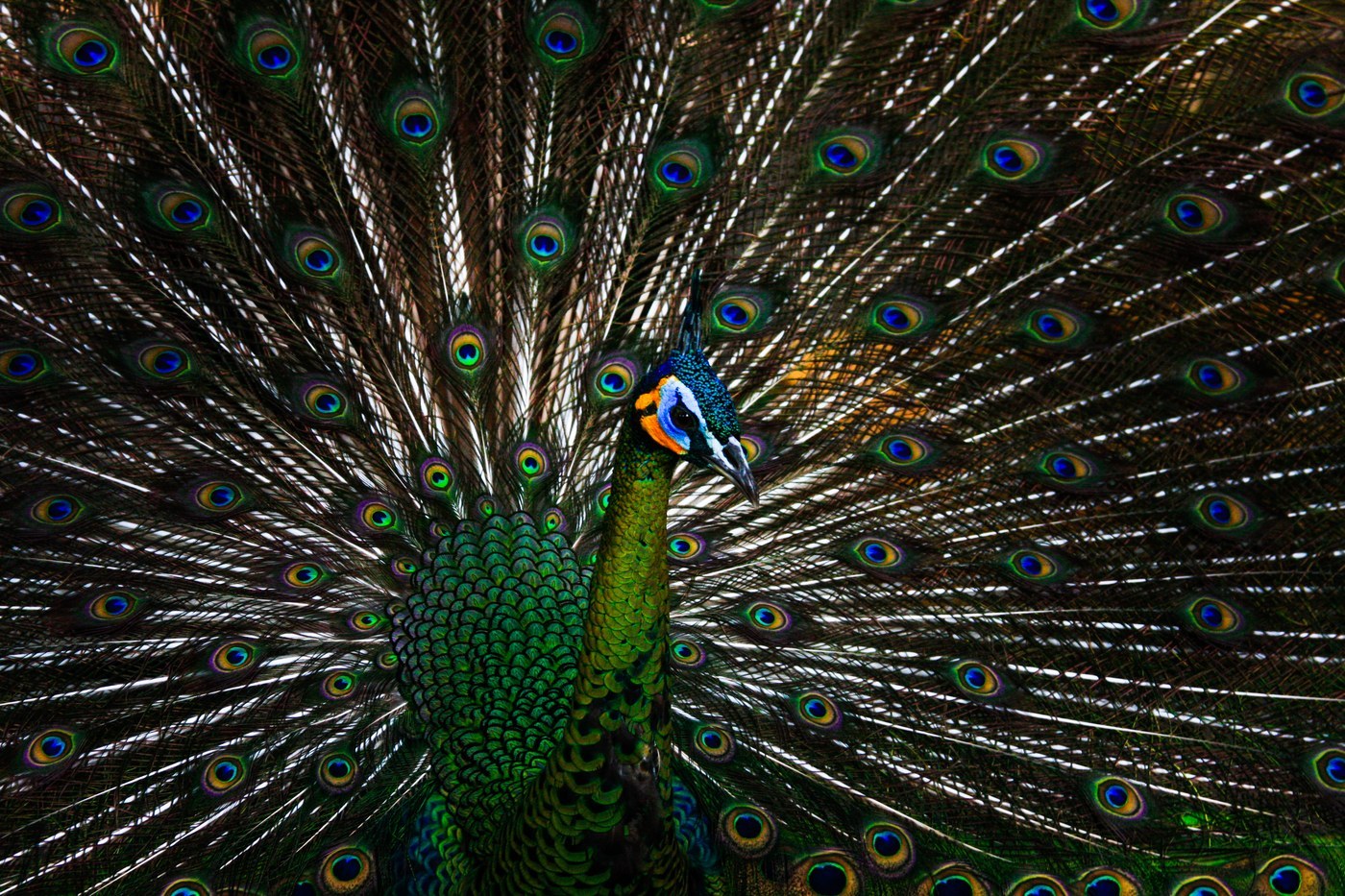
What Green Peafowl's Feathers Look Like
The neck and breast feathers of a male Green Peafowl are unlike almost anything else you'll find: each feather is emerald green edged in bronze or blackish, and the feathers overlap in a tight, scaled (imbricated) pattern - like fish scales - covering the entire neck and upper breast. This is a critical difference from the solid, unscaled blue neck feathers of the familiar Indian (Blue) Peafowl. The crest atop the head is made of narrow, upright feathers, quite different from the fan-shaped or spatula-tipped crest feathers of the Indian Peafowl. The train (elongated uppertail coverts) carries similar eye-spot ("ocellus") markings to the Indian Peafowl, but the individual train feathers are narrower and the overall fan when displayed stands more erect. Wings show a bronze-green base with blue-black flight feathers.
Step-by-Step: Is This Feather From a Green Peafowl?
- Check the neck/breast feather structure first. Look for a distinctly scaled, overlapping pattern with bronze or black edging on green - if the feather is a solid, unscaled blue, it's more likely Indian Peafowl.
- Assess crest feather shape. Narrow, upright feathers indicate Green Peafowl; broad, spatula/fan-tipped feathers indicate Indian Peafowl.
- Look at train feather width. Narrower individual feathers in an eye-spotted train support this species over the broader-feathered Indian Peafowl.
- Consider size. Green Peafowl train feathers can be very long, consistent with the species' large overall size.
- Watch for hybrids. Where the two species have been kept together in captivity (sometimes called "Spalding" peafowl), intermediate feather patterns can occur - a feather that seems to mix scaled and solid patterns may indicate a hybrid.
Similar Species & How to Tell Them Apart
- Indian/Blue Peafowl (Pavo cristatus): Solid, unscaled blue neck and breast feathers (no bronze-edged scaling), and a fan-shaped crest with spatula-tipped feathers rather than narrow upright ones - the neck feather texture is the fastest way to separate the two.
- Hybrid ("Spalding") peafowl: Show intermediate features between the two species; if a feather doesn't cleanly match either description, a captive-origin hybrid is possible.
- Other large pheasant-family birds: None combine the same scaled bronze-edged green neck feathering with an erect, narrow-feathered crest, so this pairing of traits is close to unique once Indian Peafowl and hybrids are ruled out.
Where & When You'll Find Them
Green Peafowl range across Southeast Asia, including Myanmar, Thailand, Indochina, and Java, in a mosaic of forest and grassland near water. They are considerably more shy and forest-associated than the familiar, often free-ranging Indian Peafowl. Males shed their long train feathers after the breeding season once display duties are complete, so the largest, most elaborate feathers are most likely to be found in the weeks following breeding, while everyday contour and flight feathers can turn up year-round near their forest-edge habitat.
Frequently asked questions
What does 'scaled' neck feathers mean and why does it matter?
Green Peafowl neck and breast feathers overlap in a tight, fish-scale-like pattern with bronze or black edging on green, which is fundamentally different from the solid, unscaled blue neck feathers of the familiar Indian Peafowl - it's the fastest way to tell the two apart.
How is the crest different from an Indian Peafowl's?
Green Peafowl crest feathers are narrow and stand upright, while Indian Peafowl crest feathers are broader with fan or spatula-shaped tips - a clear structural difference even without color.
Could this be a hybrid peafowl feather?
Possibly - where the two species have been kept together in captivity, hybrids (sometimes called 'Spalding' peafowl) can show intermediate feather patterns that don't cleanly match either pure species.
Are the eye-spotted train feathers different from Indian Peafowl's?
The eyespot pattern is similar, but Green Peafowl train feathers tend to be narrower, and the displayed fan stands more erect overall compared to the Indian Peafowl's train.
When are the long train feathers most likely to be found?
Males shed their elaborate train feathers after the breeding season once display season ends, so the largest ornamental feathers turn up most often in the weeks following breeding.