
How to Identify Green-cheeked Conure Feathers
How to spot the scalloped grey-brown breast, maroon belly patch, and blue flight feathers of this small South American parrot.
Read the full Green-cheeked Conure encyclopedia entry →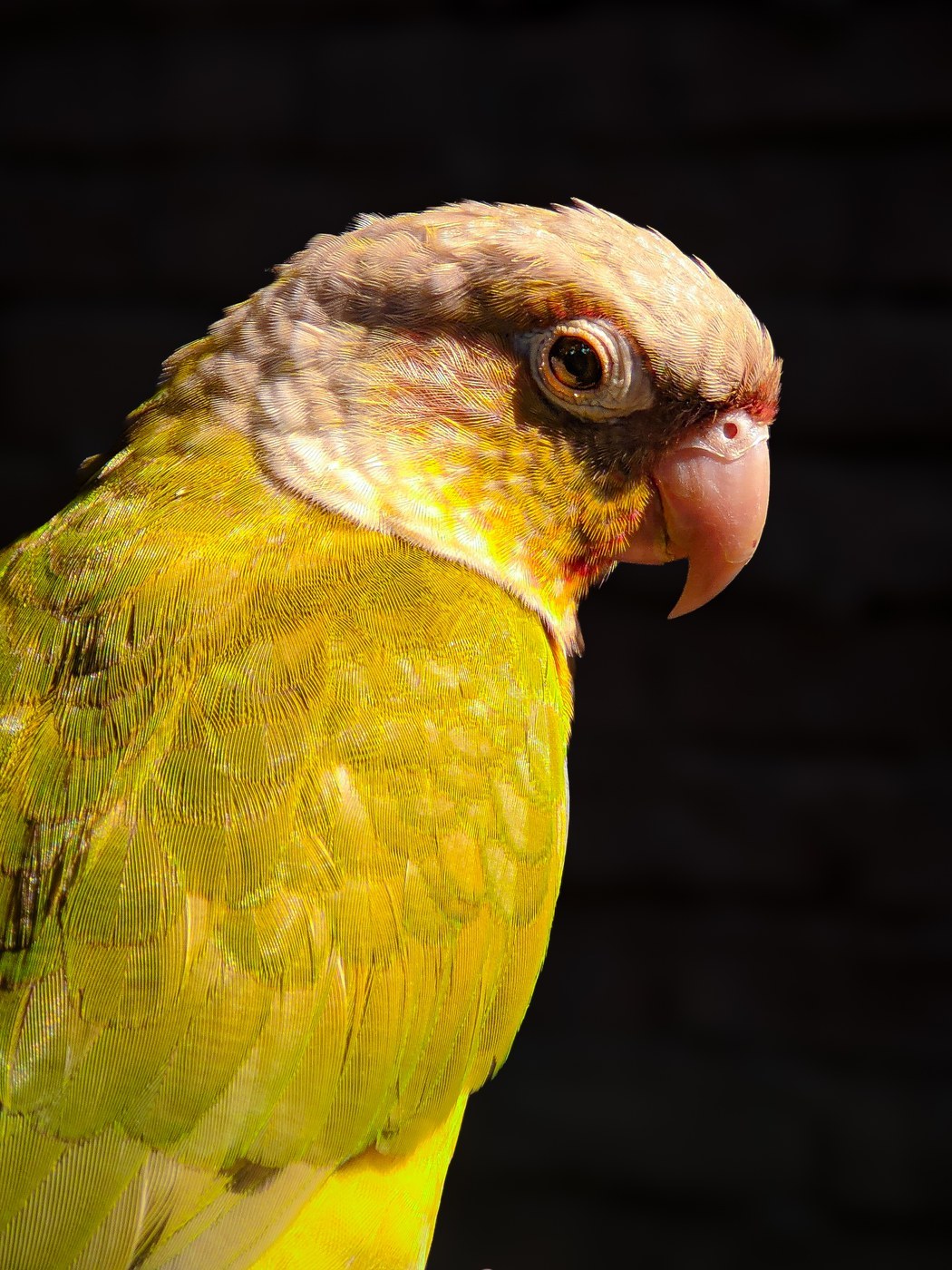
What Green-cheeked Conure's Feathers Look Like
This small parrot (about 26 cm including tail) is mostly bright green over the back, wings, and crown, but the breast tells a different story: feathers there are dull grey-brown to olive with pale, crescent-shaped scalloped edges, giving a scaled look quite unlike the plain green underparts of many small parrots. A maroon to wine-red patch covers the lower belly and extends onto the undertail area - a strong diagnostic if you find feathers from that region. The primary flight feathers are blue, contrasting against the green wing coverts, and the tail is long, tapering, and dark maroon-red at the base shading to blue-black toward the tip. The crown often shows fine grey scaling as well, similar in texture to the breast.
Step-by-Step: Is This Feather From a Green-cheeked Conure?
- Check for breast scalloping. A grey-brown feather with a pale crescent or scalloped edge (rather than plain color) is the clearest sign you're looking at this species' breast plumage.
- Look for maroon on the belly/vent. A wine-red or maroon feather from the lower body supports the ID.
- Inspect the tail. Long, pointed tail feathers that are maroon-red near the base and blue-black toward the tip are diagnostic.
- Check flight feathers for blue. Primaries that are solid blue against otherwise green wing coverts match this species.
- Consider the source. Green-cheeked Conures are extremely popular pet birds worldwide, so a feather found indoors, in a yard, or near an aviary may simply be a molted feather from a companion bird rather than a wild encounter - this is worth factoring in before assuming a wild source.
Similar Species & How to Tell Them Apart
- Maroon-bellied Conure: Very similar overall pattern; the scalloping and belly patch can look nearly identical, and telling the two apart from a single feather is difficult - range and context (captive vs. wild range in Brazil/Paraguay/Argentina/Bolivia) are the best clues.
- Painted Conure and other Pyrrhura species: Share the scalloped-breast pattern but differ in the color and extent of the belly patch and any facial markings - check whether the belly color is deep maroon (Green-cheeked) versus more localized or differently colored patches in relatives.
- Plain green parakeets (e.g., Monk Parakeet, budgerigars): Lack the grey-brown scalloped breast entirely, usually showing a plain or barred pattern instead.
Where & When You'll Find Them
In the wild, Green-cheeked Conures inhabit dry forest, cerrado woodland, and forest edge in Bolivia, Brazil, Paraguay, and Argentina, where they're resident year-round. However, because this species is bred in huge numbers as a pet, feathers are just as likely - if not more likely - to come from a captive bird, especially outside South America. Pet conures molt gradually throughout the year rather than on a strict seasonal schedule, so feather loss around cages, aviaries, and homes can happen at any time.
Frequently asked questions
What does the scalloped pattern on the breast feathers mean?
Pale crescent edges on an otherwise grey-brown breast feather are the Green-cheeked Conure's signature look, distinguishing it from parrots with plain-colored underparts.
Is a maroon feather always from this species?
Maroon coloring on the belly/vent and tail base is a strong clue, but several closely related Pyrrhura conures share similar maroon patches, so it narrows things to this genus more confidently than to this exact species.
Could this feather be from a pet bird rather than a wild one?
Very possibly - Green-cheeked Conures are one of the most popular pet parrots worldwide, so feathers found in yards, homes, or near aviaries outside South America likely come from a companion bird.
How do I tell this apart from a Maroon-bellied Conure?
The two look extremely alike; a single feather usually can't separate them reliably, so consider the context - wild range versus a known local pet population.
Do these birds molt on a predictable schedule?
Not strongly - wild birds molt on a roughly annual cycle tied to the breeding season, while captive pets often molt gradually year-round, so feathers can appear anytime.