
How to Identify Green Bee-eater Feathers
How to recognize the grass-green body, black gorget, and rufous-tinted flight feathers of this slender, streamer-tailed bee-eater.
Read the full Green Bee-eater encyclopedia entry →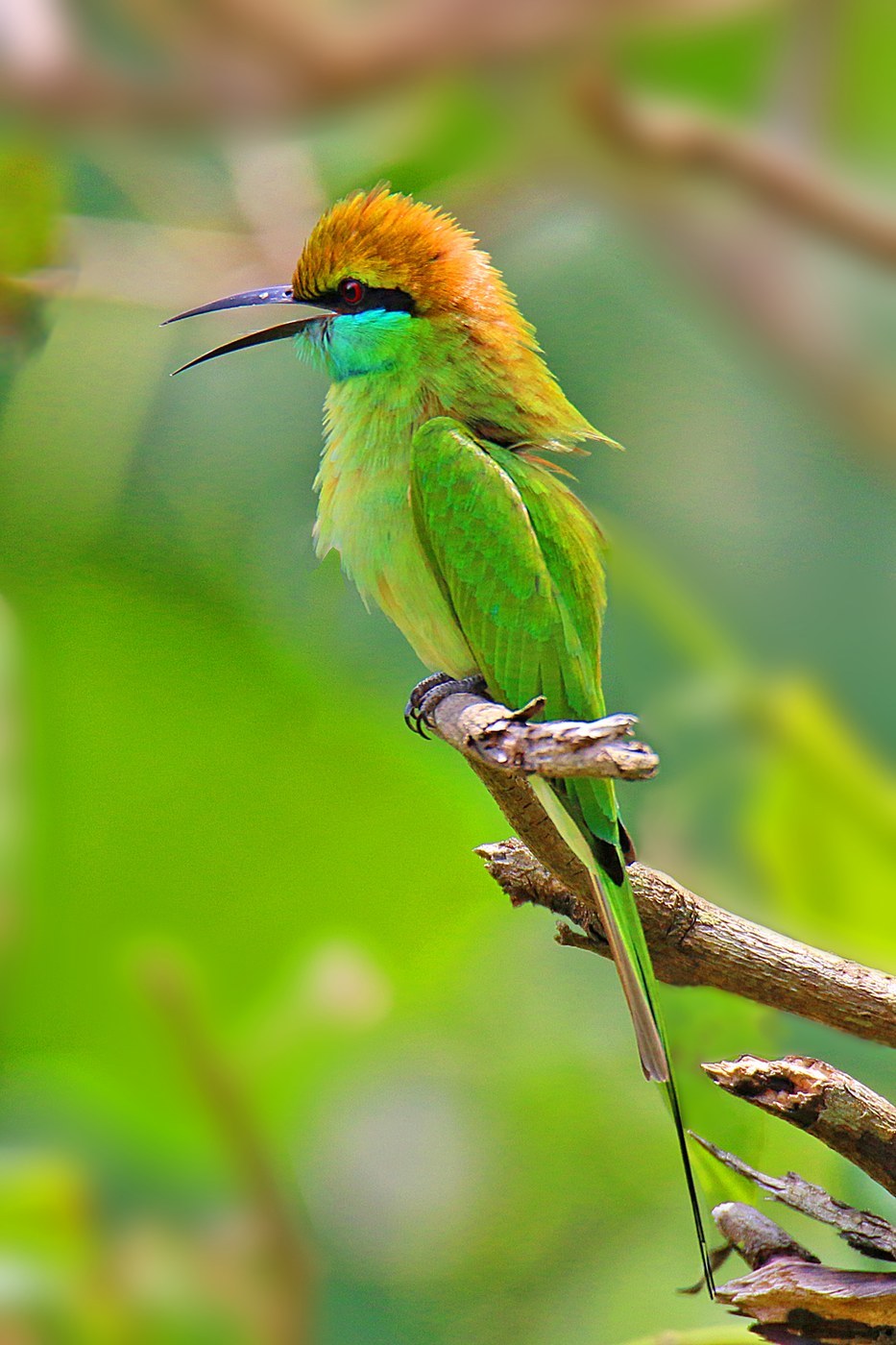
What Green Bee-eater's Feathers Look Like
Almost every contour feather on a Green Bee-eater is a bright, uniform grass green, which is the single most useful clue: few small birds are this saturated and evenly green over the entire body. The throat carries a turquoise-blue wash bordered below by a thin black gorget line, and a black stripe runs through the eye like a mask. Depending on subspecies, the crown and nape may show a light chestnut or coppery wash that fades into the green of the back. The tail is green with an elongated, thin central feather pair ("wires") that end in blunt points and lack any barbs near the tip - a shape found in few other small birds. In flight, the underside of the primaries and secondaries flashes a translucent rufous-cinnamon color tipped in black, so a flight feather that looks green on top but tawny-orange underneath is very diagnostic.
Step-by-Step: Is This Feather From a Green Bee-eater?
- Check overall color first. Body/contour feathers should be a clean, saturated grass-green with no streaking or barring.
- Look at the throat area. A small feather with turquoise-blue grading into black at the edge suggests the throat/gorget region.
- Inspect the tail. A very long, thin, wire-like feather with a blunt naked tip and green coloration along its length is almost certainly a central tail streamer.
- Hold a flight feather to the light. If the underside shows translucent rufous or cinnamon with a black tip, that confirms a primary or secondary from this species.
- Note the size. Body feathers run 2-4 cm; the tail streamers can reach 4-5 cm beyond the rest of the tail.
- Check for a chestnut crown wash, which some populations show and others lack - absence doesn't rule the bird out.
Similar Species & How to Tell Them Apart
- Blue-cheeked Bee-eater: Larger overall, with a blue cheek patch instead of green, and lacks the thin black gorget line separating throat from breast.
- European Bee-eater: Strikingly multicolored (chestnut crown/back, yellow throat, blue-green underparts) - never uniformly green like this species.
- Small green parrots/parakeets: Body feathers can look similarly green, but bee-eater feathers are narrower, more pointed, and lack the parrot's characteristically curved, broad feather structure; parrots also never show the rufous underwing flash.
- Sunbirds: Much smaller feathers with iridescent, metallic sheen rather than the matte grass-green of a bee-eater.
Where & When You'll Find Them
Green Bee-eaters range across sub-Saharan Africa, the Middle East, and South Asia, favoring open savanna, scrub, farmland edges, and riverbanks where they hawk insects from low perches or wires. They are largely resident or short-distance migrants depending on region, molting after the breeding season - so freshly dropped feathers are most common in the weeks following nesting, often near the sandy banks or bunds where they excavate nest burrows.
Frequently asked questions
Why is the whole feather such a bright, uniform green?
The Green Bee-eater is unusual among small birds in being almost entirely grass-green over the body, so a uniformly saturated green contour feather with no streaks or bars is a strong match.
What's the long thin feather with a bare tip?
That's a central tail 'wire' - an elongated, narrow feather ending in a naked shaft tip that only the central tail pair grows, a shape shared by only a few bee-eater relatives.
How do I tell this apart from a small green parrot feather?
Bee-eater feathers are narrower and more pointed than a parrot's broader, more rounded feather, and only bee-eaters show a translucent rufous-orange flash on the underside of the flight feathers.
Does the chestnut crown patch always show up?
No - it varies by subspecies and can be faint or absent, so don't rule out Green Bee-eater just because a feather lacks any chestnut wash.
When are feathers most likely to turn up?
Look shortly after the breeding season when adults molt, especially near sandy nesting banks where burrow excavation causes extra wear and feather loss.