
How to Identify Greater Blue-eared Starling Feathers
A guide to recognizing the glossy metallic green-blue feathers and blue ear patch of this common African starling.
Read the full Greater Blue-eared Starling encyclopedia entry →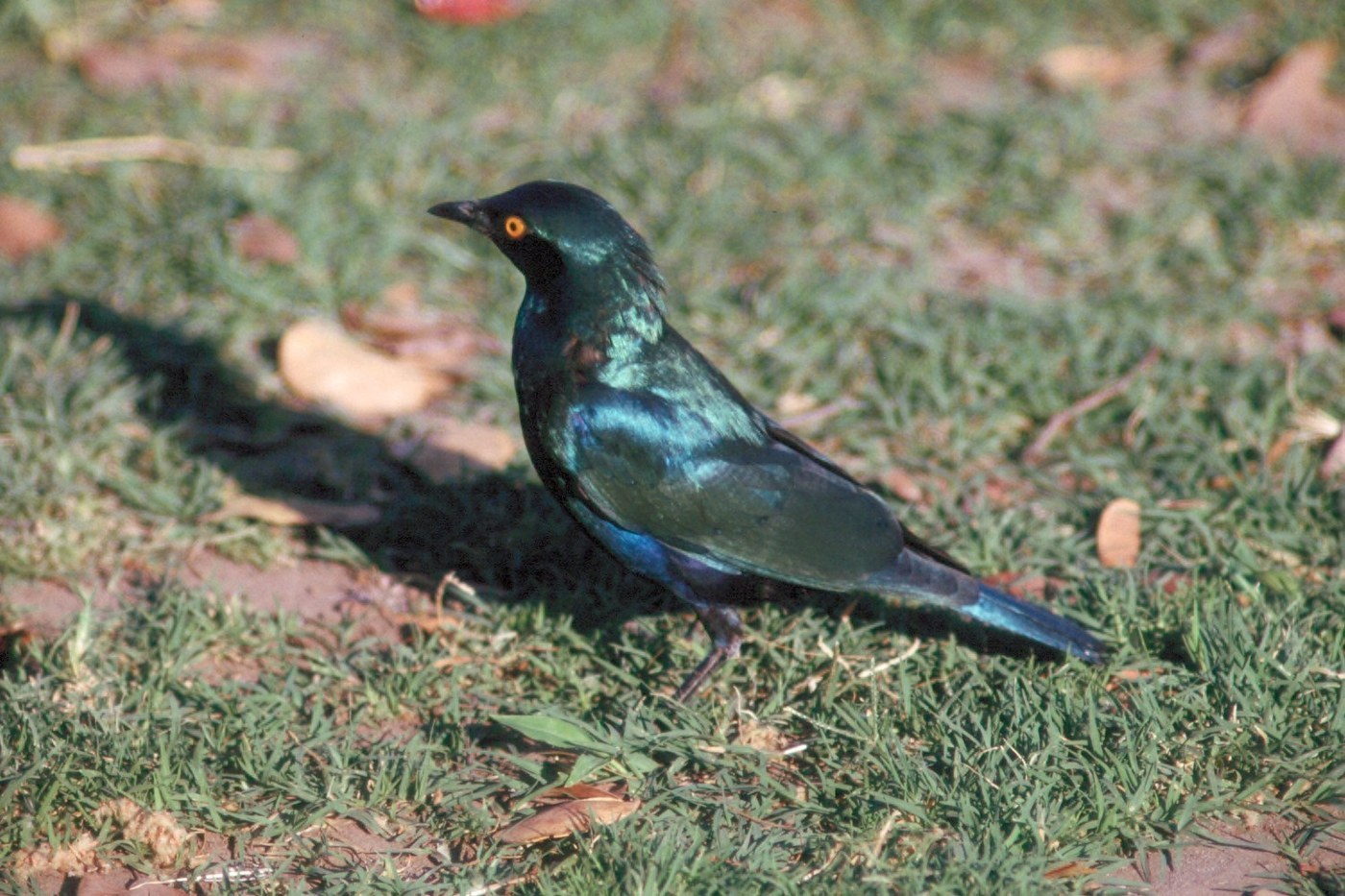
What Greater Blue-eared Starling's Feathers Look Like
The Greater Blue-eared Starling is a common, gregarious bird of African savanna and woodland, and nearly every feather on its body carries some degree of metallic shine. Back, breast, and wing covert feathers are a glossy, iridescent green overlaid with a distinct blue sheen, most concentrated and vivid on the ear-covert (cheek) feathers that give the species its name — a small feather from this exact spot will look noticeably bluer than the more evenly green feathers of the back. The belly and flanks often shift toward a violet-blue tone, adding a third color dimension to the iridescence depending on the exact feather tract and viewing angle.
Flight feathers are similarly glossy but slightly duller than the body feathers, dark green-blue rather than brilliant, and the tail is moderately long and glossy blue-green with a slight graduation in length toward the center. The bright orange-yellow eye is a soft-tissue feature rather than a feather trait, but overall feather texture is smooth, tightly webbed, and notably glossy compared to the duller brown feathers of many African songbirds sharing the same habitat.
Step-by-Step: Is This Feather From a Greater Blue-eared Starling?
- Tilt it in the light. True iridescent green-blue sheen, shifting toward violet on the belly/flank area, is the fastest confirming clue for a glossy starling feather.
- Check the ear-covert area specifically. A small feather showing a more concentrated blue tone than surrounding green feathers likely came from the cheek/ear patch.
- Measure it. Flight feathers run roughly 9–11 cm and tail feathers 8–10 cm, consistent with a medium-sized starling.
- Assess belly tone. A violet-blue rather than pure green sheen on an underpart feather fits this species' typical belly coloring.
- Feel the texture. Smooth, tightly webbed, glossy feathers distinguish this species from duller, matte-brown African songbirds of similar size.
- Consider the setting. A glossy green-blue feather found in savanna, woodland edge, or around fruiting trees across sub-Saharan Africa fits this common, social species.
Similar Species & How to Tell Them Apart
The Lesser Blue-eared Starling is extremely similar and genuinely difficult to separate by feather alone; it tends to be slightly smaller and shows marginally less contrast between the blue ear patch and the rest of the green plumage, but overlap makes confident separation difficult without a known location. The Cape Glossy Starling, found more in southern Africa, shows a more uniform blue-green sheen throughout, without the localized, more saturated blue specifically on the ear coverts, and has a proportionally longer tail. Rüppell's Starling, found in parts of East Africa, shows similar overall gloss but with a more yellow eye-ring and subtly different color balance between green and blue tones.
Where & When You'll Find Them
Greater Blue-eared Starlings are common and widespread across savanna, open woodland, and cultivated areas throughout much of sub-Saharan Africa, often gathering in noisy flocks around fruiting trees and human settlements. They are largely resident, with breeding and molt schedules loosely tied to local rainfall patterns rather than a sharply fixed calendar season. Feathers can be found near favored roosting trees and fruiting/feeding sites throughout the year, with body feather turnover often increasing somewhat following the local breeding season.
Frequently asked questions
What's the fastest way to confirm this species?
Tilt the feather in bright light and look for genuine iridescent green-blue sheen, with the blue most concentrated specifically on feathers from the ear-covert/cheek area.
How do I tell this from a Lesser Blue-eared Starling feather?
The two species are very similar; Lesser tends to be slightly smaller with marginally less contrast between the blue ear patch and the rest of the plumage, but confident separation often requires location context.
Why does the belly look more violet than the back?
Different feather tracts on this species show slightly different iridescent tones, with the belly and flanks often shifting toward violet-blue while the back stays more purely green.
How is this different from a Cape Glossy Starling feather?
Cape Glossy Starling shows a more uniformly blue-green sheen throughout its plumage, lacking the specifically concentrated blue ear patch, and has a proportionally longer tail.
Is there a season when feathers are most common?
Not sharply defined, since breeding and molt are loosely tied to local rainfall; feathers can be found near roosts and fruiting trees throughout the year, with some increase after local breeding periods.