
How to Identify Great White Pelican Feathers
A guide to recognizing the huge white body feathers and jet-black flight feathers of this massive Old World waterbird.
Read the full Great White Pelican encyclopedia entry →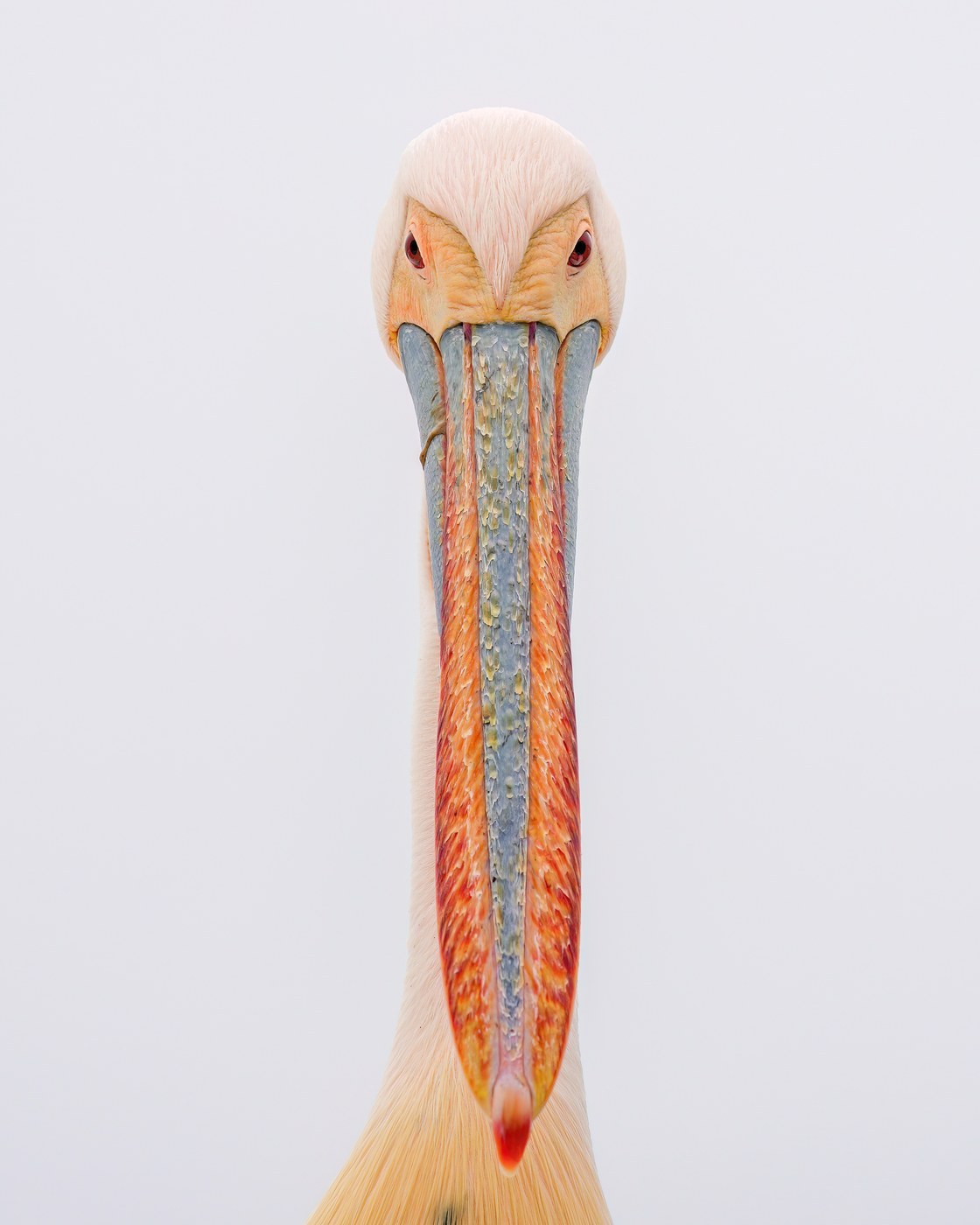
What Great White Pelican's Feathers Look Like
The Great White Pelican is one of the largest flying birds in the world, and its feathers are correspondingly enormous. Body and covert feathers are white to soft pinkish-white, with breeding adults showing a warm rosy flush across the breast and back that can fade in worn or shed feathers. A shaggy, elongated crest of feathers on the nape is another breeding-season feature, slightly longer and more pointed than typical body contour feathers.
The most diagnostic feathers by far are the flight feathers: primaries and secondaries are solid black, creating a dramatic contrast against the white body and wing coverts that is one of the most recognizable field marks of the entire pelican family in flight. These black flight feathers are also simply massive — among the largest individual feathers produced by any flying bird — with a thick, sturdy shaft built to support a wing loaded down by this species' considerable body weight. The tail is short, white to pale grey, and unremarkable compared to the flight feathers.
Step-by-Step: Is This Feather From a Great White Pelican?
- Measure it. Primaries can reach 45–55 cm or more — enormous, rivaling or exceeding the largest eagle or vulture feathers.
- Check for solid black flight feathers. A huge, entirely black primary or secondary feather paired with white body feathers is the core diagnostic pattern for this species.
- Assess body feather color. Pure white to soft pinkish-white, sometimes with a warm rosy wash, fits breeding-condition Great White Pelicans.
- Look for crest feathers. A slightly elongated, pointed white feather may be from the nape crest developed in the breeding season.
- Feel the shaft. An unusually thick, heavy rachis reflects the load-bearing demands of this very large bird's flight feathers.
- Consider the setting. A huge black-and-white feather found near large lakes, wetlands, or coastal colonies across Africa, southeastern Europe, or parts of Asia strongly supports this species.
Similar Species & How to Tell Them Apart
The Dalmatian Pelican, sharing part of the range in southeastern Europe and Asia, is more uniformly greyish-white rather than pure white, with curlier nape feathers and generally paler, less starkly contrasting flight feathers. The American White Pelican, found in the New World and essentially non-overlapping in range, looks very similar with the same white-body/black-flight-feather pattern, making location the most reliable separator between the two. The Pink-backed Pelican, found in similar African wetlands, is notably smaller with greyer body feathers and paler, not solid black, flight feathers, making it easier to rule out on close inspection.
Where & When You'll Find Them
Great White Pelicans breed colonially on islands and shorelines of large lakes and wetlands across much of Africa, with additional populations in southeastern Europe and parts of Asia, sometimes moving seasonally in response to water levels and food availability. Because pelicans are colonial nesters, feathers are often abundant near breeding colonies, particularly during and after the breeding season, when adults and growing young shed large numbers of feathers. Look for both body and flight feathers along lakeshores and colony islands from spring through summer, with additional finds near wintering wetlands during the colder months in more migratory populations.
Frequently asked questions
What's the single best clue for identifying this feather?
A huge, entirely black flight feather (primary or secondary) is the most reliable single clue, since the sharp contrast between white body feathers and solid black flight feathers is a hallmark of this species.
How large should I expect the feathers to be?
Very large — primaries can reach 45–55 cm or more, among the biggest individual feathers produced by any flying bird.
How do I tell this from a Dalmatian Pelican feather?
Dalmatian Pelican body feathers are greyish-white rather than pure white, and its flight feathers are paler and less starkly black, with curlier nape crest feathers.
Could this be an American White Pelican feather?
The two species look very similar; since they occupy different continents (Old World vs. New World), location is generally the most reliable way to tell them apart.
When are Great White Pelican feathers most likely to be found?
Spring through summer near breeding colonies on lakes and wetlands, when adults and growing chicks shed feathers in large numbers around colonial nesting sites.