
How to Identify Giant Kingfisher Feathers
A guide to the large, white-spotted, slate-gray feathers of the Giant Kingfisher — Africa's largest kingfisher — and how sex-based chestnut patterning helps confirm identification.
Read the full Giant Kingfisher encyclopedia entry →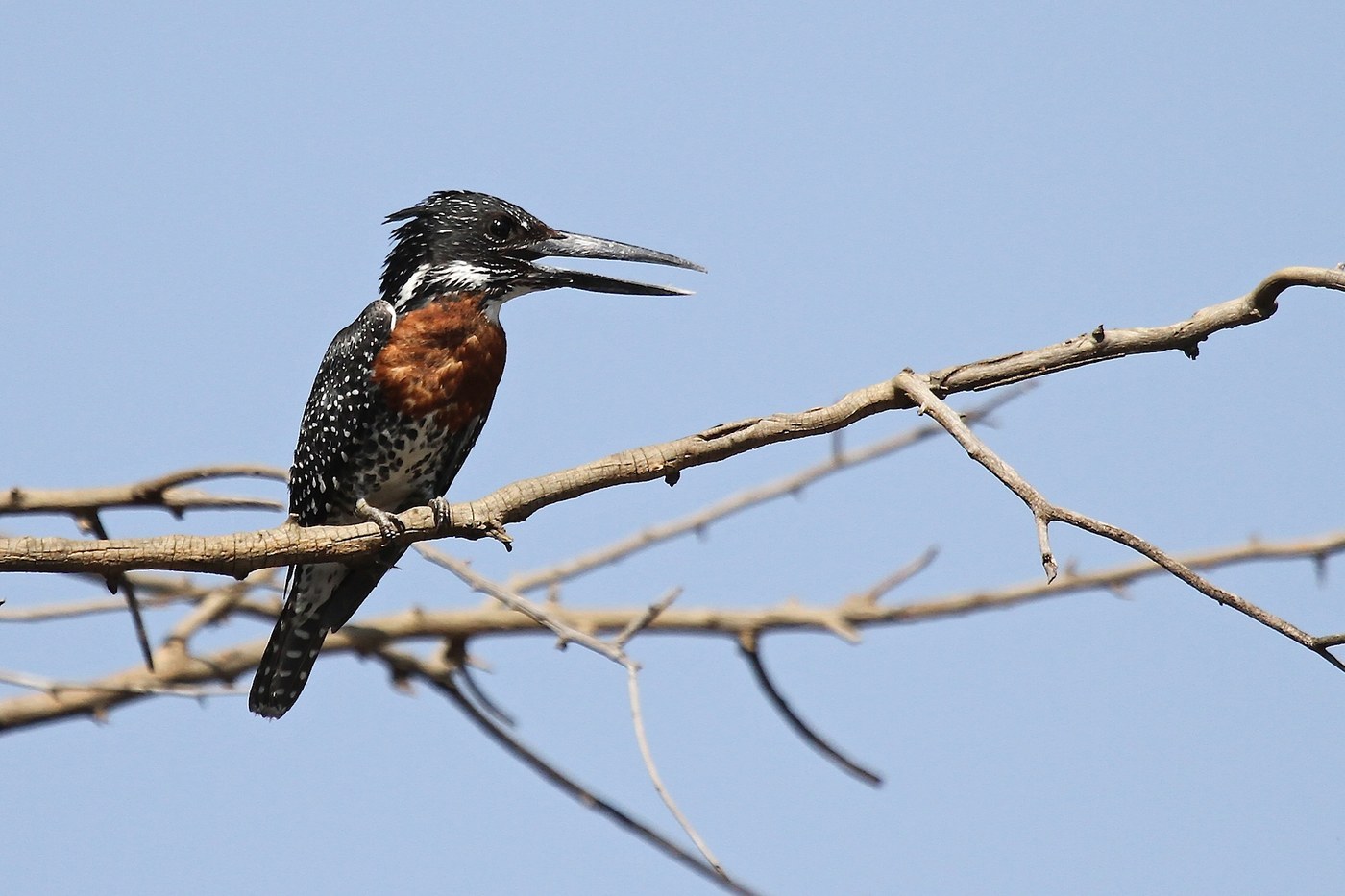
What Giant Kingfisher Feathers Look Like
The Giant Kingfisher is, as its name suggests, the largest kingfisher in Africa, and its feathers are correspondingly large and heavy compared to any other kingfisher sharing its range — often the fastest clue to identification. Upperpart feathers (crown, back, wing coverts) are slate-gray to blackish, densely covered in white spots and spangles that give the plumage a speckled, salt-and-pepper texture rather than a solid dark color. The crown feathers form a shaggy crest that the bird can raise, and these crest feathers show the same dark, white-spotted pattern as the back.
Sex differences show up clearly on the underparts: males have a chestnut/rufous breast band with a white belly below it, while females show the reverse pattern — a white breast with chestnut spotting or barring on the belly and flanks. Wing and tail feathers are blackish, barred and spotted with white in a pattern that continues the spangled look of the upperparts. Because this species is so much larger than Africa's other kingfishers, even a plain gray-and-white spotted feather without a visible chestnut patch is a strong clue based on size alone.
Step-by-Step: Is This Feather From a Giant Kingfisher?
- Measure it. This is the largest kingfisher in its range, so unusually large slate-gray, white-spotted feathers point strongly toward this species before checking any other detail.
- Look for white spotting/spangling. Dense white spots across a dark slate-gray ground on a back or crown feather fits Giant Kingfisher's speckled pattern.
- Check for a chestnut breast band or belly patches. A chestnut feather from the breast area suggests a male; chestnut spotting on belly/flank feathers with white breast suggests a female.
- Assess crest feathers. Shaggy, elongated dark feathers with white spotting from the crown support this species' raised crest.
- Confirm habitat. Feathers found along rivers, lakes, or large wetlands in sub-Saharan Africa fit this species' fish-hunting habitat.
Similar Species & How to Tell Them Apart
The Pied Kingfisher, which often shares the same waterways, is strictly black and white with no chestnut coloring at all, and it is considerably smaller than the Giant Kingfisher. The tiny Malachite Kingfisher is a completely different scale — small and brilliant blue and orange — and won't be confused on size alone. Among African kingfishers generally, the Giant Kingfisher's combination of very large feather size, dense white spotting on a slate-gray ground, and sex-specific chestnut patterning is essentially unique.
Where & When You'll Find Them
Giant Kingfishers are resident along rivers, lakes, estuaries, and other large water bodies across much of sub-Saharan Africa, where they perch and dive for fish and crabs. As a non-migratory resident, feathers can be found year-round near favored fishing perches and nesting burrows in riverbanks, with the heaviest feather turnover following the post-breeding molt, when adults replace worn flight and body feathers.
Frequently asked questions
What is the fastest way to identify a Giant Kingfisher feather?
Size — it is the largest kingfisher in its range, so unusually large slate-gray, white-spotted feathers point strongly to this species.
How can I tell a male from a female Giant Kingfisher feather?
Males show a chestnut breast band with a white belly, while females show the reverse — a white breast with chestnut spotting on the belly and flanks.
How is this different from a Pied Kingfisher feather?
Pied Kingfisher feathers are strictly black and white with no chestnut coloring and are considerably smaller than Giant Kingfisher feathers.
What does the upperpart pattern look like?
Slate-gray to blackish feathers densely covered in white spots and spangles, giving a speckled, salt-and-pepper texture.
Where are Giant Kingfisher feathers most likely to be found?
Along rivers, lakes, and large wetlands across sub-Saharan Africa, near fishing perches and riverbank nesting burrows.