
How to Identify Giant Hummingbird Feathers
How to identify the unusually large, relatively drab feathers of the Giant Hummingbird — the world's largest hummingbird — and distinguish them from other Andean hummingbirds.
Read the full Giant Hummingbird encyclopedia entry →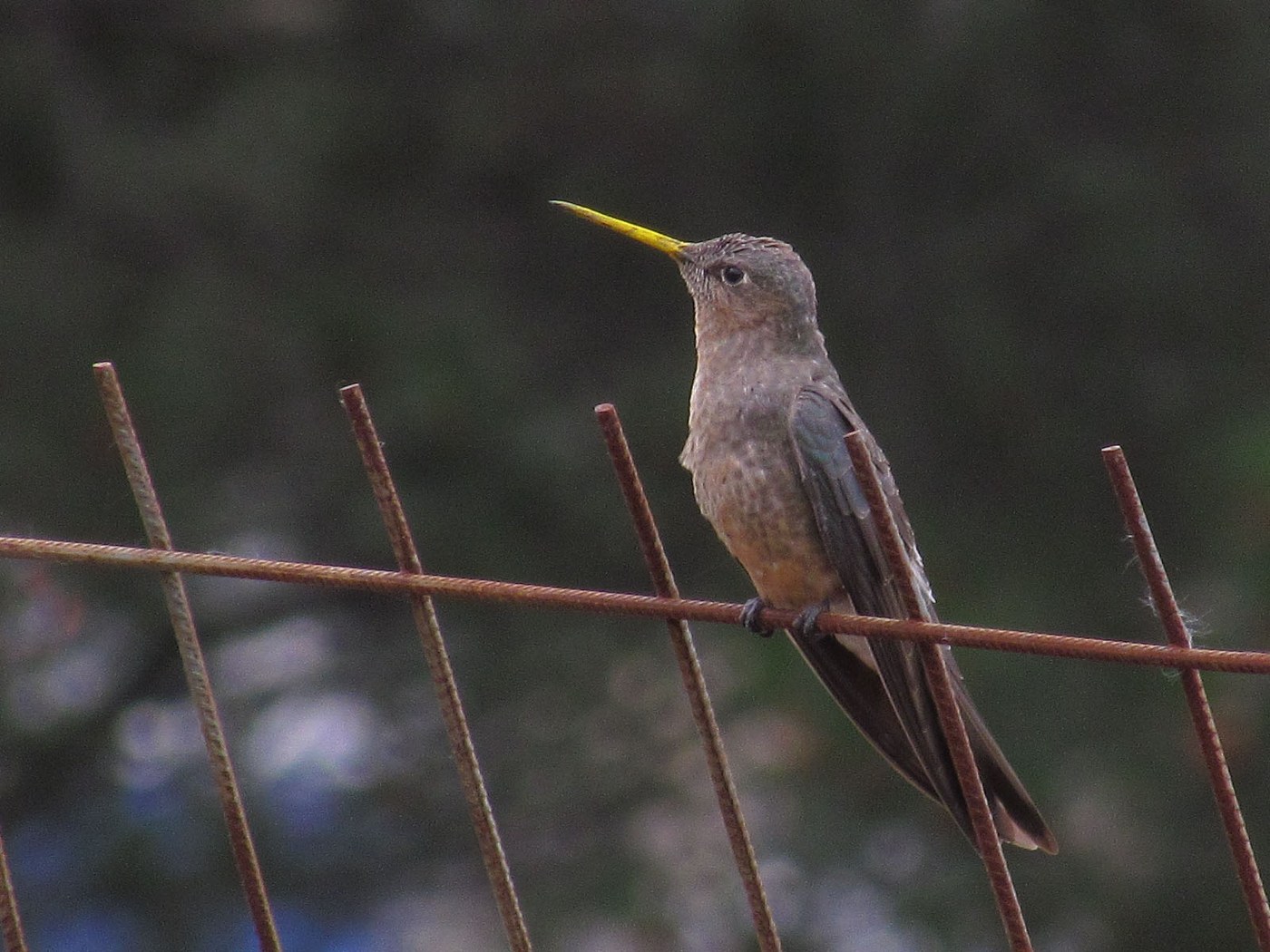
What Giant Hummingbird Feathers Look Like
The Giant Hummingbird is, true to its name, the largest hummingbird species in the world — roughly the size of a swift or swallow — and this shows immediately in feather size: its primaries and tail feathers are considerably longer than those of any other hummingbird, which is often the single fastest way to confirm identification if you find a feather in Andean habitat. Unlike the dazzling, highly iridescent plumage of most hummingbirds, Giant Hummingbird feathers are comparatively drab: upperparts are a dull grayish-brown to bronze-green, with far less structural iridescence than typical hummingbirds show.
Underpart feathers are cinnamon-buff to whitish with a subtle scaled texture created by darker feather edges. A white patch on the rump stands out against the duller body tones and is a useful confirming feature. Tail feathers are bronze-brown, broader and only slightly forked or rounded compared to the deeply forked or elaborately shaped tails of many smaller hummingbird species. Wing (primary) feathers are long and pointed but proportionally broader at the base than the needle-thin wings of most hummingbirds, reflecting this species' larger body mass and different flight mechanics (it flaps more slowly than typical hummingbirds).
Step-by-Step: Is This Feather From a Giant Hummingbird?
- Measure it first. Any hummingbird feather that seems unusually large — primaries or tail feathers well beyond the size of typical hummingbird feathers — should immediately suggest this species in Andean habitat.
- Check for drab coloring. A grayish-brown to bronze-green tone with little to no flashy iridescence fits Giant Hummingbird, unlike the vivid jewel-tones of most hummingbirds.
- Look for a white rump patch. A whitish feather from the rump area, paired with duller body feathers, supports this identification.
- Assess tail shape. Broader, only slightly forked bronze-brown tail feathers (rather than deeply forked or spike-tipped) fit this species.
- Confirm elevation and range. Feathers found in high Andean arid scrub or gardens between roughly 2,000 and 4,000 meters elevation strongly support Giant Hummingbird.
Similar Species & How to Tell Them Apart
Other large Andean hummingbirds, such as the Great Sapphirewing, can approach Giant Hummingbird in size but generally show more iridescent blue-green coloring, especially on the wings, compared to the Giant Hummingbird's notably drab, matte plumage. In practice, size alone — feather length clearly exceeding that of any smaller hummingbird species sharing the habitat — is usually enough to separate Giant Hummingbird from everything else in its range.
Where & When You'll Find Them
Giant Hummingbirds inhabit high-elevation arid scrub, agricultural land, and gardens throughout the Andes, typically between 2,000 and 4,000 meters, and some populations undertake seasonal altitudinal movements tracking flowering plants. Feathers are most likely to be found near flowering shrubs and feeding territories at these elevations, with molt occurring on a schedule tied to the local breeding season rather than a single synchronized period across its wide range.
Frequently asked questions
What is the single fastest way to identify a Giant Hummingbird feather?
Size — its primaries and tail feathers are considerably longer than those of any other hummingbird species, immediately setting it apart.
Why don't Giant Hummingbird feathers look as iridescent as other hummingbirds'?
This species has comparatively drab, matte grayish-brown to bronze-green plumage with much less structural iridescence than typical hummingbirds.
Does this species have any distinctive patch?
Yes, a white patch on the rump stands out against its otherwise duller body tones.
How is this different from the Great Sapphirewing?
The Great Sapphirewing shows more iridescent blue-green coloring, especially on the wings, compared to the Giant Hummingbird's notably drab plumage.
At what elevation would I find this species' feathers?
Typically between 2,000 and 4,000 meters in high Andean arid scrub, agricultural land, and gardens.