
How to Identify European Roller Feathers
A guide to the vivid blue body feathers and chestnut back of this striking migrant, and how to confirm its identity against Kingfisher and Bee-eater.
Read the full European Roller encyclopedia entry →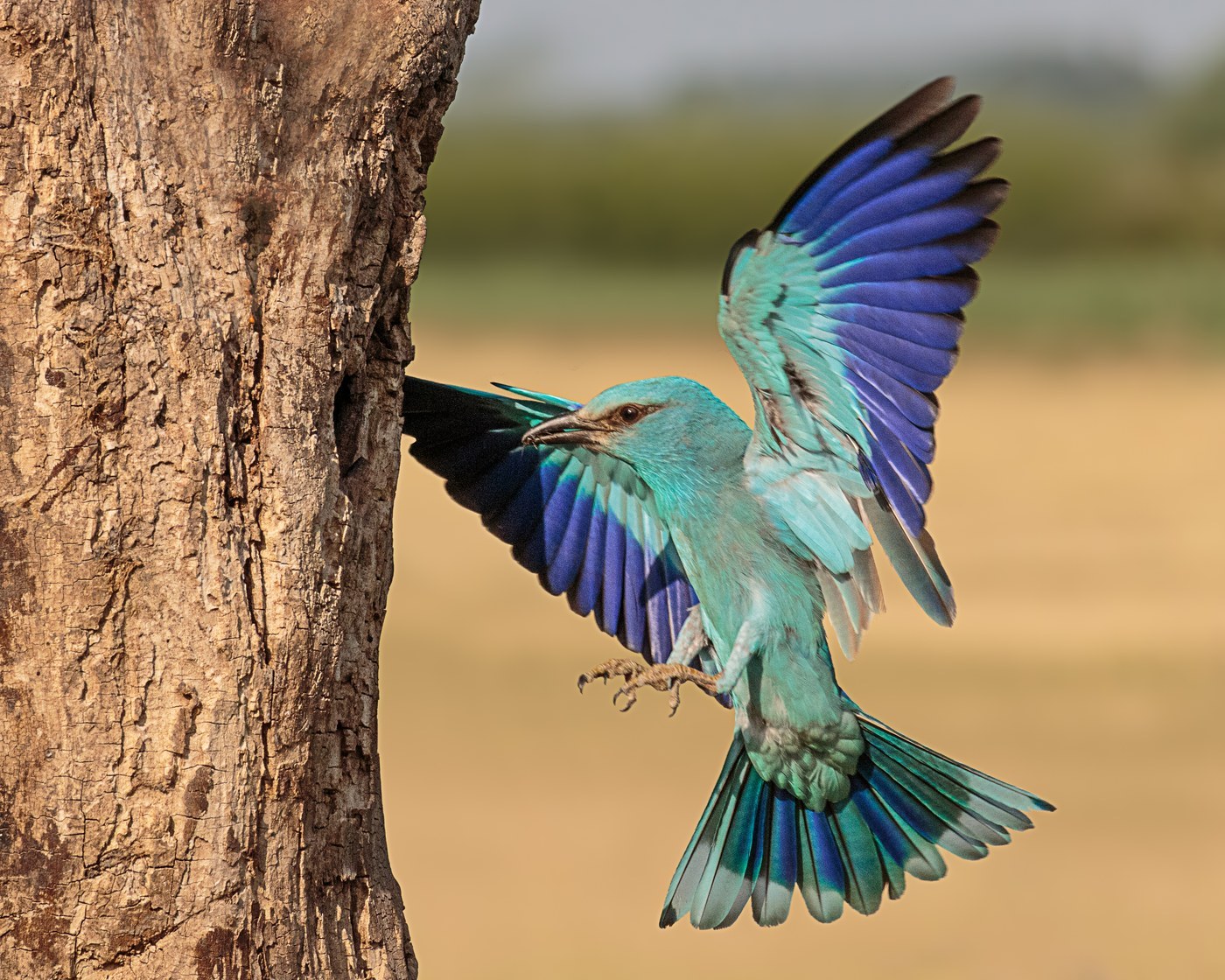
What European Roller Feathers Look Like
European Roller feathers combine two strongly contrasting colors in a way few other European birds match: the head, neck, and underparts are a rich, vivid blue (sometimes described as turquoise to azure depending on light and feather position), while the back and inner wing (scapular) feathers are a warm chestnut-brown, creating a bold two-tone body pattern. Flight feathers (primaries and secondaries) are a deeper, darker blue-black, providing a third distinct tone visible especially on the outer wing. There's no yellow, red, or green in the plumage at all, which helps rule out several superficially similar brightly colored species. Feather texture is fairly smooth and glossy, consistent with this species' habit of perching prominently in the open and making dramatic tumbling display flights (the "rolling" flight that gives the bird its name). Overall feather size is moderate — body feathers 3-4 cm, primaries around 15-18 cm — reflecting a robust, crow-sized bird.
Step-by-Step: Is This Feather From a European Roller?
- Check for vivid blue body color paired with a chestnut back/scapular feather. This specific two-tone combination, with no yellow or turquoise-green, is the fastest positive check.
- Look at flight feathers for a darker blue-black tone. A third, deeper blue-black shade on the outer wing supports the ID.
- Rule out yellow. If any part of the feather shows true yellow, reconsider Bee-eater instead.
- Assess size. A moderate, crow-jay-sized feather set (larger than Kingfisher, smaller than a crow) fits Roller.
- Consider habitat and season. Found in open country with scattered old trees or nest boxes, during the warmer months, supports Roller given its migratory habits and specific nesting needs.
Similar Species & How to Tell Them Apart
- European Bee-eater feathers share warm chestnut/gold tones on the back, but Bee-eater additionally shows a bright yellow throat and turquoise-green belly, a three-tone combination Roller does not have (Roller's underparts are blue, not turquoise-green, and there's no yellow at all).
- Common Kingfisher feathers show electric blue upperparts with orange (not chestnut) underparts and are considerably smaller overall, a clear size and color-placement difference from Roller.
- Eurasian Jay feathers show pinkish-buff body plumage with a blue-and-black barred wing patch confined to a small covert area, quite different from Roller's overall vivid blue body and chestnut back.
- Hoopoe feathers show pinkish-cinnamon body with bold black-and-white barred wings, lacking any blue tone at all, making the presence of true blue a quick way to rule out Hoopoe.
Where & When You'll Find Them
European Rollers are long-distance migrants, wintering in sub-Saharan Africa and arriving in southern and parts of central/eastern Europe from late April through May to breed in open country with scattered old trees, orchards, or nest boxes, often near cultivated farmland with good insect availability, departing again by September. They perch prominently on wires, dead branches, or posts to hunt large insects and occasionally small reptiles. Feathers are most findable in late spring through summer, near nest cavities in old trees or provided nest boxes (a conservation measure in parts of their range) and beneath favored open perches where feather wear and predation-related loss concentrate. A vividly blue feather matching this description found in winter within Europe would be very unusual, since the species is absent from the continent outside the breeding season.
Frequently asked questions
What's the fastest check to confirm a Roller feather?
Vivid blue body color paired with a chestnut back/scapular feather and no yellow anywhere — this two-tone combination is distinctive among European birds.
How do I tell Roller from Bee-eater feathers?
Bee-eater shows an additional bright yellow throat and turquoise-green belly, a three-tone pattern Roller lacks; Roller's underparts are simply blue with no yellow.
Is Roller present in Europe during winter?
No — it's a long-distance migrant to sub-Saharan Africa, so feather finds within Europe are limited to spring through summer.
How does Roller compare in size to Kingfisher?
Roller is notably larger, roughly crow/jay-sized, versus Kingfisher's much smaller, compact frame, which is reflected in correspondingly larger Roller feathers.
Where should I search for Roller feathers?
Near nest cavities in old trees or nest boxes in open farmland with scattered trees, and beneath prominent perches like wires, dead branches, or fence posts used for hunting.