
How to Identify Eurasian Wryneck Feathers
A guide to the cryptic, bark-patterned feathers of this unusual woodpecker relative that doesn't excavate wood, and how its soft tail feathers set it apart from true woodpeckers.
Read the full Eurasian Wryneck encyclopedia entry →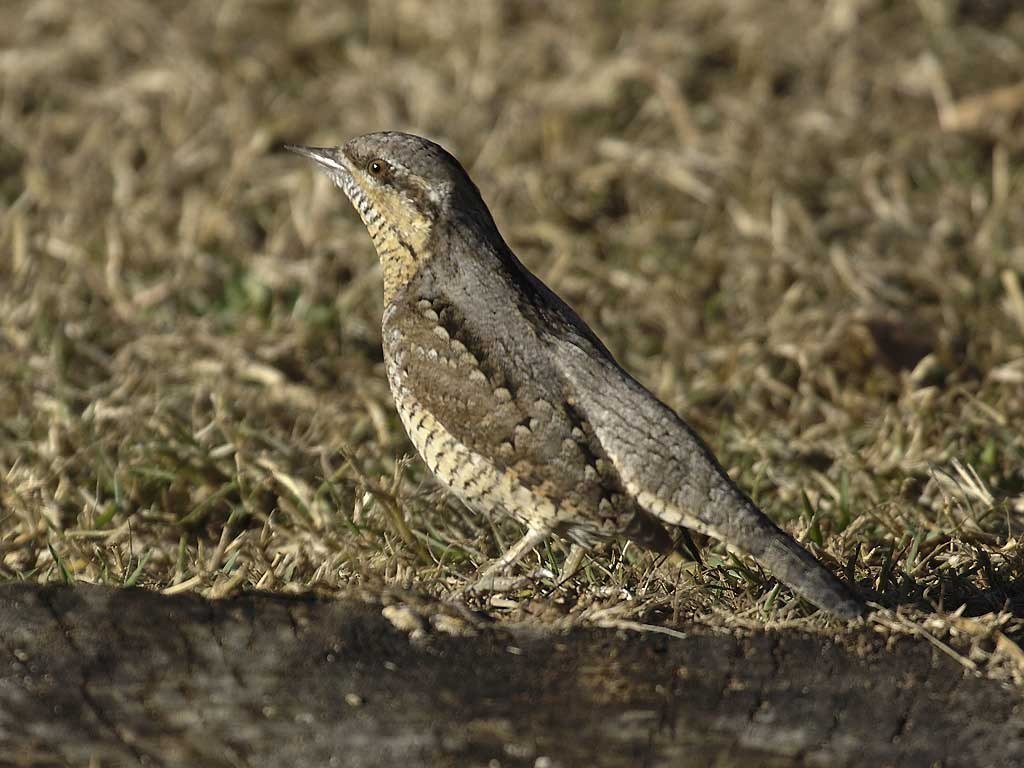
What Eurasian Wryneck Feathers Look Like
Eurasian Wryneck feathers are cryptically patterned to match tree bark and dead leaves, similar in concept to Woodcock or nightjar camouflage but built on a gray-brown base rather than warm chestnut tones. Upperpart feathers show fine gray, brown, and black mottling and vermiculation, with a characteristic dark stripe running down the center of the back from the nape — a strong diagnostic if the feather sampled includes this central back region. Underparts feathers are paler buff-white with fine dark barring or chevron-shaped markings across the breast and flanks. Despite being a member of the woodpecker family, Wryneck feathers reveal an important structural twist: because this species doesn't excavate wood or brace hard against trunks, its tail feathers are soft and flexible, not stiff and pointed like true woodpeckers — a key clue that separates a Wryneck feather from a similarly patterned true woodpecker feather. The tail itself shows fine dark barring across a grayish-brown ground.
Step-by-Step: Is This Feather From a Eurasian Wryneck?
- Check the pattern. Fine gray-brown-black mottling and vermiculation, without any bold white spotting or solid black-and-white blocks, is the starting signature.
- Look for a dark central back stripe. A darker streak running down the spine of a back feather is a strong Wryneck-specific clue.
- Test tail feather stiffness if possible. A soft, flexible tail feather despite an otherwise woodpecker-like bark pattern strongly supports Wryneck over a true woodpecker.
- Check underparts for chevron barring. Fine dark V-shaped or crossbar markings on buff-white breast feathers fit this species.
- Consider season and habitat. A cryptically patterned feather found in open orchard, parkland, or scrubby woodland edge during the warmer months (this species is a summer migrant across much of its range) supports Wryneck.
Similar Species & How to Tell Them Apart
- Eurasian Three-toed Woodpecker and other true woodpeckers show bold black-and-white barring or spotting with genuinely stiff, pointed tail feathers, contrasting with Wryneck's finer, more uniformly mottled pattern and soft tail structure.
- European Nightjar feathers share a cryptic mottled brown-gray look but are considerably larger with longer, more pointed wings for sustained aerial insect-catching, and lack Wryneck's central dark back stripe.
- Eurasian Treecreeper feathers are also camouflaged and mottled, but in warmer buff-brown tones with a rufous rump, and are much smaller overall, plus Treecreeper's tail feathers are genuinely stiffened (used as a climbing brace), unlike Wryneck's soft tail.
- Common Cuckoo feathers show more regular horizontal barring on a grayer ground without the fine vermiculated bark texture, and Cuckoo is considerably larger with more pointed wings.
Where & When You'll Find Them
Eurasian Wrynecks favor open woodland, orchards, parkland, and scrubby edges with anthills nearby (ants are a major food source, caught with a long, extendable tongue), and across most of their European range they're long-distance migrants, wintering in sub-Saharan Africa and returning to breed from April through May. Feathers are therefore most findable in the breeding season, spring through late summer, in traditional orchard and open-woodland territories, particularly near old nest holes (Wrynecks use existing cavities rather than excavating their own) and around ground-level anthills where they forage. A feather found in typical Wryneck habitat during winter in most of Europe would be unusual, since the birds have departed for Africa by autumn.
Frequently asked questions
How can I tell a Wryneck feather from a true woodpecker feather?
Check the tail feather's stiffness — true woodpeckers have rigid, pointed tail feathers for bracing against bark, while Wryneck's tail feathers are notably soft and flexible since it doesn't excavate wood.
What's the most distinctive marking on a Wryneck feather?
A dark stripe running down the center of the back feathers from the nape, combined with an overall fine gray-brown-black mottled, bark-like pattern.
Is Wryneck present in Europe year-round?
No — most populations are long-distance migrants to sub-Saharan Africa, so feathers are essentially a spring-through-summer find in the breeding range.
How does Wryneck's pattern compare to nightjar camouflage?
Both are cryptically mottled, but nightjar feathers are longer and more pointed for sustained flight, while Wryneck lacks that wing shape and shows the diagnostic dark central back stripe.
Where should I look for these feathers?
In open woodland, orchards, and parkland near old nest cavities and ground-level anthills, since Wrynecks nest in existing holes and feed heavily on ants at ground level.
Eurasian Wryneck identified by the community
Recent Eurasian Wryneck feathers identified with Feather Identifier.


