
How to Identify Eurasian Bittern Feathers
How to recognize the intricate reed-camouflage patterning on this secretive heron's feathers and separate it from similar marsh birds.
Read the full Eurasian Bittern encyclopedia entry →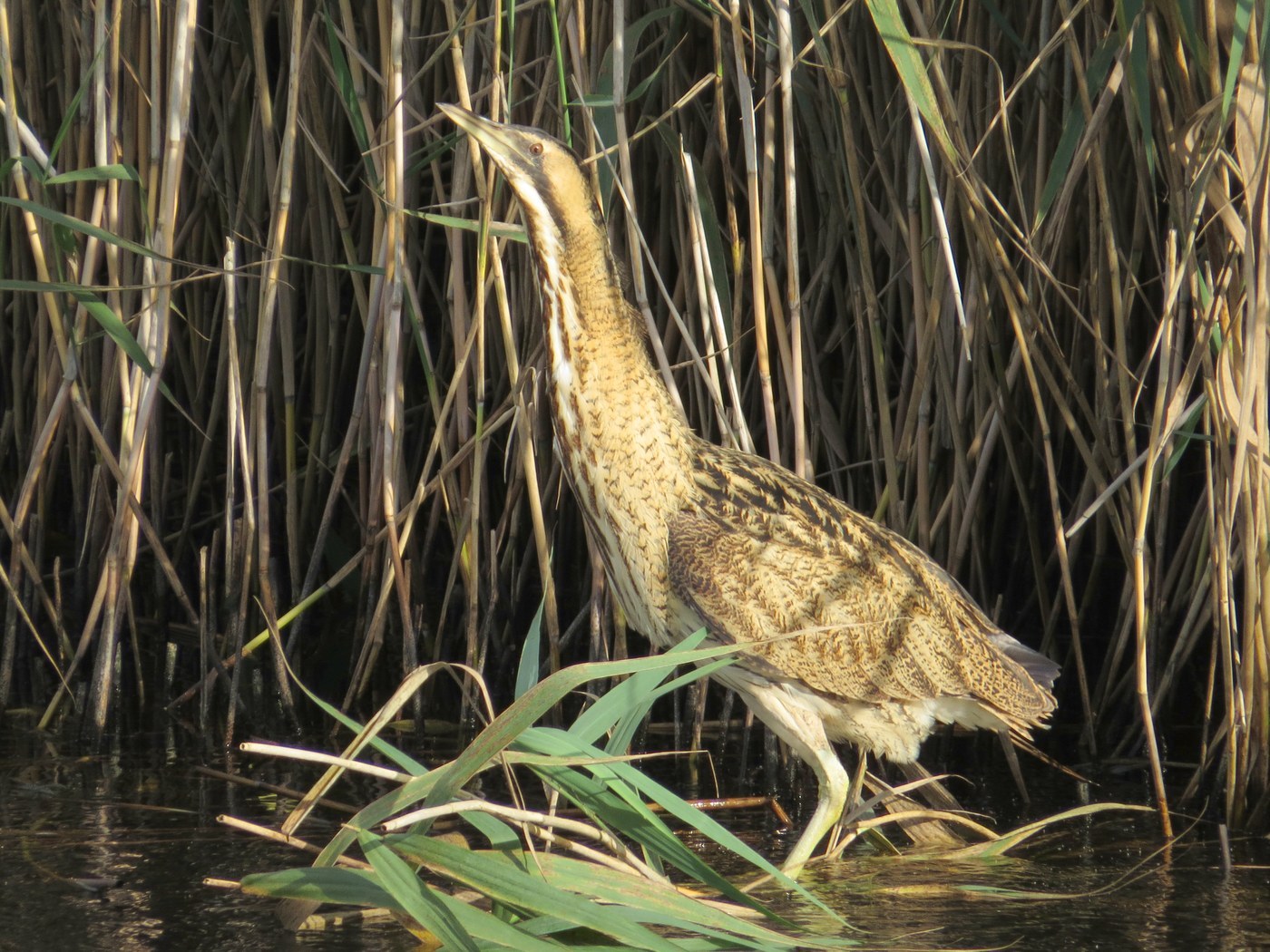
What Eurasian Bittern Feathers Look Like
Everything about a Eurasian Bittern's plumage is built for one purpose: disappearing into a reedbed. Rather than solid colors or simple bars, its feathers show an intricate, almost bark-like camouflage.
- Overall pattern: buffy-brown ground color overlaid with a complex mix of blackish-brown streaks, chevrons, and fine vermiculations — no single feather looks plain or uniform.
- Crown feathers: blackish, standing out somewhat against the otherwise mottled head and neck.
- Flight feathers: barred rufous-brown and blackish, retaining the same "broken" camouflage look even on the wing.
- Overall texture: soft, loose contour feathers typical of herons, but colored to mimic dead, dry reed stems and shadows rather than to stand out.
- Size: fairly large heron-type feathers, with flight feathers reaching a substantial length reflecting the bird's sizeable wingspan.
Step-by-Step: Is This Feather From a Eurasian Bittern?
- Look for "dead reed" camouflage. A feather with intricate, irregular streaking and mottling across its whole surface, rather than simple spots or bars, is the starting point.
- Check the crown color if you have a head feather. A blackish cap contrasting with mottled buffy-brown elsewhere supports bittern.
- Examine flight feather barring. Rufous-brown and blackish bands running the length of the feather, rather than solid dark tips, suggest bittern.
- Rule out simple spotting. If the pattern looks like discrete white spots on brown rather than an intricate marbled texture, consider a young heron instead.
- Factor in habitat. A feather found deep in a dense reedbed rather than open shoreline strongly favors this notoriously secretive species.
Similar Species & How to Tell Them Apart
The American Bittern, found in a different range, is extremely similar in overall camouflage pattern but tends to show more solidly dark, less barred primary feathers and a distinct black neck stripe pattern not matched by the Eurasian species. Juvenile night-herons can show a spotted brown-and-white plumage, but their pattern reads as discrete white spots on a darker ground rather than the Eurasian Bittern's finely marbled, streaky camouflage that lacks bold white spotting. The key distinguishing feature is the intricacy: bittern feathers look like a woven pattern of reed shadows rather than simple spots or stripes.
Where & When You'll Find Them
Eurasian Bitterns are secretive residents (with partial migration in northern populations) of dense reedbeds across much of Europe and Asia, rarely venturing into open water or short vegetation where they'd lose their camouflage advantage. Their molt is protracted, with wing feathers replaced gradually over the summer and body feathers molting more continuously, so shed feathers are most often found tucked among reed margins in late summer, when both breeding adults and newly fledged young are actively molting.
Frequently asked questions
Why is the bittern's feather pattern so complex compared to other herons?
Bitterns rely on remaining motionless and camouflaged among reeds rather than fleeing or hiding in cover, so natural selection has favored an intricate, reed-mimicking pattern rather than the bolder patterns seen in more open-water herons.
How is this different from a young Grey Heron feather?
Grey Heron feathers, even in juveniles, tend to be more uniformly gray with simpler streaking, lacking the dense, multi-toned marbled texture that covers nearly every bittern feather.
Do male and female Eurasian Bitterns have different feather patterns?
The sexes look quite similar in plumage, so feather pattern alone isn't a reliable way to determine sex, though males average slightly larger overall.
Is it common to actually find a bittern feather given how secretive the bird is?
It's relatively uncommon precisely because the species stays hidden in dense reeds, so most finds happen during the molt period when feathers accumulate along reedbed edges that people can access.
Does the crown color change with age?
Juveniles show a somewhat duller, less solidly black crown than adults, gradually developing the fuller blackish cap as they mature.