
How to Identify Downy Woodpecker Feathers
How to identify the black-and-white checkered wings, white back stripe, and spotted tail feathers of North America's smallest woodpecker.
Read the full Downy Woodpecker encyclopedia entry →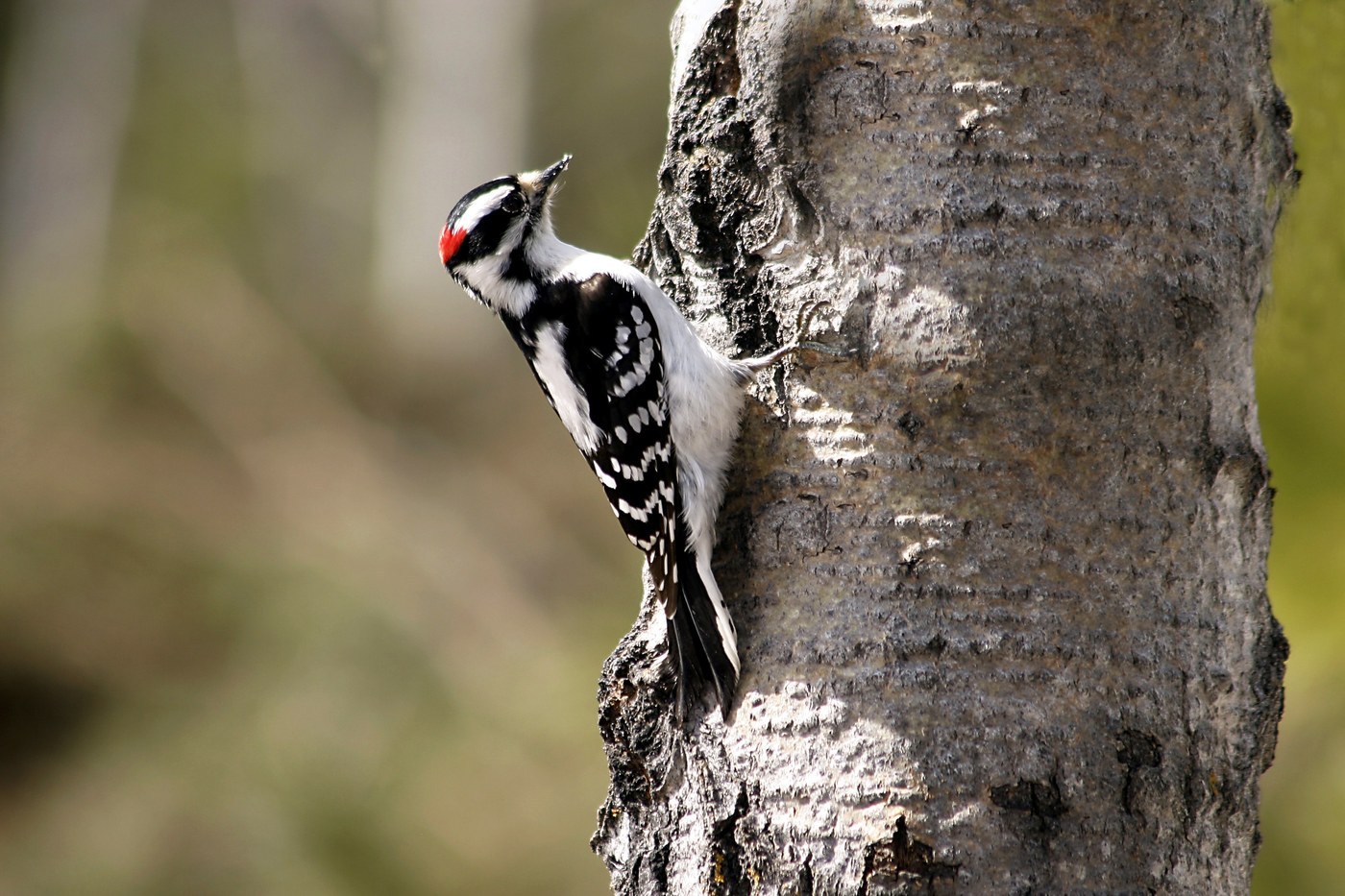
What Downy Woodpecker Feathers Look Like
As North America's smallest woodpecker, this species shows a crisp black-and-white pattern packed into notably small feathers. Wing feathers show a checkered black-and-white spotting pattern, with rows of white spots across otherwise black flight feathers — fine and delicate compared to larger woodpeckers, but following the same general checkered theme common to many black-and-white woodpeckers. A broad white stripe runs down the center of the back, formed by a block of solid white feathers distinct from the black-and-white checkered wing feathers alongside them. The outer tail feathers are white with black spots or bars, a useful and fairly distinctive detail, while the central tail feathers are plain black and notably stiff, as in all woodpeckers, for bracing against tree bark. Males show a small red patch on the nape (back of the head), a solid, relatively small red feather patch that is completely absent in females. Overall feather size is quite small for a woodpecker (flight feathers 6–8 cm), reflecting this species' status as the smallest woodpecker in North America.
Step-by-Step: Is This Feather From a Downy Woodpecker?
- Check size first. Small flight feathers (6–8 cm) with stiff shafts point to a small woodpecker rather than a larger species — this is one of the most useful initial filters.
- Look for a solid white back-stripe feather. A block of plain white feather, rather than checkered or barred, found alongside black-and-white wing feathers supports this identification.
- Examine wing feathers for fine checkering. Small, evenly spaced white spots across black wing feathers fit this species' delicate pattern.
- Check outer tail feathers for spotting. White outer tail feathers marked with black spots or bars are a useful supporting detail.
- Look for a small red nape feather. If present, a solid red feather patch from the back of the head indicates a male; its absence doesn't rule out the species, since females lack it entirely.
Similar Species & How to Tell Them Apart
The Hairy Woodpecker is the classic look-alike, sharing an almost identical black-and-white pattern including the white back stripe and red nape patch in males — the most reliable distinction is size: Hairy Woodpecker feathers, especially flight and tail feathers, are noticeably larger, and its bill (not reflected in feathers) is proportionally much longer and more robust. Careful measurement is essential since color pattern alone often cannot separate these two species reliably. Other black-and-white woodpeckers with checkered wings, such as certain sapsuckers, typically show additional color elements (like yellow wash or red crown patches beyond just the nape) that Downy Woodpecker lacks, helping to rule them out once the overall color scheme is considered alongside size.
Where & When You'll Find Them
Downy Woodpeckers are widespread, non-migratory residents found across most of the United States and Canada in forests, woodlots, parks, and even suburban yards with mature trees, making them one of the most commonly encountered woodpeckers overall. Because they don't migrate, feathers can be found in any season across their extensive range, typically near deciduous or mixed woodland, dead trees, and even backyard suet feeders where they are frequent visitors. Molt occurs gradually after breeding through summer, so worn or shed body and flight feathers are most often found from mid-summer into autumn beneath favored foraging trees and feeder locations.
Frequently asked questions
What's the single most reliable way to separate this from a Hairy Woodpecker feather?
Size — Downy Woodpecker feathers, especially flight and tail feathers, are noticeably smaller than the nearly identically patterned Hairy Woodpecker, since color pattern alone often can't reliably separate the two.
How can I tell if a feather is from a male or female?
A small solid red feather patch from the nape (back of the head) indicates a male; females lack this red patch entirely, though its absence doesn't rule out the species since only males have it.
What does the white back stripe look like on a feather?
It's a block of solid white feather, distinct from the finely checkered black-and-white pattern seen on the wing feathers found alongside it.
Where are Downy Woodpecker feathers most commonly found?
Near deciduous or mixed woodland, dead trees, and backyard suet feeders across most of the US and Canada, since this is one of the most common and widespread woodpeckers.
Is there a season when feathers are easiest to find?
Mid-summer into autumn tends to be most productive, following the gradual post-breeding molt, though the species can be found year-round since it doesn't migrate.
Downy Woodpecker identified by the community
Recent Downy Woodpecker feathers identified with Feather Identifier.


