
How to Identify Dickcissel Feathers
How to identify the yellow breast with black V, chestnut shoulder patch, and streaked back of this North American grassland songbird.
Read the full Dickcissel encyclopedia entry →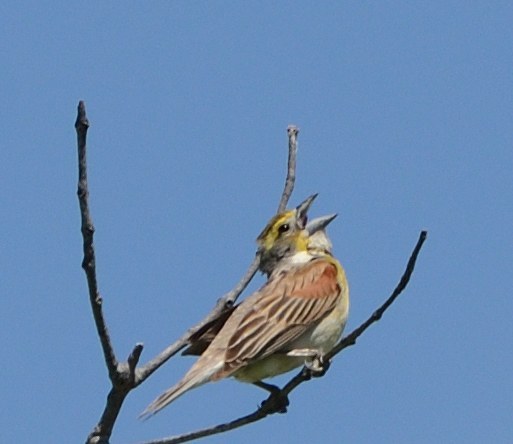
What Dickcissel Feathers Look Like
This grassland songbird of the central United States looks like a miniature meadowlark, and its feathers show a similar but smaller-scale color scheme. Breeding male breast feathers are a bright lemon-yellow, with a bold black patch forming a V or bib shape on the upper breast/throat — a found feather showing solid black against bright yellow, rather than streaking, strongly suggests this diagnostic throat/breast area. The back and crown are brown, heavily streaked with black, giving a typical grassland-sparrow camouflage look from above. A key supporting feature is the chestnut-rust shoulder patch (lesser wing coverts), a small but distinctly colored rufous-chestnut feather patch on the bend of the wing, unusual in combination with the yellow breast. The head shows a gray face with a pale eyebrow stripe. Females and non-breeding males are much duller, lacking the black bib and showing muted yellow or buffy tones with fine streaking instead. Flight feathers are plain brown, small-to-medium (6–8 cm), typical of a sparrow-sized bird.
Step-by-Step: Is This Feather From a Dickcissel?
- Look for solid black on a bright yellow feather. A breast/throat feather that's black meeting yellow in a clean block (rather than a streaked pattern) suggests the male's diagnostic V-shaped bib.
- Check for a chestnut wing patch feather. A small rufous-chestnut covert feather, distinct from the duller brown flight feathers, is a strong supporting clue when found with yellow body feathers.
- Examine back/crown feathers for streaking. Brown feathers with bold black streaks fit the species' upperpart pattern.
- Consider gray facial feathers. A plain gray feather with a pale stripe, if from the head region, is consistent with this species' face pattern.
- Factor in grassland habitat. A feather combination matching yellow-black-chestnut found in tallgrass prairie, hayfields, or grassy meadows in the central US supports this identification strongly.
Similar Species & How to Tell Them Apart
Eastern Meadowlark, which shows a similar bright yellow breast with a black V, is considerably larger with correspondingly bigger feathers and a longer, more robust bill-associated head shape — size is the fastest way to separate a meadowlark feather from the much smaller Dickcissel. House Sparrow, which can show some chestnut on the head/nape, lacks the yellow breast entirely, showing gray-brown tones instead — the presence of yellow immediately rules out sparrows. Female or non-breeding Dickcissel feathers, being duller and more streaked, can resemble various grassland sparrows; the chestnut shoulder patch, when present, remains one of the more reliable clues across all plumages.
Where & When You'll Find Them
Dickcissels breed in tallgrass prairie, hayfields, and weedy grassland across the central United States, then undertake a long migration to winter in large flocks in northern South America, particularly the Venezuelan llanos. Feathers showing full breeding male coloring (yellow breast, black bib, chestnut shoulder) are most likely to be found on breeding grounds from late spring through summer, while duller female/non-breeding feathers could turn up during migration periods in spring and fall as birds pass through the central and southern US. Molt occurs after breeding in late summer, so freshly shed feathers are most commonly found in grassland habitat during this period before the population departs for South America.
Frequently asked questions
What's the fastest way to confirm a Dickcissel feather?
Look for a breast/throat feather showing solid black meeting bright yellow in a clean block, ideally paired with a small chestnut-rust wing covert feather — this combination is distinctive to the species.
How is this different from an Eastern Meadowlark feather?
Meadowlark shows a very similar yellow-and-black-V pattern but is considerably larger, with bigger feathers overall — size is the quickest way to tell them apart.
What if the feather is dull and streaky with no yellow?
That's likely a female or non-breeding bird; look for the chestnut shoulder patch as a supporting clue, since duller plumages otherwise resemble various grassland sparrows.
Where does this species spend the winter?
Primarily in large flocks in northern South America, especially the Venezuelan llanos grasslands, after migrating from its central US breeding range.
When are breeding-plumage feathers most likely to be found?
Late spring through summer on breeding grounds in tallgrass prairie, hayfields, and grassy meadows across the central United States.