
How to Identify Diamond Dove Feathers
How to spot the white-spotted wing coverts, blue eye-ring feather clues, and small size of Australia's tiniest dove.
Read the full Diamond Dove encyclopedia entry →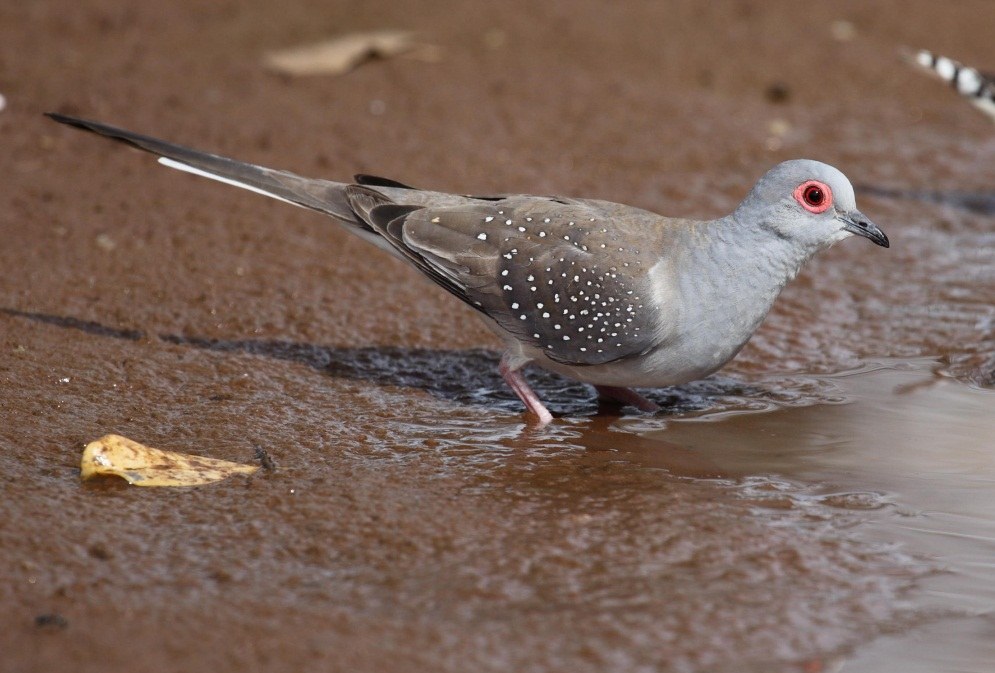
What Diamond Dove Feathers Look Like
As one of the smallest doves in the world, this Australian species produces correspondingly tiny, delicate feathers. Body feathers are a soft blue-grey on the head and breast, transitioning to warmer grey-brown on the back, with an overall gentle, muted color palette typical of many doves. The standout diagnostic feature is on the wing: wing covert feathers marked with small, crisp white spots, arranged in evenly spaced rows that create the "diamond" pattern the species is named for — these white-spotted covert feathers are unlike the wing pattern of most other small doves and are the best single clue to this species. The tail is fairly long relative to body size for such a small dove, dark centrally with white outer tail feather edges visible in flight and on shed tail feathers. Around the eye, though not part of the feather itself, a bright reddish-orange bare skin ring is characteristic, sometimes leaving a color impression on adjacent facial feathers. Overall feather size is very small (contour feathers 1–2 cm, flight feathers 5–7 cm), among the smallest of any dove.
Step-by-Step: Is This Feather From a Diamond Dove?
- Check for white spots on a wing covert feather. Small, neat, evenly spaced white spots on an otherwise grey-brown covert feather are highly distinctive and the fastest way to confirm this species.
- Assess overall size. Very small feather dimensions (covert and body feathers around 1–2 cm) fit this species' status as one of the tiniest doves.
- Look at the tail. Long-for-its-size, dark tail feathers with white edges on the outer feathers support the identification.
- Note general color. A gentle blue-grey head/breast blending into grey-brown upperparts, without bold color patches elsewhere, is typical of this species.
- Factor in arid Australian habitat. A tiny spotted-wing dove feather found in dry inland Australian scrub or woodland fits this species' known range and habitat preference.
Similar Species & How to Tell Them Apart
The Peaceful Dove, a similarly small Australian dove often sharing habitat, shows fine black barring or scaling on the neck and breast rather than white spots on the wing coverts — barring versus spotting, and neck versus wing placement, are the key differences. Common Bronzewing and other larger Australian pigeons can show iridescent wing spots too, but are considerably larger overall with correspondingly bigger feathers, making size the quickest way to rule them out. The neat, evenly spaced white spotting pattern on the wing coverts, combined with very small overall feather size, makes Diamond Dove fairly straightforward to identify once a covert feather is examined closely.
Where & When You'll Find Them
Diamond Doves inhabit arid and semi-arid inland Australia, favoring open woodland, scrub, and areas near water sources such as waterholes and rivers running through dry country. They are largely resident but can be somewhat nomadic in response to rainfall and water availability, moving to follow suitable conditions rather than migrating on a fixed schedule. Because of this, feathers can be found at any time of year, though local concentrations near reliable water sources during dry periods make these areas particularly productive places to search, with molt and feather turnover occurring gradually throughout the year rather than in one sharp seasonal pulse.
Frequently asked questions
What is the clearest way to confirm this species from a feather?
Look for small, evenly spaced white spots on a wing covert feather — this 'diamond' spotting pattern is distinctive and gives the species its name.
How do I tell this apart from a Peaceful Dove feather?
Peaceful Dove shows fine black barring on the neck and breast rather than white spots on the wing coverts, so checking both the pattern type and its location on the body separates the two.
Why is size such an important clue for this species?
Diamond Dove is one of the smallest doves in the world, so its feathers (roughly 1–2 cm for body feathers) are noticeably tinier than those of most other pigeons and doves sharing its range.
Does this species migrate on a fixed schedule?
No — it's largely resident but can move nomadically in response to rainfall and water availability, so feathers can turn up in any season, especially near reliable water sources in dry periods.
What habitat should I search in?
Arid and semi-arid inland Australian woodland and scrub, particularly near waterholes and rivers that provide reliable water in dry country.