
How to Identify Curve-billed Thrasher Feathers
How to recognize the plain grayish-brown, faintly spotted body feathers and long tail of this common desert songbird.
Read the full Curve-billed Thrasher encyclopedia entry →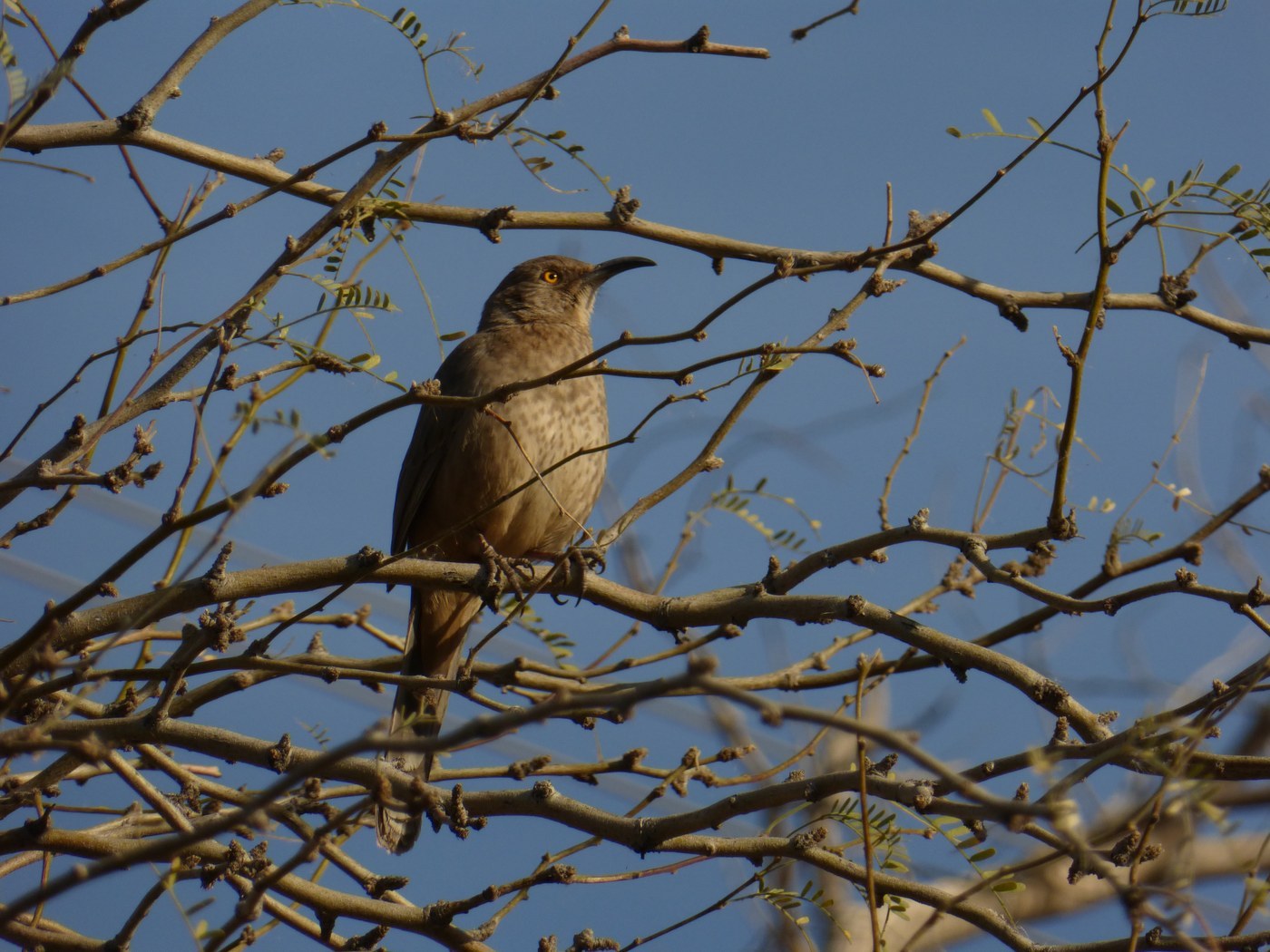
What Curve-billed Thrasher Feathers Look Like
This desert-dwelling songbird of the southwestern United States and Mexico shows a fairly understated plumage built for blending into arid scrub. Body and contour feathers are grayish-brown overall, with breast feathers showing faint, diffuse dark spotting rather than the crisp, bold spots seen in some other thrasher species — the spotting can be subtle enough to be easily overlooked. The back and wing covert feathers are a slightly warmer brown, unremarkable and without strong patterning. The tail is notably long relative to body size, with tail feathers often showing pale, buffy tips — visible as small light patches at the very end of an otherwise plain brown tail feather, which is one of the more useful diagnostic details on an otherwise plain-looking bird. Flight feathers are plain brown, moderate in size (7–9 cm), without strong wing bars or bright patches. Overall, feathers from this species read as "generic desert brown" more than boldly patterned, so subtle details (faint breast spotting, pale tail tips) matter more than dramatic color for identification.
Step-by-Step: Is This Feather From a Curve-billed Thrasher?
- Check overall color first. A plain grayish-brown feather with no bright colors or bold patterns is consistent with this species and rules out brightly marked songbirds immediately.
- Look closely for faint breast spotting. Hold the feather at an angle in good light — subtle, diffuse dark spotting on a breast feather (rather than sharp, high-contrast spots) fits this species.
- Check tail feathers for pale tips. A brown tail feather with a small buffy or whitish tip is a useful supporting clue.
- Assess tail feather length. Long feathers relative to typical songbird proportions match this species' notably long tail.
- Factor in desert habitat. A plain brown feather found in arid scrub, desert edge, or cactus-dominated habitat in the southwestern US or Mexico fits this species' known range far better than a similar feather found in humid or forested habitat.
Similar Species & How to Tell Them Apart
The Bendire's Thrasher, which overlaps in parts of the same desert range, is extremely similar in plumage but shows a shorter, straighter bill (not reflected in feathers) and generally even fainter, more diffuse breast spotting with a shorter tail — feather-level separation between these two is genuinely difficult and often relies on subtle tail-tip and overall proportion differences rather than one clear diagnostic mark. Northern Mockingbird, sharing similar habitat, is a paler gray overall with bold white wing patches and white outer tail feathers, both features absent in Curve-billed Thrasher — a feather with any white patch is more likely a mockingbird. Brown Thrasher, found further east, shows a much brighter rufous-red back and bold, crisp breast streaking rather than faint spotting, making it noticeably more richly colored than Curve-billed Thrasher.
Where & When You'll Find Them
Curve-billed Thrashers are non-migratory residents of desert scrub, cactus country, and arid thornscrub across the southwestern United States and much of Mexico, closely associated with cholla and other cacti used for nesting. Because they remain in the same territories year-round, feathers can be found in any season near cactus stands, desert washes, and arid residential landscaping. Molt occurs mainly after the breeding season, generally through the hot late summer months, so worn body and tail feathers are most commonly found on the ground beneath cactus or shrub cover from late summer into early autumn.
Frequently asked questions
The feather looks totally plain — what should I check for?
Look for faint, diffuse dark spotting on breast feathers and a small pale buffy tip on tail feathers — subtle details are key since this species lacks bold, high-contrast markings.
How do I rule out a Northern Mockingbird?
Mockingbird feathers show bold white patches on the wings and white outer tail feathers; Curve-billed Thrasher has neither, so any white patch points away from this species.
Is it easy to distinguish from Bendire's Thrasher?
Not always — the two are very similar. Bendire's tends to show even fainter breast spotting and a somewhat shorter tail, but confident separation from feathers alone can be difficult.
Why is the tail feather length important?
Curve-billed Thrasher has a notably long tail relative to its body, so unusually long, plain brown tail feathers with pale tips fit this species better than shorter-tailed desert songbirds.
When are feathers most likely to be found?
Late summer into early autumn, after the post-breeding molt, typically near cactus stands and desert scrub where the birds nest and forage year-round.