
How to Identify Crowned Eagle Feathers
A field guide to the barred, rufous underparts and long banded tail feathers of Africa's powerful forest eagle.
Read the full Crowned Eagle encyclopedia entry →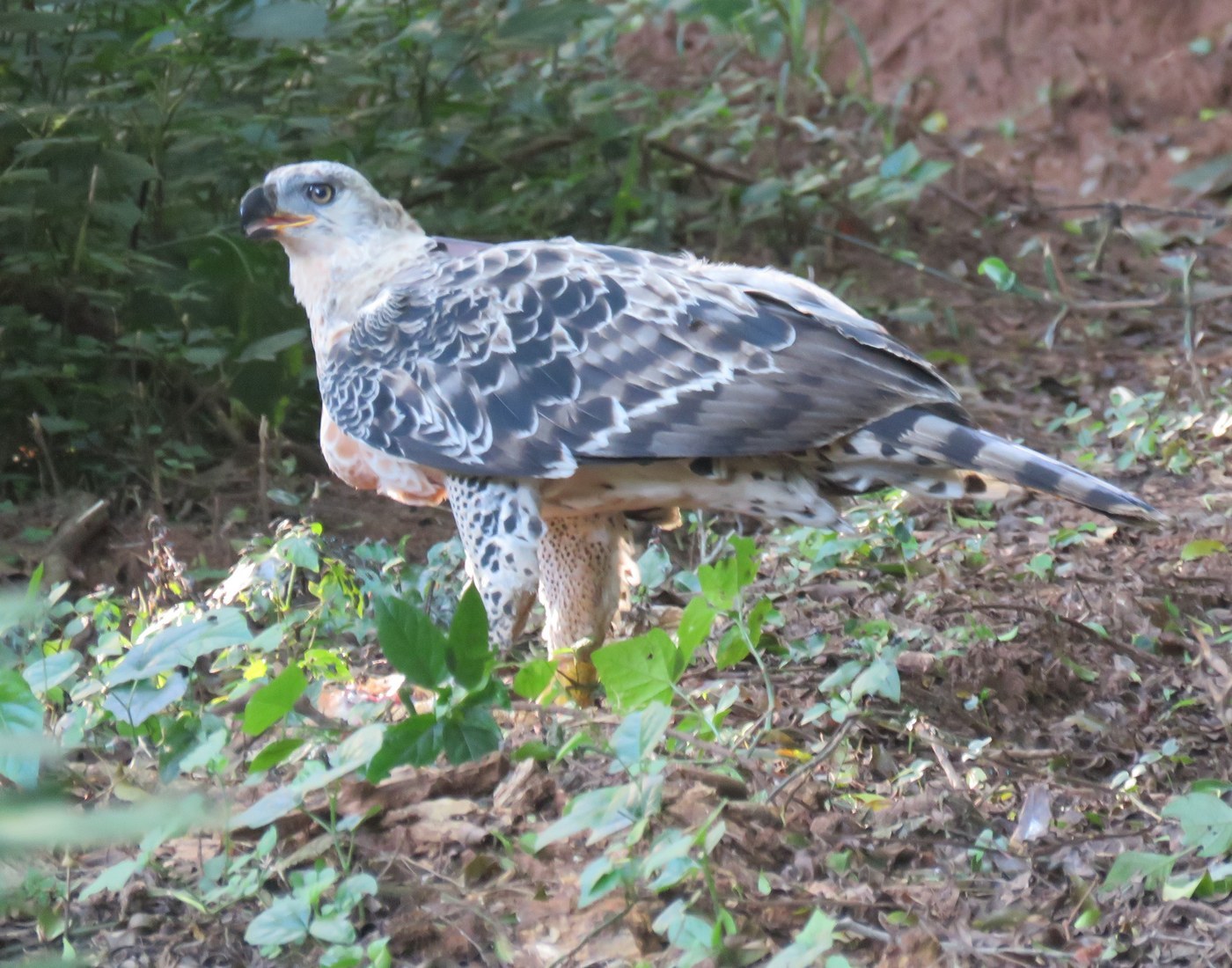
What Crowned Eagle Feathers Look Like
Africa's most powerful forest raptor produces large, robust feathers befitting a bird capable of taking sizeable mammalian prey. Body and underwing feathers from the breast and belly show rich rufous-chestnut coloring boldly barred with black, a strong, contrasty pattern that is one of the best clues to this species. Upperpart feathers (back, wing coverts) are dark blackish-brown, plainer and less patterned than the underparts. The tail is long and broadly banded, showing alternating dark and pale grey-brown bars across individual tail feathers, with a dark terminal band — tail feathers are large (25–35 cm in adults) and strongly built. Flight feathers are large, heavily barred beneath, and notably broad and rounded at the tip, consistent with a forest raptor built for maneuvering through canopy rather than open-country soaring. Crowned Eagles also carry a distinctive double-pointed crest on the head; crest feathers are elongated, dark, and stiffer than typical head feathers.
Step-by-Step: Is This Feather From a Crowned Eagle?
- Check the size first. This is a large eagle — tail feathers 25–35 cm and broad flight feathers point to a big raptor, ruling out small hawks and falcons immediately.
- Look for rufous-and-black barring on underparts. Bold chestnut coloring with heavy black barring on a body/breast feather is a strong diagnostic sign specific to this species among African eagles.
- Examine tail banding. Wide, evenly spaced dark and pale bands across a long, sturdy tail feather fit this species' pattern.
- Look for a crest feather. An elongated, somewhat stiff dark feather from the head/nape area, distinct from typical contour feathers, suggests a crested raptor.
- Note feather robustness. Thick shafts and dense vane structure reflect a powerful predator's flight feathers, different from the more lightly built feathers of buzzards or smaller hawks.
Similar Species & How to Tell Them Apart
The Martial Eagle, Africa's largest eagle by some measures, shows white underparts with dark spotting rather than the rufous-and-black barring of Crowned Eagle — spotting versus barring, and white versus rufous base color, are the fastest ways to separate the two. African Hawk-Eagle is smaller with white underparts streaked in black rather than barred rufous, and its tail shows finer banding. Various forest buzzards and smaller hawk species in the same forest habitat show similar barred patterns but on much smaller feathers with thinner shafts — overall size remains the most reliable separator from lookalike barred raptor feathers.
Where & When You'll Find Them
Crowned Eagles inhabit dense tropical and subtropical forest across sub-Saharan Africa, particularly favoring large tracts of undisturbed canopy where they hunt monkeys and other mid-sized mammals from concealed perches. They are non-migratory residents, so feathers can be found at any time of year, typically beneath large emergent trees used as favored perches or near known nest sites, which are reused across multiple breeding attempts. Because this species breeds only once every two to three years and molts gradually over an extended period, feather finds are relatively infrequent but can occur in any season near long-term nesting or roosting trees.
Frequently asked questions
What's the fastest way to rule out a Martial Eagle?
Martial Eagle underparts are white with dark spotting, while Crowned Eagle underparts are rufous-chestnut with bold black barring — spotting versus barring is the quickest distinction.
How large should a Crowned Eagle tail feather be?
Adult tail feathers typically run 25–35 cm with broad, even dark-and-pale banding, reflecting the bird's substantial size.
Is the crest feather noticeably different from body feathers?
Yes — crest feathers are elongated and stiffer than ordinary head contour feathers, forming the eagle's characteristic double-pointed crest.
Does this species migrate, affecting when feathers can be found?
No, it's a non-migratory forest resident, so feathers can turn up in any season, most often near long-used nest or perch trees.
Why might feather finds be relatively rare for this species?
Crowned Eagles breed only every two to three years and molt gradually, so feather turnover and encounter rates are lower than for smaller, more common raptors.