
How to Identify Crimson Sunbird Feathers
How to spot the tiny iridescent crimson throat and back feathers, and elongated male tail feathers, of this Asian sunbird.
Read the full Crimson Sunbird encyclopedia entry →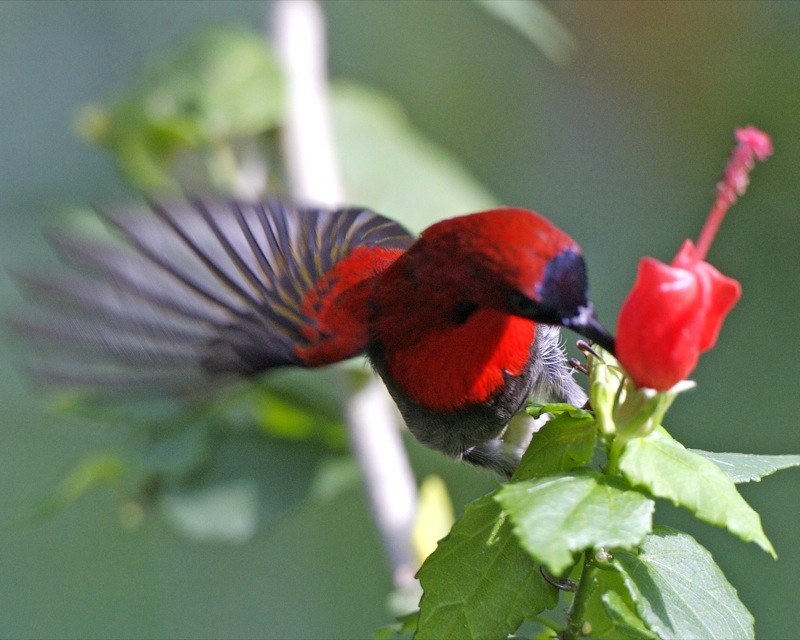
What Crimson Sunbird Feathers Look Like
As one of Asia's smallest and most vividly colored songbirds, the male Crimson Sunbird shows an iridescent crimson-red crown, throat, and upper back, a metallic purple or violet-blue band across the lower throat/breast, and an olive-yellow belly. These feathers are tiny — most contour feathers measure only 1–2 cm — and the red and purple areas have a glossy, almost metallic sheen caused by structural iridescence rather than pigment alone, so the color can shift from crimson to blackish depending on the angle of light. Males also grow elongated central tail feathers that extend well beyond the rest of the tail, a feature entirely absent in females. Females and immatures are a much plainer olive-green above and dull yellow below, with no red, no iridescent throat band, and a short, evenly-shaped tail — the sexual difference here is extreme, much like many sunbirds.
Step-by-Step: Is This Feather From a Crimson Sunbird?
- Check the size. Sunbird feathers are minute — typically 1–2 cm — much smaller than most songbird feathers people find.
- Look for iridescent sheen. True structural iridescence (color shifting with viewing angle) on a crimson or violet feather is a strong sunbird indicator, as opposed to a flat, matte red.
- Identify a metallic purple throat band feather if present. This narrow band of glossy violet-blue between the red throat and yellow belly is distinctive to breeding male sunbirds.
- Look for one unusually long, narrow tail feather. An elongated central tail feather much longer than typical tail feathers points to a breeding male sunbird's ornamental plumes.
- Consider the curved shape context. While the feather itself won't show it, sunbirds have downcurved bills for nectar feeding — a clue if any head parts are still attached.
Similar Species & How to Tell Them Apart
Other red sunbirds, such as the Scarlet Sunbird (sometimes treated as the same or a very close relative) and Temminck's Sunbird, look extremely similar and are best separated by range and by subtle differences in the extent of the purple throat band rather than by feather alone. Flowerpeckers, which share similar tiny size and can show red patches (e.g., Scarlet-backed Flowerpecker), lack the extensive iridescent throat band and elongated tail feathers of male sunbirds, and their red is typically confined to a smaller back patch. Larger red songbirds like minivets show red in bigger, non-iridescent patches and are considerably larger overall, making size the quickest way to rule them out.
Where & When You'll Find Them
Crimson Sunbirds inhabit forest edges, gardens, mangroves, and flowering shrubs across South and Southeast Asia, staying resident year-round in most of their range without long migrations. Because they feed constantly among flowering plants, feathers are most often found near flowering trees, shrubs, and gardens rather than deep forest interior. Molt tends to follow the breeding cycle, with males regrowing their elongated tail plumes afresh each breeding season (timing varies by region but often aligns with local flowering peaks), so the showiest elongated tail feathers are most likely to be found molted out shortly after breeding activity winds down.
Frequently asked questions
Why is the feather so small?
Sunbirds are among the smallest songbirds, and their contour feathers typically measure only 1–2 cm, much smaller than sparrow- or finch-sized feathers.
What does the elongated tail feather tell me?
Only breeding male Crimson Sunbirds grow an elongated central tail feather; finding one strongly suggests a male in or near breeding plumage.
How do I know if the color is truly iridescent rather than just bright red?
Tilt the feather under different light — true structural iridescence will shift between crimson, purple, and near-black depending on the angle, unlike a flat pigment-based red.
Could this be a flowerpecker feather instead?
Flowerpeckers are similarly tiny but lack the glossy purple throat band and elongated tail feather of male sunbirds, and their red is usually a smaller, duller back patch.
Where are these feathers usually found?
Near flowering trees, shrubs, and gardens in South and Southeast Asia, since sunbirds spend most of their time feeding at flowers.