
How to Identify Crested Tit Feathers
A guide to identifying the black-and-white speckled crest and brown-and-buff body feathers of the European Crested Tit, and separating them from Coal Tit and Marsh Tit feathers.
Read the full Crested Tit encyclopedia entry →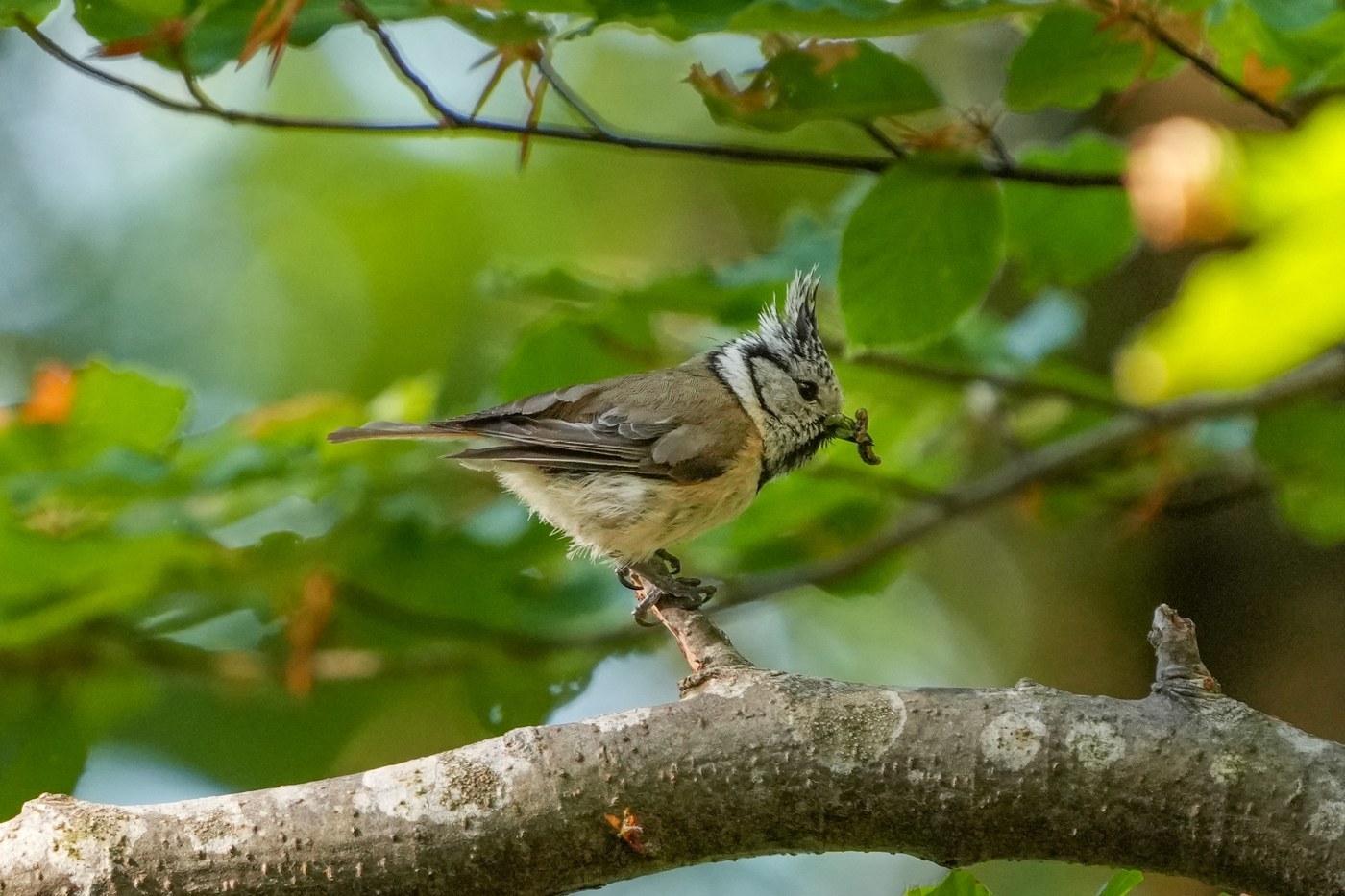
What Crested Tit Feathers Look Like
The Crested Tit is a small European woodland bird, and its most unmistakable feature is the pointed, black-and-white speckled crest on the crown — a texture and pattern unlike any other European tit, which normally have plain, uncrested caps. These crest feathers are elongated, narrow, and finely barred in black and white, forming a distinct peaked shape when raised.
The rest of the body is comparatively subdued: brown-gray upperparts and buffy-white underparts, without any bright yellow, green, or blue tones seen in some other common European tits. A black bib marks the throat, and a black stripe curves back from the eye through the ear coverts, bordered by white. Overall feather size is small and compact, in keeping with this tiny woodland bird, roughly the same scale as a Coal Tit or Blue Tit feather.
Step-by-Step: Is This Feather From a Crested Tit?
- Look first for a crest feather — elongated, pointed, and speckled black-and-white; if present, this is close to conclusive for this species in Europe.
- Check overall body tone — plain brown-gray above and buffy-white below, without bright yellow or blue.
- Inspect for a black throat bib and a black eye-stripe curving behind the ear coverts.
- Confirm small size — consistent with a tiny tit, similar in scale to Coal or Marsh Tit.
- Rule out a plain black cap — a solid black crown with no crest points to a different tit species.
- Factor habitat — coniferous forest, especially pine, across parts of Europe supports this ID.
Similar Species & How to Tell Them Apart
Coal Tit has no crest at all — instead it shows a plain black cap with a distinctive white patch on the nape, a completely different crown pattern from the Crested Tit's speckled peak. Marsh Tit and Willow Tit are also uncrested, with a plain glossy or matte black cap covering the crown rather than any raised feather tuft, and neither shows the black-and-white speckled texture unique to Crested Tit. Because no other tit species in Europe has a crest at all, finding any crest feather with this speckled black-and-white pattern is essentially conclusive for Crested Tit within its range, making it one of the easier tit species to confirm from a single feather.
Where & When You'll Find Them
Crested Tits are residents of coniferous forest, particularly old pine woodland, found locally across Scotland, Fennoscandia, and much of central and southern Europe, generally avoiding areas without mature conifer stands. As a non-migratory resident, feathers can be found across the year, but molt is concentrated in late summer (July through September), following the breeding season, when adults replace worn plumage before the onset of colder weather. Feathers are most likely to be found in pine forest, near nest holes in dead or decaying trees, and around feeding areas where the species caches conifer seeds.
Frequently asked questions
What is the single most reliable feather to confirm a Crested Tit?
Any crest feather at all — elongated, pointed, and speckled black-and-white — since no other European tit species grows a crest, making it essentially conclusive.
How is a Crested Tit feather different from a Coal Tit feather?
Coal Tit has a plain black cap with a white nape patch and no crest, while Crested Tit has a distinctive raised, speckled black-and-white crest on the crown.
Does the Crested Tit have any bright yellow or blue feathers?
No, its plumage is subdued brown-gray above and buffy-white below, unlike some other European tits that show brighter yellow or blue tones.
When are Crested Tit feathers most likely to be found?
Late summer through early fall, during the post-breeding molt, in mature coniferous (especially pine) forest where the species is resident.