
How to Identify Common Bulbul Feathers
A guide to recognizing the plain brown-grey feathers, faint crest, and yellow vent of this widespread African songbird.
Read the full Common Bulbul encyclopedia entry →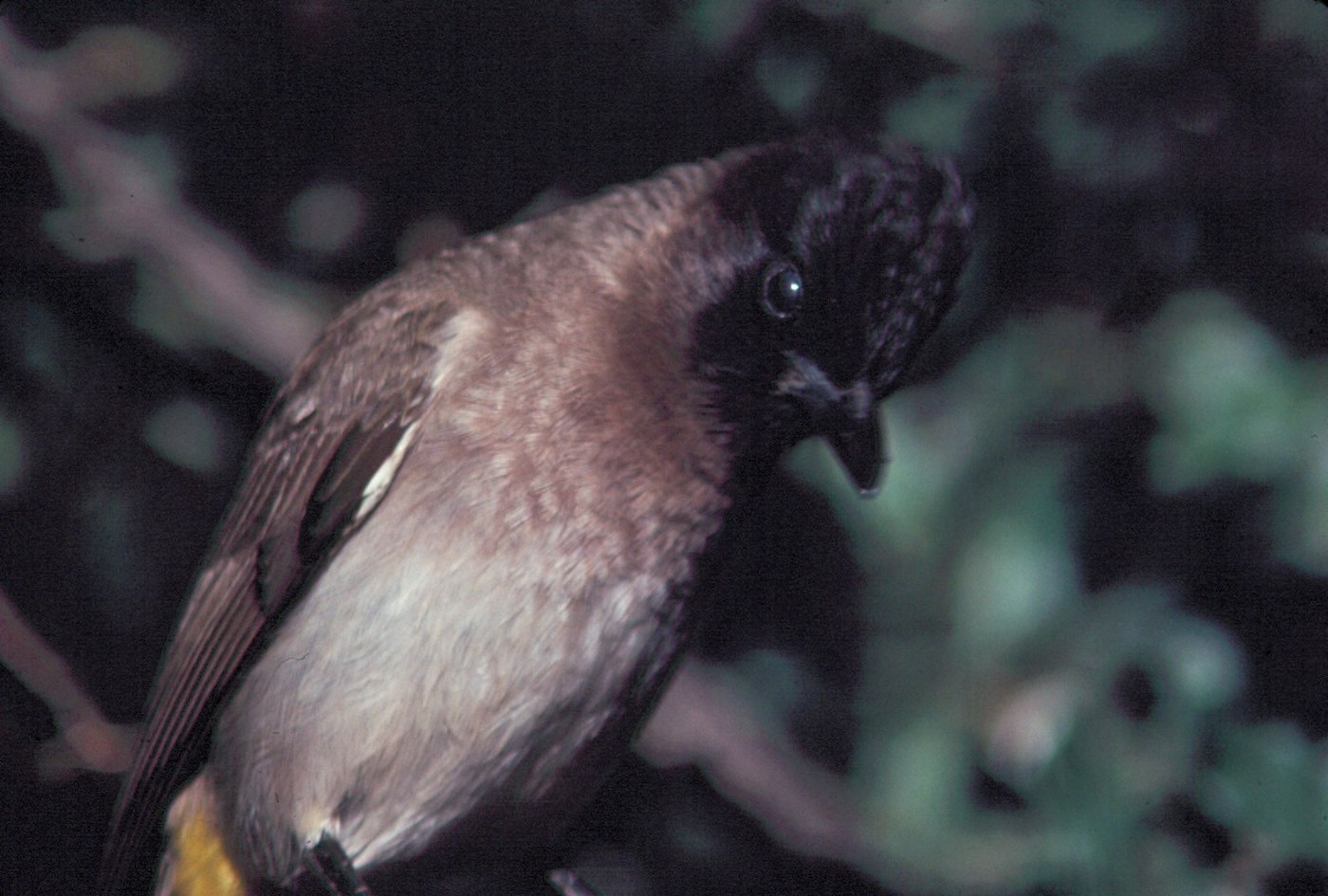
What Common Bulbul's Feathers Look Like
The Common Bulbul is one of the most familiar and vocal songbirds across sub-Saharan Africa, and its feathers are practical rather than flashy. Upperpart feathers are a plain sooty brown to grey-brown, darkest on the crown, which is often slightly raised into a small, loose crest — crown feathers can look faintly peaked or ragged at the tip compared to smooth back feathers. Underparts are paler grey-brown to whitish on the belly, with contrasting bright yellow undertail covert feathers in most subspecies, a small but genuinely diagnostic patch of color on an otherwise drab bird.
Flight feathers are uniform dark brown with no wing bars or bold pattern, and the tail is fairly long, dark brown, and slightly notched or squared at the tip, sometimes with very faint paler edging. The overall feather texture is soft and loosely webbed, typical of a bulbul, giving a slightly "fluffy" look to fresh body feathers compared to the tighter feathers of many finches. Feathers are of moderate small-to-medium songbird size, without any iridescence or barring.
Step-by-Step: Is This Feather From a Common Bulbul?
- Check for yellow. A small feather that is otherwise plain brown-grey but shows bright yellow specifically at the base near the vent likely came from the undertail coverts, a strong species clue.
- Measure it. Flight feathers run about 7–9 cm and tail feathers 8–10 cm, consistent with a robin-to-thrush-sized songbird.
- Look for crest texture. A slightly ragged, peaked feather from the crown may be from this species' loose, low crest.
- Assess overall pattern. Plain, unstreaked, unspotted brown-grey with no wing bars is consistent with Common Bulbul and rules out many patterned finches and warblers.
- Feel the texture. A somewhat loose, soft-webbed feather fits bulbuls generally, versus the tighter feathers of estrildid finches often found in the same habitat.
- Consider the setting. A feather found in a garden, forest edge, or roadside scrub across sub-Saharan Africa fits this extremely common and adaptable species.
Similar Species & How to Tell Them Apart
Several other African bulbuls, such as the Dark-capped Bulbul (now often considered the same or a close relative depending on taxonomy) and Garden Bulbul, look almost identical in the hand and share the yellow vent; range and subtle tone differences are the only real separators. The Common Bulbul differs from greenbuls, which share the drab brown look but generally lack the bright yellow vent and instead show olive-tinged plumage throughout. It is easily told from true thrushes, which are larger with heavier bills and often show breast spotting, and from sunbirds, which have iridescent green or colorful plumage rather than plain brown.
Where & When You'll Find Them
Common Bulbuls are extremely widespread and adaptable, found in gardens, savanna edges, forest margins, and urban parks across most of sub-Saharan Africa, often in small noisy groups. Because they are non-migratory and breed across an extended season depending on local rains, feather molt is not sharply seasonal, and feathers can be found near garden shrubs, hedges, and forest-edge perches throughout the year. Look for feathers below favored perches and dense shrubby cover where these birds roost and forage close to the ground.
Frequently asked questions
What's the fastest way to confirm a Common Bulbul feather?
Look for a small feather that is plain brown-grey overall but shows a patch of bright yellow at the base — this is characteristic of the undertail covert feathers unique to bulbuls with yellow vents.
How do I tell this from a similar African bulbul species?
In the hand, many bulbul species look nearly identical; location and very subtle tonal shading are usually the only distinguishing factors, so treat close calls as 'bulbul species' rather than a certain Common Bulbul.
Why does the crown feather look ragged or peaked?
Common Bulbuls have a small, loose crest that gives crown feathers a slightly disheveled, peaked look compared to the smooth feathers on the back and wings.
Could a plain brown feather with no yellow still be this species?
Yes — most of the body is plain brown-grey without yellow; the yellow is confined to the vent area, so a feather from elsewhere on the body can still belong to this species.
Is there a season when feathers are most common?
Not strongly, since this non-migratory species breeds across an extended, rain-linked season; feathers can be found near shrubby roosts and perches throughout the year.