
How to Identify Collared Sunbird Feathers
A guide to recognizing the tiny, iridescent green feathers of this African sunbird and telling isolated feathers apart from other sunbirds.
Read the full Collared Sunbird encyclopedia entry →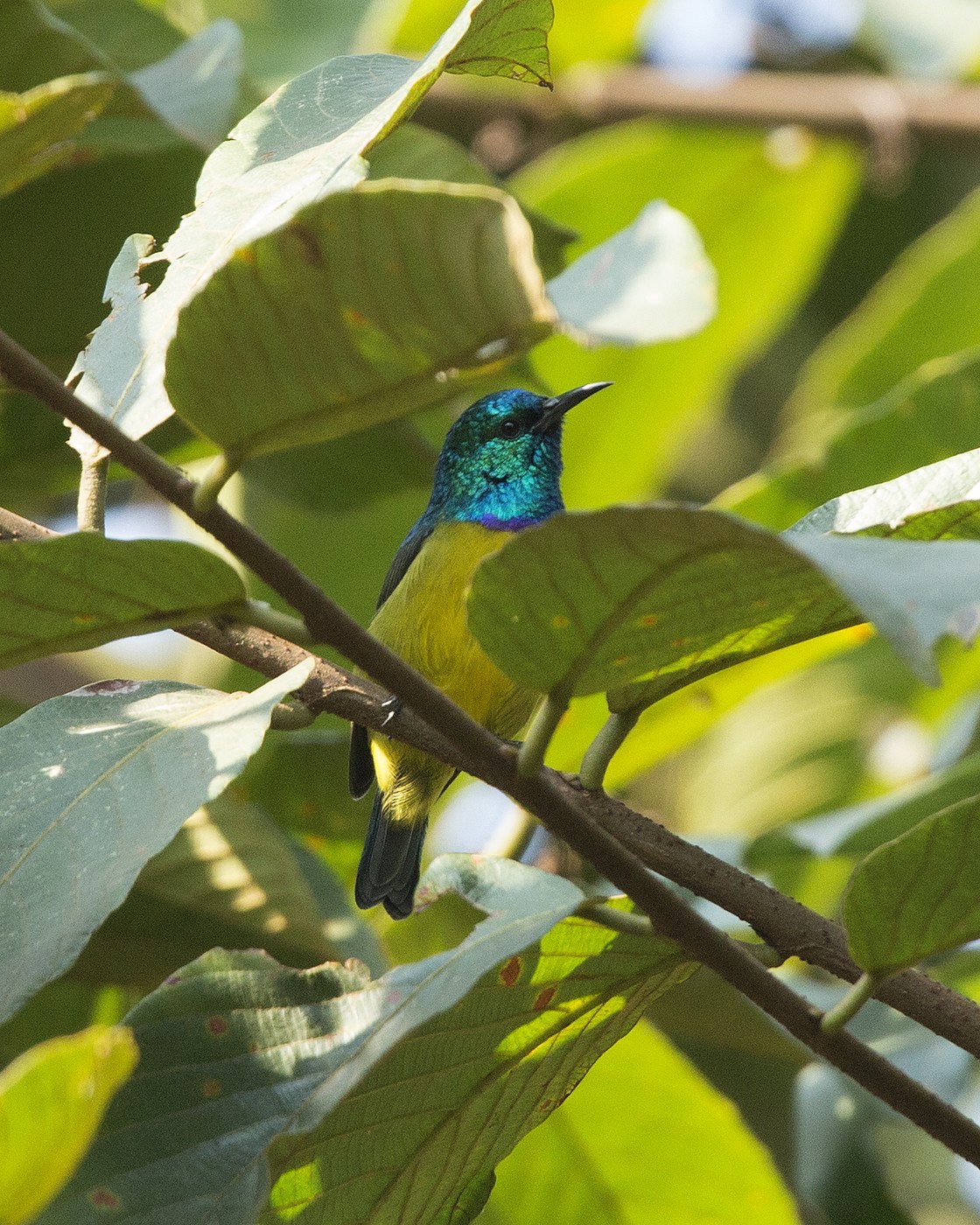
What Collared Sunbird's Feathers Look Like
The Collared Sunbird is a tiny, active nectar-feeder of African forests and thickets, and its feathers are correspondingly small and jewel-like. Back and crown feathers show a brilliant, iridescent metallic green sheen that shifts toward blue or gold depending on the angle of light — this is structural color from the feather's microscopic surface layers, not pigment, so the same feather can look dull olive in shade and blazing emerald in direct sun. The throat and upper breast of the male carry a narrow violet-to-purple iridescent band (the "collar" that gives the species its name), bordered below by clean yellow underparts; females lack the iridescent throat patch and instead show plain grayish-white to pale yellow underparts.
Feathers are very small, generally under 4–5 cm even for the longest flight feathers, with a fine, almost hair-like texture on the body feathers and a delicate, slightly curved shaft. The tail is short and squared-off, without the elongated central feathers seen in some other sunbird species, and tail feathers show a subdued blackish-green rather than bold patterning.
Step-by-Step: Is This Feather From a Collared Sunbird?
- Check the size first. If the feather is longer than about 5–6 cm, it is almost certainly too large to be from this species — Collared Sunbirds are among the smaller sunbirds.
- Tilt it in the light. Genuine iridescent green with a metallic, oily-sheen quality (rather than flat pigment green) is the single best confirming clue for a sunbird feather.
- Look for a violet throat patch. A small feather that is iridescent purple-violet rather than green likely came from the male's collar band specifically.
- Note the yellow. Clean, fairly bright yellow on a small underpart feather, without streaking, fits the plain yellow belly of this species.
- Feel the texture. Sunbird body feathers are unusually fine and silky compared to a similarly-sized finch or warbler feather.
- Consider the tail shape. A short, squared, unadorned tail feather rules out long-tailed sunbird species and fits Collared Sunbird's stubbier tail.
Similar Species & How to Tell Them Apart
Many African sunbirds share iridescent green upperparts, but the Collared Sunbird is distinguished by its combination of small size, plain yellow (not orange or red-washed) underparts, and a narrow violet rather than broad multicolored throat band. The Olive-bellied Sunbird and Green-headed Sunbird are similarly sized but typically show a red or maroon breast band in males rather than violet. Larger species like the Scarlet-chested Sunbird or Bronzy Sunbird produce noticeably bigger, coarser feathers with more extensive red, scarlet, or bronze tones. Female sunbirds across species are notoriously difficult to separate by feather alone; plain grayish-yellow underparts with green-glossed upperparts and small size are the best you can do without a confirmed collection location.
Where & When You'll Find Them
Collared Sunbirds inhabit forest edges, secondary growth, thickets, and gardens across much of sub-Saharan Africa, often staying low in dense vegetation rather than high in the canopy. Because they build compact, hanging nests low in shrubs, molted feathers and nest-lining down are sometimes found near these structures. Molt in tropical sunbirds tends to be less tightly seasonal than in temperate songbirds and can follow local breeding cycles, so feathers may be found scattered through much of the year, with body feather turnover often loosely tied to the local wet-season breeding peak.
Frequently asked questions
Why does the same feather look green in one light and dull in another?
Sunbird iridescence is structural, produced by microscopic layers in the feather barbules that reflect light at specific angles, rather than by pigment. Tilting the feather in bright, direct light will reveal the true metallic sheen.
How do I tell a male from a female Collared Sunbird feather?
Male throat/collar feathers show a narrow band of iridescent violet-purple; females lack this iridescent patch entirely and have plain, duller underpart feathers.
Is the yellow belly a reliable clue?
It helps narrow things down since Collared Sunbird underparts are a fairly clean, unmarked yellow, but several other African sunbirds also show yellow bellies, so combine it with small size and green iridescence.
Could this be a hummingbird feather instead?
Only if you're in the Americas — sunbirds and hummingbirds are unrelated but look similar due to convergent evolution. In Africa, iridescent nectar-feeder feathers this small are sunbirds, not hummingbirds.
When are these feathers most commonly found?
Near forest edges, thickets, and hanging nests, with feathers turning up somewhat year-round given the relaxed, breeding-linked molt schedule typical of tropical sunbirds.