
How to Identify Cassin's Sparrow Feathers
A guide to the plain grayish-brown, finely streaked feathers of Cassin's Sparrow, a desert grassland songbird of the southwestern US.
Read the full Cassin's Sparrow encyclopedia entry →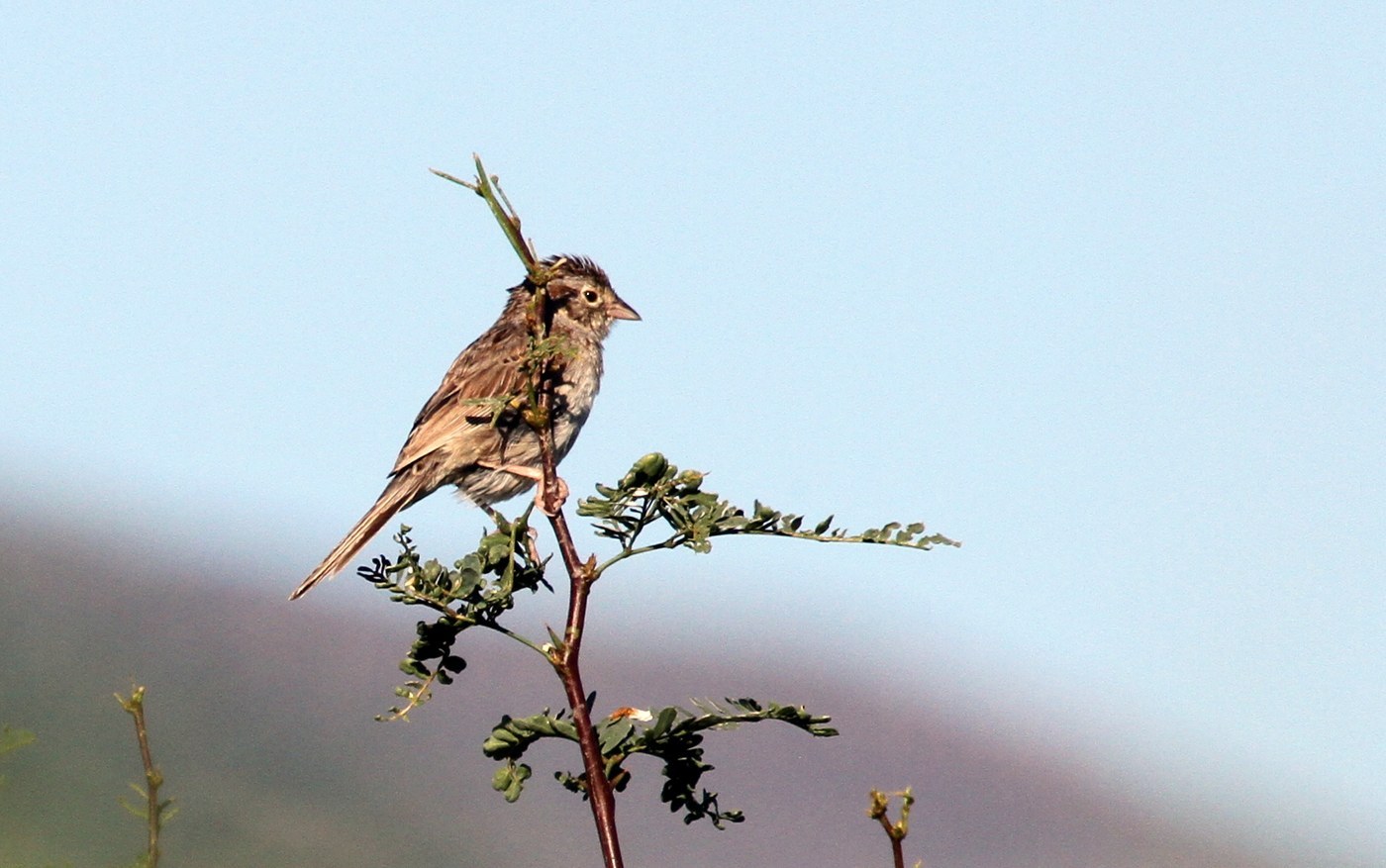
What Cassin's Sparrow Feathers Look Like
Cassin's Sparrows are subtly patterned birds built to blend into desert grassland. Back and mantle feathers are grayish-brown with fine dark streaking, while underpart feathers are largely plain, unmarked pale gray-buff — a notably clean, unstreaked belly and breast compared to many sparrows. The face is plain with minimal contrast, lacking bold eyebrow stripes or malar marks found in many sparrow relatives. Tail feathers are grayish-brown with narrow pale tips, a detail that becomes visible in flight during this species' distinctive skylarking display flight, when the tail is fanned. Overall feather texture and color are muted and understated, consistent with a bird that relies on camouflage in open, sparse habitat.
Step-by-Step: Is This Feather From a Cassin's Sparrow?
- Check underparts for streaking. Cassin's Sparrow shows plain, unmarked pale gray-buff underparts — heavy streaking below suggests a different species.
- Inspect back feathers. Fine dark streaking on a grayish-brown background fits this species' subtle pattern.
- Look at tail feather tips. Narrow pale tips on grayish-brown tail feathers are a useful, if subtle, clue.
- Assess overall contrast. A notably plain, low-contrast face with no bold markings supports this species over more boldly patterned sparrows.
- Consider habitat. Feathers found in desert grassland or mesquite scrub in the southwestern US or Mexico fit this species' preferred terrain.
- Factor in unpredictability. This species is somewhat nomadic depending on rainfall, so its presence in an area can vary year to year.
Similar Species & How to Tell Them Apart
Botteri's Sparrow overlaps in some of the same desert grassland habitat but is browner overall with less crisply contrasting streaking on the back, and tends to favor slightly denser grass cover than Cassin's Sparrow. Grasshopper Sparrow is buffier overall with a shorter tail and a flatter-headed structural profile, and its back feathers show a more scaled pattern rather than the fine linear streaking of Cassin's Sparrow. The combination of plain unstreaked underparts with fine (not scaled) back streaking helps separate Cassin's Sparrow from both.
Where & When You'll Find Them
Cassin's Sparrows favor desert grasslands and mesquite scrub across the southwestern United States and northern Mexico, and their presence in a given area can shift from year to year depending on rainfall patterns, since the species is somewhat nomadic in response to habitat conditions. Feathers are most likely to be found in grassland habitat during the breeding season, with the post-breeding molt occurring in August-September, when adults replace worn plumage before the cooler months.
Frequently asked questions
What's the key underpart clue for Cassin's Sparrow?
Plain, unmarked pale gray-buff underparts with no streaking, distinguishing it from more heavily marked sparrows.
How is Cassin's Sparrow different from Botteri's Sparrow?
Botteri's Sparrow is browner overall with less crisply contrasting back streaking and tends to favor denser grass cover.
How do I rule out Grasshopper Sparrow?
Grasshopper Sparrow is buffier with a shorter tail and a more scaled back pattern, rather than the fine linear streaking Cassin's Sparrow shows.
Where do Cassin's Sparrows live?
Desert grasslands and mesquite scrub across the southwestern United States and northern Mexico, with a somewhat nomadic presence tied to rainfall.
When do Cassin's Sparrows molt?
After breeding, roughly August through September, before cooler months arrive.