
How to Identify Canyon Wren Feathers
How to spot the rusty-brown feathers with a bright white throat patch that identify a Canyon Wren, a cliff- and canyon-dwelling songbird.
Read the full Canyon Wren encyclopedia entry →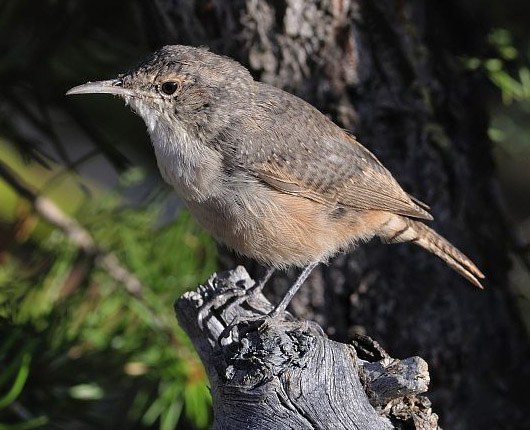
What Canyon Wren Feathers Look Like
Canyon Wrens have a striking two-part color scheme that carries clearly into individual feathers. Body feathers on the back, flanks, and belly are a rich rusty-cinnamon brown, while throat and upper breast feathers are bright white, creating a sharp, clean boundary between the two zones — unusual crispness for a small songbird. Wing and tail feathers show fine dark barring across the rusty-brown background, giving a subtly speckled or barred texture rather than a solid color. The tail feathers in particular are rufous with narrow blackish bars running across the width of the feather, and the tail itself is fairly long and often cocked in life. Overall feather size is small, consistent with this bird's tiny body, though the bill (not a feather) is unusually long and downcurved.
Step-by-Step: Is This Feather From a Canyon Wren?
- Check for a sharp color break. A feather showing bright white transitioning abruptly into rusty-brown, rather than gradually, points strongly to this species' throat/breast boundary.
- Look for fine barring. Tail and wing feathers should show narrow dark bars across a rusty-cinnamon background.
- Note overall warmth of color. Canyon Wren plumage runs noticeably ruddier/rustier than most other wrens.
- Measure size. Small feathers (wing under 6 cm) fit this diminutive species.
- Check the tail feather shape. Rufous, barred, moderately long, and often held cocked in the living bird.
- Consider the setting. Feathers found wedged into rock crevices or near cliff faces and canyon walls strongly support Canyon Wren over more generalist wrens.
Similar Species & How to Tell Them Apart
Rock Wren overlaps extensively in rocky habitat but is overall grayer and buffier rather than rusty, with a streaked (not solid white) breast and pale buffy tail tips rather than a sharply contrasting white throat. House Wren is a plainer, uniform grayish-brown all over with no bold white throat patch and only faint barring, making it easy to separate once the throat-to-body contrast is checked. The combination of a sharply demarcated white throat against rusty-cinnamon body plumage is unique enough among wrens in canyon habitat to make Canyon Wren straightforward to confirm.
Where & When You'll Find Them
Canyon Wrens are non-migratory residents of steep canyons, cliff faces, and rocky outcrops across the western United States and Mexico, rarely straying far from vertical rock terrain. Because they don't migrate, feathers can turn up near cliff nests and rocky crevices at any time of year, but the greatest number tends to appear after the late-summer molt, when adults replace worn plumage following the breeding season — check ledges, crevices, and talus slopes near known singing perches.
Frequently asked questions
What's the key feather clue for Canyon Wren?
A sharp, clean boundary between a bright white throat feather and rusty-cinnamon body feathers — an unusually crisp contrast for such a small bird.
How do Canyon Wren and Rock Wren feathers differ?
Rock Wren is grayer and buffier with a streaked breast and pale tail tips, while Canyon Wren shows a solid white throat and warmer rusty tail with fine dark barring.
Are Canyon Wren feathers barred or plain?
Wing and tail feathers show fine dark barring across a rusty-cinnamon background, rather than being a solid plain color.
Where should I search for Canyon Wren feathers?
Near cliff faces, canyon walls, rock crevices, and talus slopes in the western US and Mexico, where the species nests and forages year-round.
When do Canyon Wrens molt?
Primarily in late summer, after the breeding season, when worn feathers are replaced.