
How to Identify Brown-capped Rosy-Finch Feathers
How to identify the chocolate-brown, pink-washed feathers of the Brown-capped Rosy-Finch, an alpine specialist restricted to the Colorado Rockies.
Read the full Brown-capped Rosy-Finch encyclopedia entry →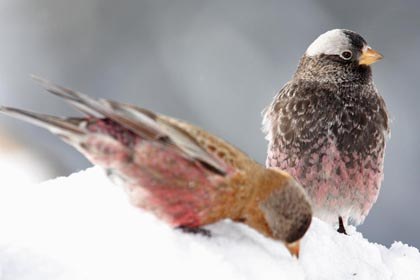
What Brown-capped Rosy-Finch Feathers Look Like
This stocky, sparrow-sized alpine finch (14-16 cm) is the only rosy-finch with an entirely brown (not gray) face, making its feathers distinctive within its limited range.
- Body/contour feathers: chocolate-brown overall, with a rosy-pink wash visible on the belly, wing coverts, and rump — this pink tinge on the covert and rump feather edges is the group's signature "rosy" feature.
- Head feathers: a solid brown cap, with a contrasting gray patch restricted to the hindcrown and nape — no gray extends onto the face itself.
- Flight feathers: blackish-brown edged with pink or rosy tones, about 7-8 cm.
- Tail feathers: blackish-brown, notched, roughly 6 cm.
Step-by-Step: Is This Feather From a Brown-capped Rosy-Finch?
- Measure it — sparrow-sized, in the 6-8 cm range for flight and tail feathers.
- Look for a rosy-pink wash on the edges of wing covert, rump, or belly feathers — this is the defining "rosy-finch" trait.
- Check the brown tone of the body feathers — chocolate-brown rather than gray or black.
- If a head feather is present, confirm gray is limited to the nape/hindcrown, not spread across the face — this separates it from other rosy-finches.
- Factor in elevation and range. A feather like this found above treeline in Colorado or southern Wyoming strongly supports this ID.
Similar Species & How to Tell Them Apart
- Gray-crowned Rosy-Finch: shows much more extensive gray across the face, not just the nape, and overlaps in range in parts of the Rockies.
- Black Rosy-Finch: has a noticeably blacker overall body tone with more strongly contrasting (brighter) pink, rather than the more uniform chocolate-brown of Brown-capped Rosy-Finch.
- Among the three North American rosy-finches, Brown-capped is the only one with an entirely brown face and no gray extending past the nape — a useful default check.
- House Finch: superficially brownish but shows no rosy wash on the wing coverts or rump and lacks the gray nape patch entirely, plus it occupies lowland habitats rather than alpine tundra.
Winter flocks of Brown-capped Rosy-Finch sometimes mix with the other two rosy-finch species at lower elevations, so a feather found well below treeline in winter still needs the face-color check (brown, not gray) to confirm species rather than relying on habitat alone.
Where & When You'll Find Them
Brown-capped Rosy-Finches breed on alpine tundra above treeline in the Colorado Rockies (and adjacent southern Wyoming), nesting in rock crevices and cliffs near snowfields — one of the most restricted breeding ranges of any North American songbird. They descend to lower elevations, including foothills and open country, in winter, sometimes visiting bird feeders. Molt follows breeding, roughly August through September, at high elevation, so summer feathers are found near talus slopes and snowfields, while winter feathers may turn up at lower elevations where flocks forage in mixed groups.
Frequently asked questions
What's the single best clue for this species?
A rosy-pink wash on the edges of wing covert, rump, or belly feathers combined with an otherwise chocolate-brown body.
How do I tell it from Gray-crowned Rosy-Finch?
Gray-crowned Rosy-Finch shows gray extending across the face, while Brown-capped Rosy-Finch has gray restricted to the nape and hindcrown only, with a fully brown face.
Is this species found outside Colorado?
Its range is quite limited — mainly the Colorado Rockies and adjacent southern Wyoming, above treeline in the breeding season.
When and where does molt happen?
Roughly August through September, at high elevation near the alpine breeding grounds.
Where might I find feathers in winter?
At lower elevations and foothills, since the species descends from the alpine zone outside the breeding season.