
How to Identify Bronzed Cowbird Feathers
A guide to spotting the glossy bronze-black body feathers of a male Bronzed Cowbird versus the plainer gray-brown feathers of a female.
Read the full Bronzed Cowbird encyclopedia entry →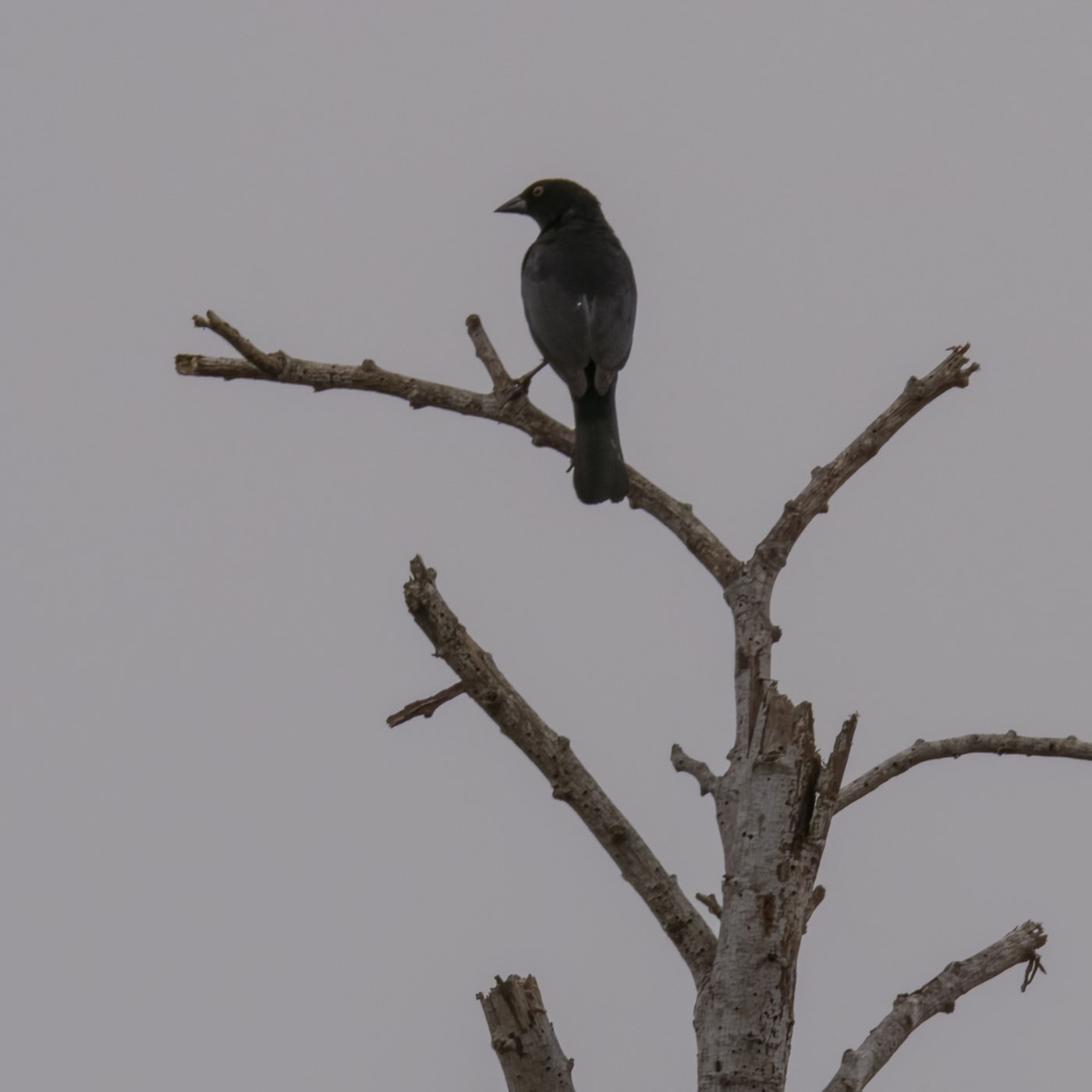
What Bronzed Cowbird Feathers Look Like
The Bronzed Cowbird is a medium-sized icterid (about 8-9 in long) with strongly different male and female plumage.
- Male body/contour feathers: glossy black overall with a distinct bronze-green iridescent sheen that shifts with the light — dense, glossy, and small (roughly 1.5-2.5 in).
- Male flight feathers: black with blue-violet gloss, moderately short and broad, around 3-4 in.
- Female feathers: dull sooty gray-brown throughout, lacking any iridescent sheen — noticeably plainer than the male.
- Shaft color: dark gray to black in both sexes.
Step-by-Step: Is This Feather From a Bronzed Cowbird?
- Measure the feather. A small blackbird-sized feather in the 1.5-4 in range fits this species.
- Tilt it in the light. If it's black with a bronzy-green iridescent sheen that shifts as you rotate it, that points to an adult male.
- Rule out a plain feather. If the feather is uniformly dull gray-brown with no sheen at all, consider it may be a female — check size and texture rather than color pattern.
- Compare the sheen color specifically. Bronzed Cowbird iridescence reads bronze-green, not the blue-green of some blackbirds or the purple gloss of grackles.
- Think about habitat. A glossy blackbird feather found in open farmland, brushland, or scrubby edge in the southwestern US to Central America supports this ID.
Similar Species & How to Tell Them Apart
- Brown-headed Cowbird: males show a sharply two-toned pattern — a matte brown head contrasting with a glossy black body — whereas Bronzed Cowbird is uniformly bronze-black with no head/body break.
- Brewer's Blackbird: males have a blue-green gloss but a noticeably longer tail and slimmer body feather profile; females are plain gray like Bronzed Cowbird females, so size and range become the deciding factors.
- Great-tailed/Boat-tailed Grackle: much larger overall, with long, keeled tail feathers unlike the cowbird's short, broad tail.
- Red-winged Blackbird: males show bold orange-red shoulder patches absent in any Bronzed Cowbird plumage, an easy giveaway if a shoulder/covert feather is present.
Juvenile Bronzed Cowbird feathers resemble the female's plain gray-brown but can show faint, indistinct scaling on the breast that fades with the first molt into adult plumage, so a lightly patterned dull feather found in late summer may simply be a young bird rather than a different species.
Where & When You'll Find Them
Bronzed Cowbirds favor open country, agricultural fields, and brushy edges from the southwestern United States south through Central America. As a brood parasite, it builds no nest of its own, so feathers are typically found scattered in open foraging habitat rather than around a nest site, often near where flocks gather to feed on the ground alongside cattle or in stubble fields. The post-breeding molt runs roughly July through September, making late summer and early fall the best time to find fresh body feathers in farmland and scrub, though resident populations in the far south can produce stray feathers nearly year-round.
Frequently asked questions
How do I tell a male from a female Bronzed Cowbird feather?
Male feathers are glossy black with a bronze-green iridescent sheen; female feathers are plain dull gray-brown with no gloss at all.
What's the key difference from Brown-headed Cowbird feathers?
Brown-headed Cowbird males show a two-toned pattern — brown head, black body — while Bronzed Cowbird is uniformly bronze-black throughout.
Does Bronzed Cowbird build its own nest, so feathers cluster near one?
No — it's a brood parasite with no nest of its own, so feathers tend to be scattered across open foraging habitat rather than concentrated at a nest site.
When is molt season for this species?
Roughly July through September, after breeding, when fresh body feathers are most likely to be found.
Where in North America is this species found?
The southwestern United States south through Mexico and Central America, in open farmland, brushland, and scrubby edge habitat.