
How to Identify Brewer's Blackbird Feathers
Separate the glossy, iridescent feathers of the male Brewer's Blackbird and the plain gray-brown feathers of the female from similar blackbirds and grackles found across North America.
Read the full Brewer's Blackbird encyclopedia entry →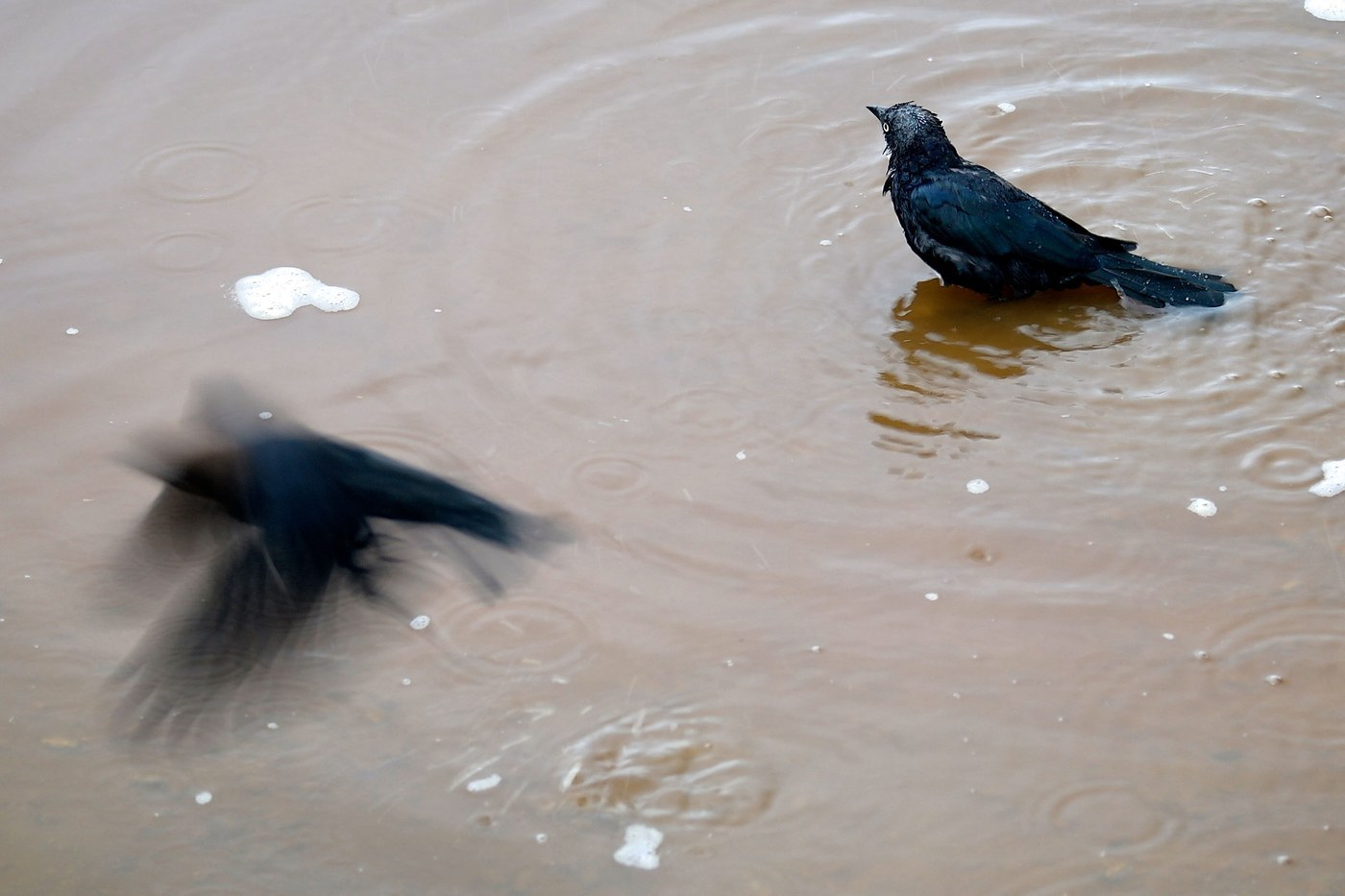
What Brewer's Blackbird Feathers Look Like
Brewer's Blackbird is a widespread North American blackbird with a strong sexual difference in plumage, making feather identification dependent on recognizing both the glossy male type and the much plainer female type.
- Male body/contour feathers: glossy black overall with a strong iridescent sheen — purplish-blue on the head and neck, shifting to greenish-bronze on the body and wings — a two-toned iridescence that's a good diagnostic when both areas are represented.
- Female body/contour feathers: plain gray-brown throughout, without iridescence, feathers 3-5 cm, notably duller and flatter in appearance than the male's.
- Eye color note (not feather, but useful context): males have pale yellow eyes and females dark eyes, useful if any head tissue remains attached.
- Flight feathers (males): glossy black with greenish-bronze sheen, 6-8 cm, fairly narrow and pointed.
- Flight feathers (females): plain dull brown, similar shape but lacking any iridescent sheen.
- Tail feathers: black and glossy in males (moderately long, slightly rounded, without the strong keel of grackles), plain brown in females.
- Shaft color: black in males, brown in females.
Step-by-Step: Is This Feather From a Brewer's Blackbird?
- Check for two-toned iridescence. A glossy black feather that shows purplish-blue sheen on some parts (head/neck-type feathers) and greenish-bronze sheen on others (body/wing-type feathers) fits male Brewer's Blackbird well.
- Assess tail feather shape. Brewer's Blackbird tail feathers are only slightly rounded and lack the pronounced keel (V-shaped cross-section) of grackle tail feathers — this is a key way to separate the two groups.
- Consider plain gray-brown feathers. If the feather is uniformly dull gray-brown without any sheen, it likely belongs to a female — compare size and shape to rule out other similarly plain blackbirds and cowbirds.
- Compare size. Brewer's Blackbird feathers are notably smaller than grackle feathers but similar in size to Red-winged Blackbird females.
- Match to open habitat. Feathers found in open fields, parking lots, parks, and agricultural areas across most of North America fit this adaptable, human-tolerant species.
Similar Species & How to Tell Them Apart
- Common Grackle: larger overall with a distinctly longer, keeled tail feather (V-shaped cross-section) versus Brewer's flatter, less elongated tail.
- Rusty Blackbird: in fall/winter, shows rusty-brown fringed feathers (especially in fresh plumage), a warm tone Brewer's Blackbird lacks; breeding male Rusty Blackbird is also glossy black but with a greener, less purple-headed iridescence.
- European Starling: shows fine white/buff speckling on fresh feathers in fall/winter, a spangled pattern Brewer's Blackbird never displays.
- Female Red-winged Blackbird: shows heavier streaking on the underparts compared to the more uniformly plain gray-brown of female Brewer's Blackbird.
Where & When You'll Find Them
Brewer's Blackbirds are found year-round across much of the western and central US, with northern and some western populations migrating short distances south for winter, and inhabit open country, agricultural fields, parks, and urban areas throughout their range. Feathers can be found across most of the year given the species' partial residency, but the heaviest feather drop occurs during the post-breeding molt in late summer, and large wintering flocks in agricultural fields and urban parking lots are a reliable place to find feathers from fall through winter.
Frequently asked questions
How do I tell a male Brewer's Blackbird feather from a grackle feather?
Check the tail feather shape — Brewer's Blackbird tail feathers are only slightly rounded and lack the pronounced keeled (V-shaped) cross-section found in grackle tail feathers.
What does the iridescence look like on a male?
Purplish-blue sheen on head/neck feathers transitioning to greenish-bronze sheen on body and wing feathers — a two-toned iridescent pattern.
How do I identify a female's feather?
Female feathers are plain gray-brown with no iridescent sheen at all, smaller and duller than the glossy male type.
Where are Brewer's Blackbird feathers commonly found?
Open fields, parking lots, parks, and agricultural areas across the western and central US, especially in fall and winter when flocks gather in large numbers.