
How to Identify Bonelli's Eagle Feathers
Learn the diagnostic dark trailing edges, pale body plumage, and long, evenly barred tail feathers that identify a Bonelli's Eagle feather among Old World raptors.
Read the full Bonelli's Eagle encyclopedia entry →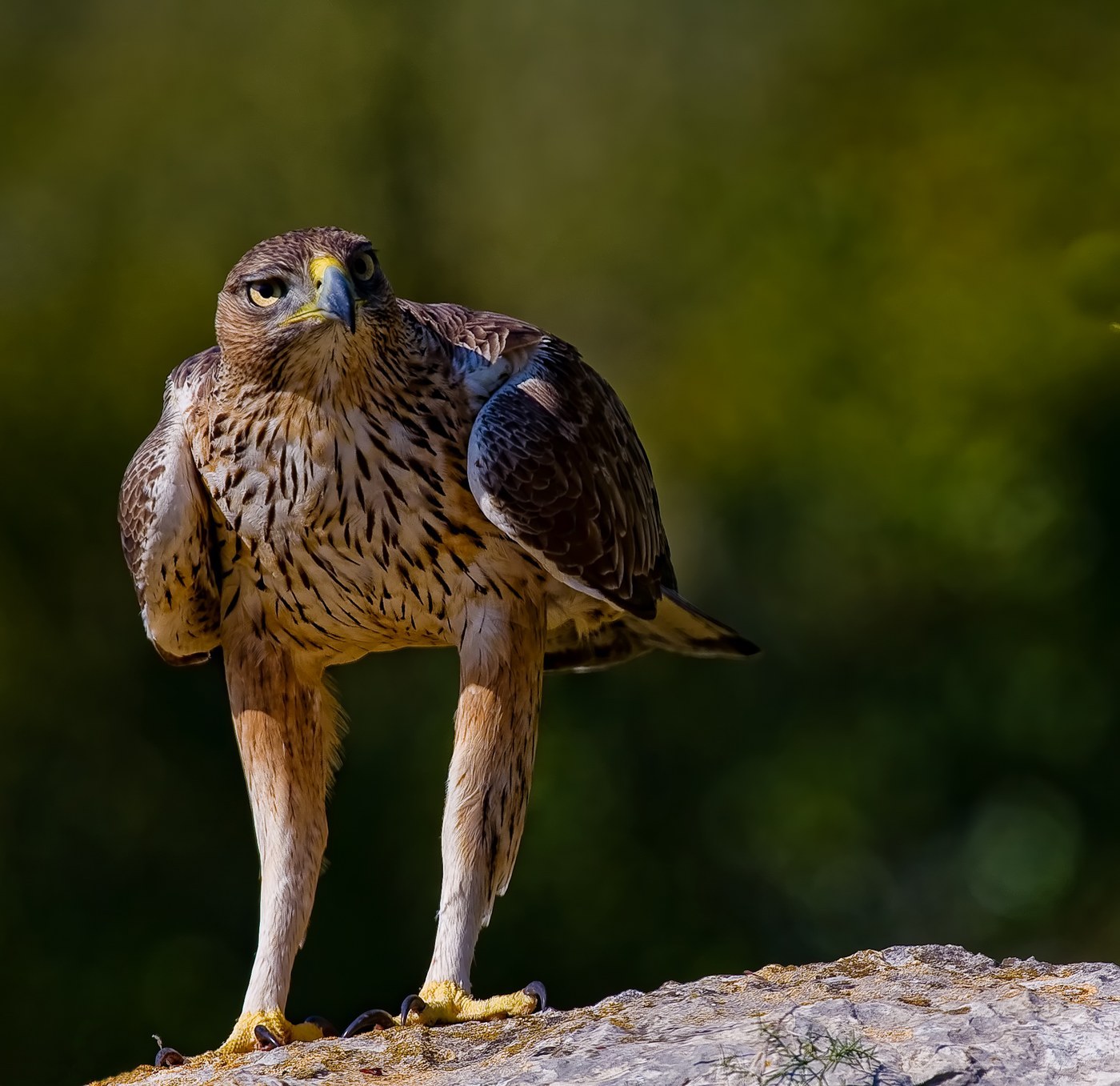
What Bonelli's Eagle Feathers Look Like
Bonelli's Eagle is a powerful, medium-large raptor of rocky and hilly terrain across southern Europe, the Middle East, and Asia, and its feathers show the strength and patterning typical of an active, agile predator.
- Body/contour feathers (adult): pale to whitish on the underparts with fine dark shaft streaks, contrasting with darker brown upperparts — feathers 4-8 cm on the body, sturdy and slightly stiff.
- Body/contour feathers (juvenile): warmer rufous-buff below with less streaking, browner overall than adults.
- Flight feathers (primaries/secondaries): long (25-40 cm), broad, dark grayish-brown above with a conspicuous blackish trailing edge and dark carpal-area markings, pale grayish-white below with fine dark barring — the strong dark rear border on an otherwise pale flight feather is a key diagnostic.
- Tail feathers: long (22-28 cm), pale gray with narrow, evenly spaced dark bars and a broader dark subterminal band near the tip — a fairly uniform, fine-barred pattern rather than bold blotching.
- Underwing covert feathers: pale, contrasting against darker flight feathers, giving the characteristic pale-underwing/dark-trailing-edge look typical of this species in flight.
- Shaft color: pale tan to whitish on body feathers, darker brown on flight and tail feathers.
Step-by-Step: Is This Feather From a Bonelli's Eagle?
- Check the size. Flight feathers 25-40 cm and tail feathers over 20 cm indicate a medium-large raptor, consistent with Bonelli's Eagle's size class (larger than a buzzard, smaller than a Golden Eagle).
- Look for the dark trailing edge. A pale flight feather with a bold, blackish rear border is one of the most diagnostic features of this species in the field and on shed feathers alike.
- Examine the tail barring. Fine, evenly spaced dark bars on a pale gray tail feather, plus a wider dark band near the tip, fit Bonelli's Eagle well.
- Assess overall paleness. Adult body feathers should look notably pale and lightly streaked rather than heavily blotched or solid dark.
- Match to terrain. Feathers found in rocky gorges, cliffs, and hilly Mediterranean or subtropical scrubland habitat support this identification, since the species favors rugged terrain over dense forest.
Similar Species & How to Tell Them Apart
- Golden Eagle: considerably larger overall, with feathers noticeably bigger (flight feathers can exceed 45-50 cm) and a more uniformly dark brown body plumage lacking the pale, streaked underparts of adult Bonelli's.
- Booted Eagle: much smaller flight feathers (typically under 25 cm) and comes in both pale and dark morphs, but lacks the strong dark trailing edge combined with Bonelli's larger size.
- Short-toed Snake Eagle: shows heavier, more barred underwing patterning overall and a distinctly larger, broader-headed silhouette in life; its flight feathers show less contrast between a pale body and dark trailing edge.
- Juvenile Bonelli's vs. juvenile Golden Eagle: juvenile Bonelli's is more rufous-toned and smaller-feathered; juvenile Golden Eagle shows bold white patches at the base of the flight and tail feathers that Bonelli's lacks.
Where & When You'll Find Them
Bonelli's Eagles are non-migratory residents of rocky, hilly, and cliff-lined terrain across the Mediterranean basin, the Middle East, and parts of South and East Asia, often nesting on cliff ledges. Because they don't migrate, feathers can be found year-round near nest cliffs and hunting territories, with the heaviest feather drop typically during the late summer to autumn post-breeding molt. Look along cliff bases, rocky outcrops, and open scrubland where the birds hunt for rabbits and partridges.
Frequently asked questions
What's the most reliable feature for identifying a Bonelli's Eagle flight feather?
A pale flight feather with a bold, blackish trailing edge is one of the most consistent diagnostic marks for this species.
How can I tell an adult from a juvenile feather?
Adults show pale, finely streaked underparts, while juveniles are warmer rufous-buff with less streaking and a browner overall tone.
How do I rule out a Golden Eagle?
Golden Eagle feathers are noticeably larger and more uniformly dark brown, lacking the pale streaked body plumage of adult Bonelli's.
Where should I look for feathers near a known territory?
Check cliff bases, rocky outcrops, and open scrub or hilly terrain, since Bonelli's Eagles favor rugged terrain over forested areas.