
How to Identify Blue-throated Mountain-gem Feathers
A guide to the tiny iridescent blue throat feathers, white facial stripes, and gray-green body plumage of this large North American hummingbird.
Read the full Blue-throated Mountain-gem encyclopedia entry →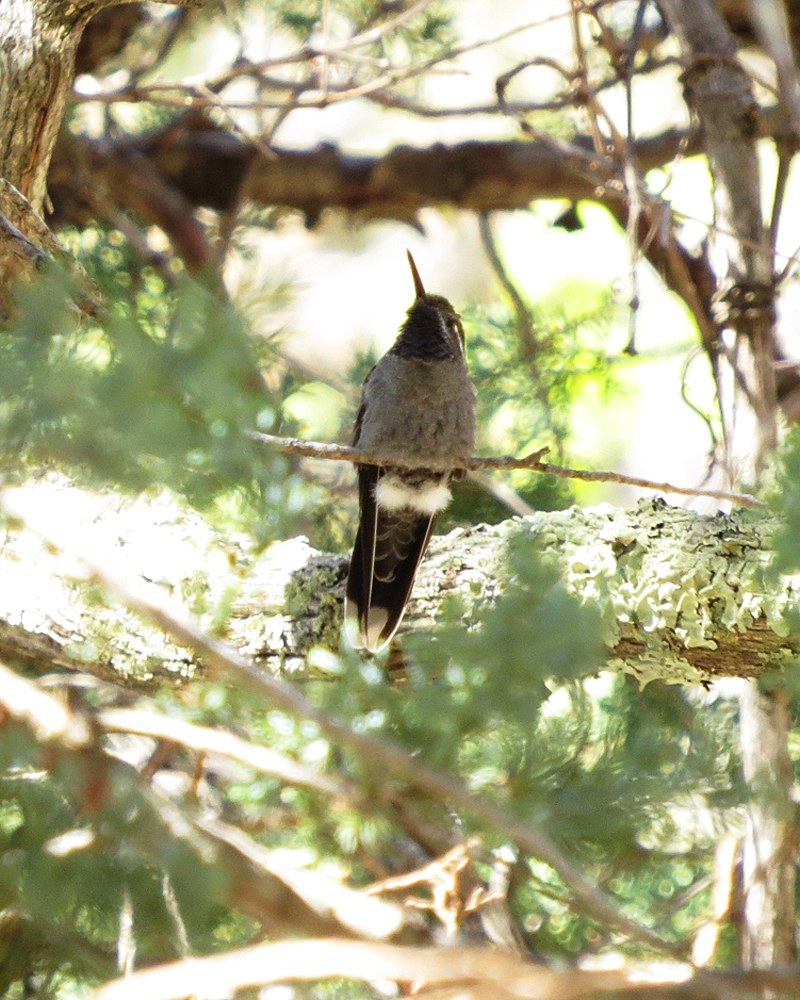
What Blue-throated Mountain-gem's Feathers Look Like
Blue-throated Mountain-gem is one of the largest hummingbirds in North America, but its feathers are still tiny by non-hummingbird standards — most body feathers measure only a few millimeters to about a centimeter. The male's throat (gorget) feathers are the standout feature: brilliant, iridescent sapphire-to-violet-blue, but like many hummingbird gorgets this color is structural and highly angle-dependent — the same feather can look flat black or dull gray-brown if not caught in direct light at the right angle, so always check it from multiple angles before ruling it out. Body feathers are an understated gray-green to olive-gray on the back and crown, without iridescence, and pale grayish-white on the underparts. A key facial clue is a bold white stripe behind the eye and a second white stripe below/behind it (malar stripe), framing the face distinctly — visible on individual face feathers as clean white with sharp edges. Tail feathers are unusually large for a hummingbird, dark with white corners/tips on the outer feathers, and the overall tail is broader and more rounded than most North American hummingbirds.
Step-by-Step: Is This Feather From a Blue-throated Mountain-gem?
- Rotate any dark throat feather in the light. If it flashes brilliant blue at certain angles despite looking black or dull otherwise, that's consistent with an iridescent gorget feather.
- Check for bold white facial stripes — a double white stripe pattern (behind the eye and along the malar area) is a strong supporting clue even without a gorget feather.
- Look at tail feather size and pattern. Large, broad tail feathers with white corners on the outer pair point to this species over smaller hummingbirds.
- Confirm body feathers are matte gray-green, not iridescent — iridescence in this species is essentially confined to the male's throat.
- Consider overall size: this is a notably large hummingbird, so its feathers (while still tiny) run larger than typical small hummingbird species in the same region.
Similar Species & How to Tell Them Apart
Blue-throated Mountain-gem is often confused with other large mountain hummingbirds sharing its range, such as Rivoli's Magnificent Hummingbird, which has a green (not blue) gorget and lacks the bold double white facial stripes. Smaller hummingbirds like Broad-tailed or Black-chinned Hummingbird have much smaller overall feather size and simpler facial patterns without the strong white stripes. The combination of large size, a blue (not green or red) iridescent gorget, and bold white facial striping is the most reliable set of clues for this species.
Where & When You'll Find Them
Blue-throated Mountain-gem inhabits shaded canyons and pine-oak woodland in mountainous areas of the southwestern United States (notably southeastern Arizona and southern New Mexico) south through the highlands of Mexico. Feathers are most often found near favored nectar sources — flowering shrubs, hummingbird feeders, and streamside vegetation in shaded canyon habitat — since this species is a canyon specialist that often defends specific feeding territories. Molt in hummingbirds is gradual, but worn or damaged gorget and tail feathers are more likely to be found in late summer, after the breeding season, near nest sites and regularly used feeding perches.
Frequently asked questions
Why does a throat feather from this species sometimes look black instead of blue?
The blue color of the gorget is structural and angle-dependent, so the feather can look flat black or dull gray-brown unless viewed at the right angle in good light.
What facial pattern should I look for?
Bold white stripes behind the eye and along the malar (cheek) area, framing the face distinctly — a strong clue even without a gorget feather.
How does this compare to Rivoli's Magnificent Hummingbird?
Rivoli's Magnificent Hummingbird has a green, not blue, iridescent gorget and lacks the bold double white facial stripes of Blue-throated Mountain-gem.
How large are this species' feathers compared to other hummingbirds?
Larger overall, since Blue-throated Mountain-gem is one of the biggest hummingbirds in North America, though all its feathers remain tiny in absolute terms.
Where and when are feathers most likely to be found?
Near flowering shrubs, feeders, and streamside vegetation in shaded mountain canyons of the southwestern U.S. and Mexican highlands, especially in late summer after breeding.