
How to Identify Blue-footed Booby Feathers
How to recognize the brown-and-white seabird feathers of this Pacific coast booby (the blue is in the feet, not the plumage) and separate them from related boobies.
Read the full Blue-footed Booby encyclopedia entry →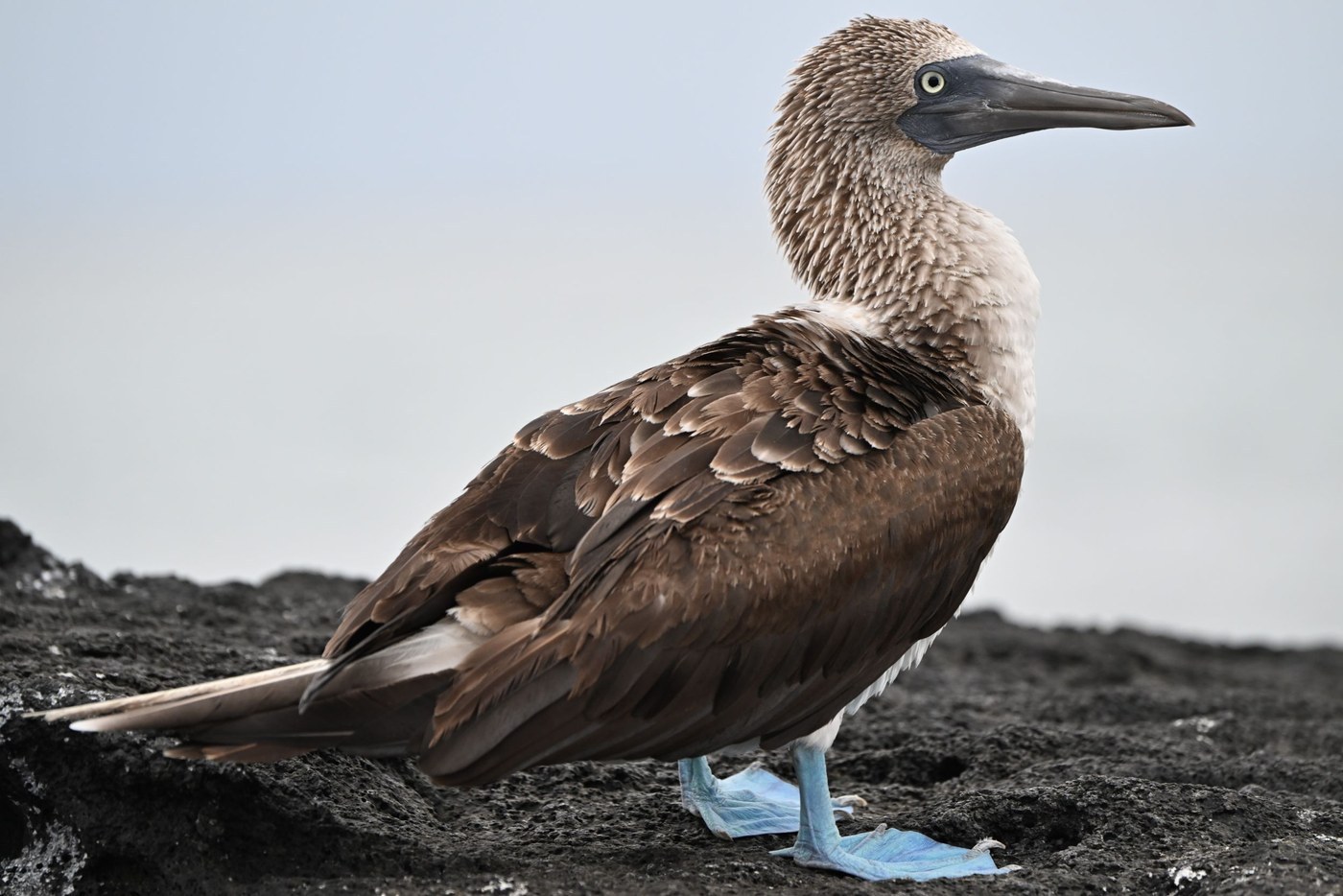
What Blue-footed Booby's Feathers Look Like
Despite the name, the "blue" in Blue-footed Booby refers to its bare foot skin, not its feathers — so identifying a feather means focusing on its brown-and-white plumage pattern instead. Head, neck, and upper back feathers are mottled grayish-brown, with fine pale streaking on the crown and hindneck giving a slightly scaly texture. The back and upperwing feathers are a darker chocolate-brown, contrasting sharply with clean white underparts and a white patch at the base of the tail and rump, visible as an abrupt color break on body feathers taken from that boundary zone. Flight feathers are dark brown, long, stiff, and narrow, built for sustained gliding and plunge-diving — the shafts are notably thick and strong compared to a typical songbird. Tail feathers are dark brown and moderately long, tapering to a point. Overall feather texture is dense and slightly oily-glossy, an adaptation shared with other seabirds for water resistance.
Step-by-Step: Is This Feather From a Blue-footed Booby?
- Check the color break. A feather that's sharply brown on one part and clean white on another, especially near what would be the tail base, matches this species' rump/tail pattern.
- Assess texture. Dense, slightly glossy, water-resistant feel points to a seabird rather than a landbird.
- Note streaking on brown areas. Fine pale streaks on the crown/neck feathers, rather than solid brown, is typical of this species' head plumage.
- Measure flight feathers. Long, narrow, and stiff-shafted, consistent with a plunge-diving seabird — thicker-shafted than most gulls of similar length.
- Consider location. Found along a tropical or subtropical Pacific coastline or on offshore islands, brown-and-white seabird feathers are a strong match for a booby.
Similar Species & How to Tell Them Apart
Brown Booby looks superficially similar but has a more uniformly solid dark brown hood and breast with a sharper, straighter line to the white belly, lacking the fine pale streaking on the head/neck typical of Blue-footed Booby. Nazca Booby and Masked Booby are predominantly white-bodied with black (not brown) flight feathers and a more clean-cut wing pattern. Brown Pelican feathers are much larger and coarser, with a more uniformly grayish-brown tone throughout. The finely streaked brown head/neck combined with a well-demarcated white rump/tail-base patch is the most useful combination for confirming Blue-footed Booby specifically.
Where & When You'll Find Them
Blue-footed Booby breeds and forages along the Pacific coast of the Americas from the Gulf of California south to Peru, with the Galápagos Islands hosting a particularly large and well-known population. Feathers are most often found on breeding islands, rocky coastal cliffs, and beaches near nesting colonies, since these birds nest on the ground in the open. Molt is continuous and gradual, so feathers can be found year-round, but the greatest concentration of shed feathers typically appears near colonies during and after the breeding season, when chick-rearing and increased activity around nest sites lead to more feather loss and damage.
Frequently asked questions
Is the blue color found anywhere on a Blue-footed Booby feather?
No — the blue is restricted to the bird's bare foot skin. Feathers themselves are brown and white, so identification relies on plumage pattern rather than color.
What is the key pattern to look for?
A sharp color break between dark brown upperparts/head and clean white underparts, plus fine pale streaking on the crown and neck feathers.
How is this different from a Brown Booby feather?
Brown Booby shows a solid, unstreaked dark brown hood and breast with a cleaner, straighter boundary to the white belly, lacking the fine streaking seen in Blue-footed Booby.
Why do the feathers feel dense and slightly glossy?
This is a seabird adaptation for water resistance during plunge-diving and long periods on or near the ocean surface.
Where are feathers most commonly found?
Near breeding colonies on Pacific coastal islands and cliffs, including the Galápagos, especially during and after the breeding season.