
How to Identify Black-necked Stork Feathers
A guide to the iridescent black-and-white body feathers of this large stork, one of the tallest wading birds in its range.
Read the full Black-necked Stork encyclopedia entry →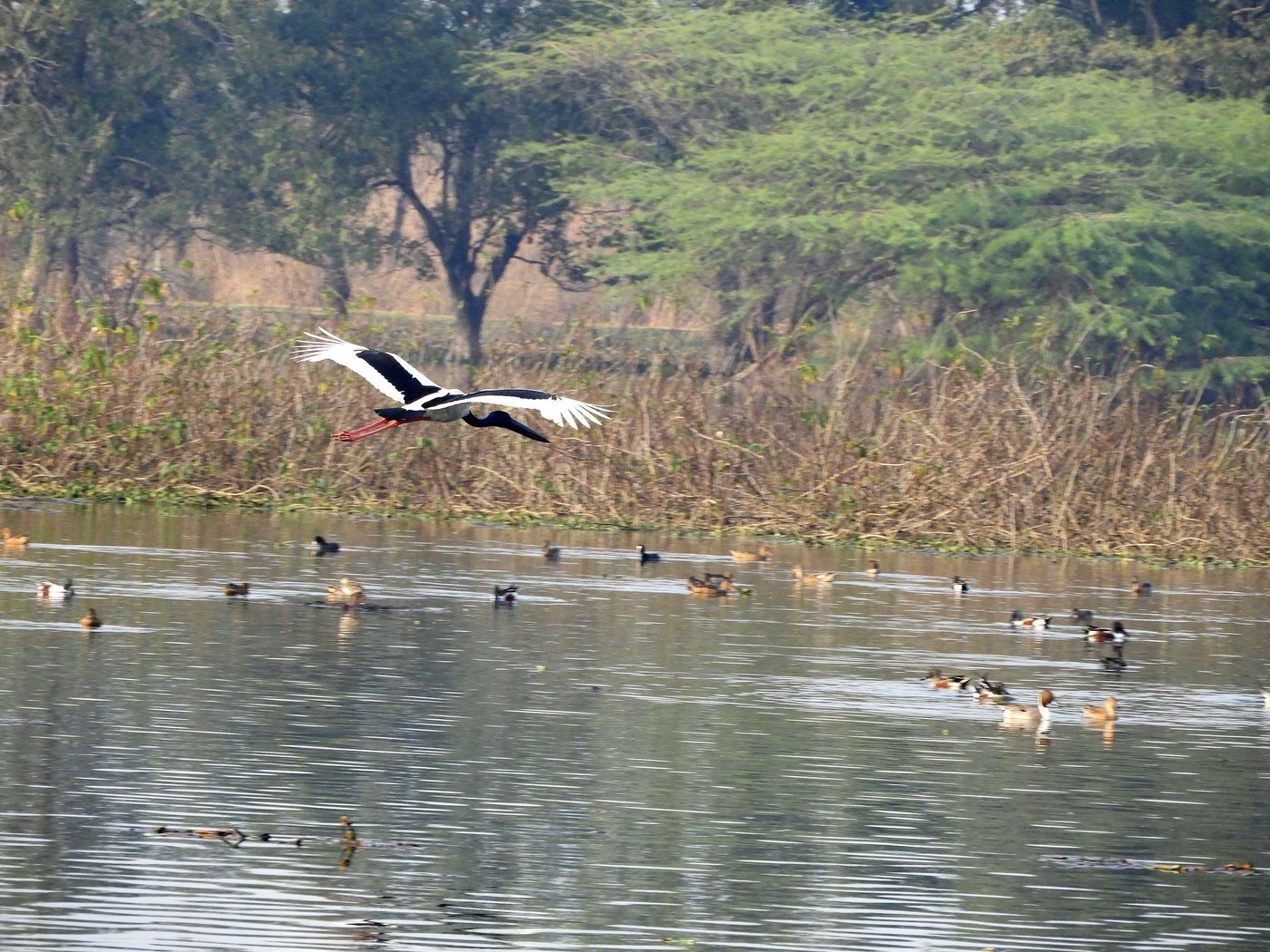
What Black-necked Stork Feathers Look Like
As one of the tallest storks in its range, this species produces correspondingly large feathers. The head, neck, and much of the wings are glossy black, showing a strong iridescent green-and-purple sheen in good light — a genuinely striking feature, since the black is not flat but shimmers with color depending on the angle of light, 6-10 cm on the body and neck. The back (lower mantle) and belly are pure white, forming a bold contrast band across the body. Wing coverts include both black and white feathers depending on position, so a wing feather from this species could be either solid glossy black or clean white.
Flight feathers are large, 25-35 cm, black with the same iridescent sheen as the body/neck feathers, stiff and long, reflecting this stork's large flight muscles and soaring capability. The tail is short and black. Overall the feather set is dominated by the black-white contrast, similar in concept to a few other pied storks, but the iridescent quality of the black feathers (rather than a flat matte black) is a helpful distinguishing detail when comparing feathers side by side.
Step-by-Step: Is This Feather From a Black-necked Stork?
- Check for iridescence on black feathers. A greenish-purple sheen visible when the feather is tilted in light is a strong supporting clue for this species over a flat matte-black feather from an unrelated bird.
- Confirm the pattern includes both solid black and clean white feathers. Finding both types together, both large, supports this species' pied pattern.
- Measure size. Body feathers 6-10 cm and flight feathers 25-35 cm reflect one of the larger storks, notably bigger than most herons.
- Assess stiffness. Flight feathers should feel notably stiff and strong, consistent with a large soaring bird.
- Consider habitat and range context. A large iridescent black-and-white feather found near wetlands in South or Southeast Asia or northern Australia strongly supports this species.
Similar Species & How to Tell Them Apart
Asian Openbill, sharing some range, is much smaller with grey-brown (not glossy black) body feathers and lacks the strong iridescent sheen entirely. Woolly-necked Stork shows a white neck rather than black, with black restricted to the body and wings — the neck color is the key separator between these two similarly patterned storks. Saddle-billed Stork, an African relative with a broadly similar pied pattern, has a black body divided differently, with a black band across the chest area and white elsewhere on the body — the pattern layout differs enough that comparing exactly which body zones are black versus white can help separate a feather.
Where & When You'll Find Them
Black-necked Storks (also called Jabirus in parts of their range, not to be confused with the unrelated New World Jabiru) are found from South Asia and Southeast Asia to northern and eastern Australia, favoring wetlands, floodplains, and wet grassland, typically as solitary or paired birds rather than in large flocks. Feathers are most often found near wetland foraging areas and around large stick nests built in tall trees near water, where pairs return to breed year after year. Molt is gradual and not sharply pulsed, but worn feathers are most commonly found near nest sites during and after the breeding season, when adults are most active around a fixed location.
Frequently asked questions
What makes the black feathers on this species distinctive?
They show a strong iridescent green-and-purple sheen in good light, rather than flat matte black, a genuinely useful identifying trait.
Is the plumage all one color?
No, it's boldly pied — glossy black on the head, neck, and much of the wings, with a pure white back and belly.
How do I tell this apart from Woolly-necked Stork?
Woolly-necked Stork has a white neck, while this species' neck is solid black, making neck color the clearest separator.
How large are the flight feathers?
Quite large — 25-35 cm, stiff and strong, consistent with one of the bigger storks in its range.
Where do these storks nest?
In large stick nests built in tall trees near wetlands, which pairs return to and reuse across breeding seasons.