
How to Identify Black Kite Feathers
A guide to the dark brown flight feathers, forked tail, and pale wing patch that identify this widespread raptor.
Read the full Black Kite encyclopedia entry →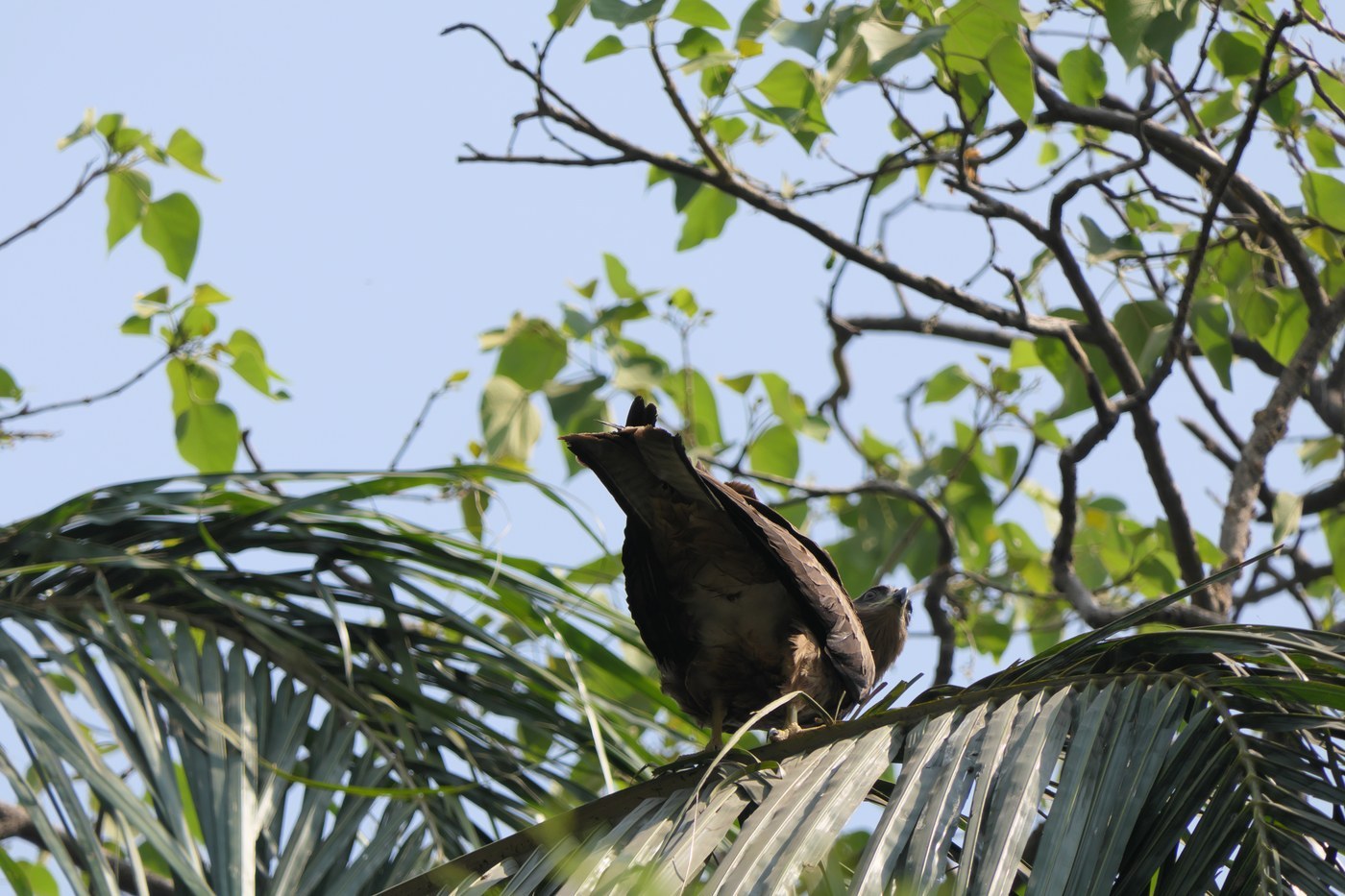
What Black Kite Feathers Look Like
Black Kites are, despite the name, more dark brown than truly black — body and covert feathers are dull dark brown, unmarked or very faintly mottled, 4-7 cm on the body, without the bold barring or streaking seen in many other raptors. The single most useful structural clue is the notched or forked tail — Black Kite tail feathers are relatively long (14-18 cm) and the tail as a whole shows a shallow fork when spread, though individual feathers may just look slightly asymmetrical and squared rather than dramatically forked. Primaries are long, 22-28 cm, dark brown, with a pale, translucent patch near the base of the underside of the outer primaries — visible as a lighter brown or slightly translucent zone if the feather is held up to light, a helpful and fairly reliable clue for this species among similarly sized brown raptors.
The head and face are only slightly paler than the body, without a strongly contrasting pale head like some kites and buzzards show, giving an overall drab, uniform brown impression. Juveniles show more pale streaking on the body and covert feathers than adults, whose plumage is more uniformly plain dark brown.
Step-by-Step: Is This Feather From a Black Kite?
- Check overall color. Dull dark brown, largely unmarked, fits Black Kite; strongly barred or richly rufous feathers suggest a different raptor.
- Look for a pale translucent patch near the primary base when held to light. This subtle window-like patch is one of the more diagnostic clues for this species among similarly sized brown raptors.
- Assess tail feather shape. A moderately long, slightly notched or asymmetrical tail feather (part of an overall forked tail) supports Black Kite over a rounder-tailed buzzard.
- Measure flight feathers. Primaries 22-28 cm fit a mid-large raptor, smaller than a large eagle but bigger than most falcons.
- Check for pale streaking on juvenile-type feathers, which can appear on body/covert feathers of young birds even when the overall dark brown tone is otherwise correct.
Similar Species & How to Tell Them Apart
The Red Kite, found in overlapping parts of the Old World, is notably more rufous-red overall with a much more deeply forked tail and bolder pale wing patches, easily separated from the duller, less forked Black Kite. Various buzzards (Buteo species) sharing brown plumage typically show a rounded (not forked) tail and broader, less angular wings, without the translucent primary-base patch. Marsh Harrier, found in similar wetland habitat, is more variably patterned with paler head and shoulder patches in many individuals, and shows longer, narrower wings overall than the kite's more angular shape.
Where & When You'll Find Them
Black Kites are among the most widespread raptors in the world, found across Europe, Asia, Africa, and Australia in habitats ranging from wetlands and rivers to farmland, garbage dumps, and urban areas, since the species is a notably opportunistic scavenger. Feathers are commonly found near communal roosts (sometimes numbering in the hundreds or thousands of birds), around nest sites in tall trees, and near food sources like landfills, fishing harbors, and agricultural land where kites gather to feed. Molt is gradual through the breeding season and beyond, so feathers can be found nearly year-round near roosts and feeding areas, with the heaviest accumulation near large communal roost sites during non-breeding congregations.
Frequently asked questions
What's the best structural clue for this species?
A pale, slightly translucent patch near the base of the underside of the outer primaries, visible when the feather is held up to light.
Is the tail deeply forked like Red Kite's?
No, Black Kite's tail fork is much shallower — individual feathers look slightly notched or asymmetrical rather than dramatically forked.
How do I rule out a buzzard (Buteo) feather?
Buzzards have rounded, not forked, tails and broader wings, and lack the translucent patch near the primary base.
Why is the plumage so plain and unmarked?
Adult Black Kites show largely uniform dark brown plumage with little patterning; more pale streaking suggests a juvenile bird instead.
Where are feathers most commonly found?
Near communal roosts, nest trees, and opportunistic feeding sites like landfills and fishing harbors, where the species gathers in numbers.
Black Kite identified by the community
Recent Black Kite feathers identified with Feather Identifier.
