
How to Identify Black-headed Caique Feathers
A guide to the black cap, orange face, and white belly feathers of this small, playful South American parrot.
Read the full Black-headed Caique encyclopedia entry →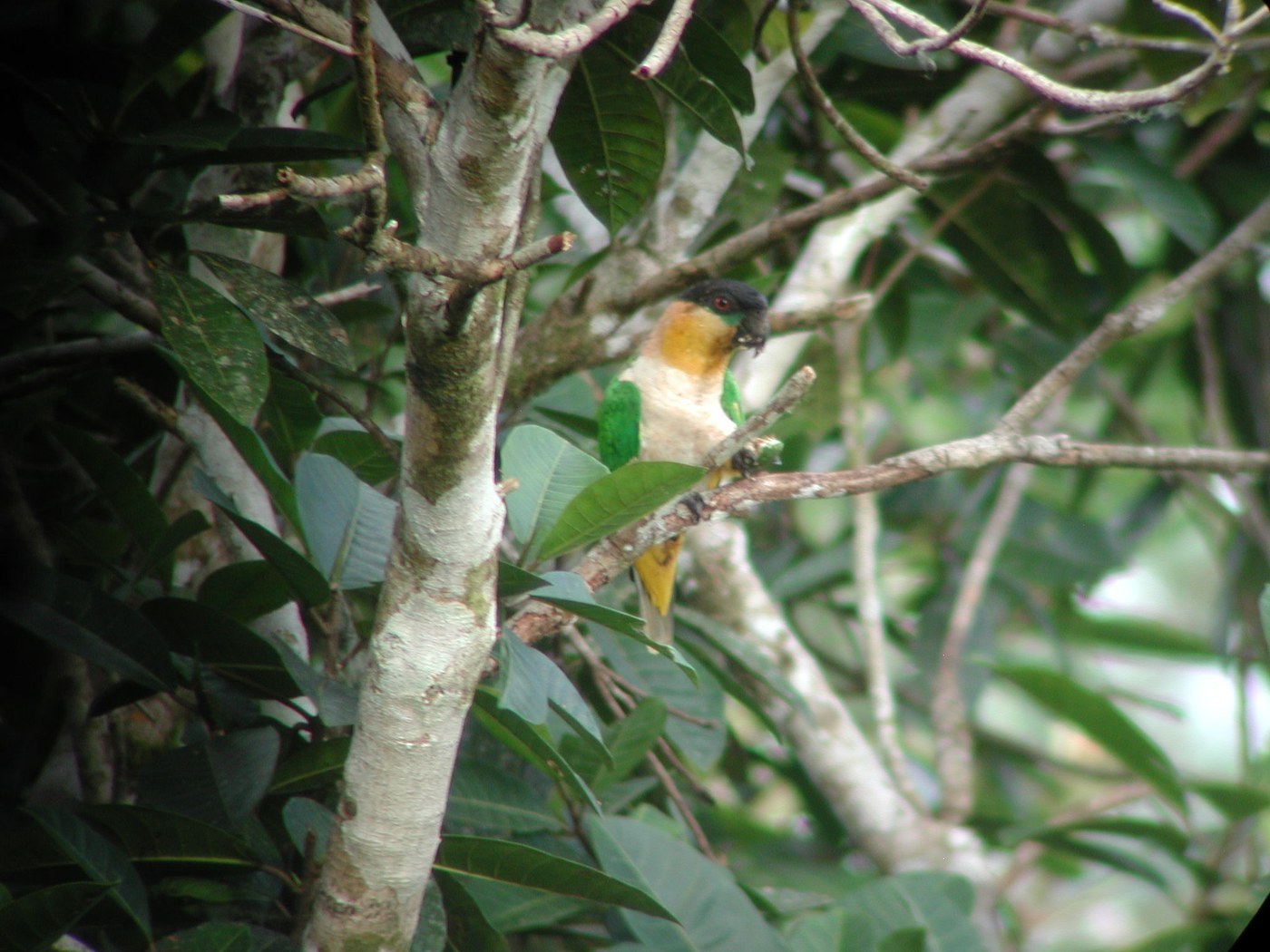
What Black-headed Caique Feathers Look Like
This small, chunky parrot has a bold and unmistakable color-blocked pattern. The crown and nape are solid black, feathers dense and slightly velvety-looking rather than glossy. The cheeks and throat are bright orange to orange-yellow, contrasting sharply with the black cap directly above. The breast and belly are clean white to pale cream, while the wings and back are grass-green, typical parrot green with a slight yellowish cast on some covert feathers. Body feathers are fairly small for a parrot, 2-4 cm, with the rounded, slightly curved shape typical of psittacine contour feathers.
Flight feathers are green with darker blue-green tips on the primaries, a common pattern in many parrots where the flight feathers carry more blue pigment than the body. Primaries run about 8-11 cm, sturdy and slightly stiff, with the rounded parrot wingtip shape rather than a falcon's sharp point. The tail is short and green, sometimes with a faint yellowish tinge on the underside. As a cage-trade-popular species, feathers from this bird are also commonly found in captivity/aviary settings, not just in the wild range.
Step-by-Step: Is This Feather From a Black-headed Caique?
- Look for the black-orange-white-green combination. Finding two or more of these zones — especially black next to orange, or white next to green — is close to diagnostic for this species among Neotropical parrots.
- Check feather shape. A short, rounded, slightly curved contour feather with a thick basal quill is typical parrot structure, ruling out songbirds and raptors.
- Assess the wing tips for blue-green shading. Darker blue-toned tips on green flight feathers support a caique or similar small parrot.
- Measure size. Contour feathers 2-4 cm and flight feathers 8-11 cm fit a small, stocky parrot rather than a macaw or large Amazon parrot.
- Consider context. If found near an aviary, pet shop, or urban area outside its native range, this is likely an escaped or released pet rather than a wild vagrant.
Similar Species & How to Tell Them Apart
The White-bellied Caique, its closest relative, shows a similar white belly and green wings but has a duller olive-brown crown instead of solid black, and less vivid orange on the face — the black cap is the clearest separator. Various Amazon parrots are larger overall with proportionally bigger feathers and typically lack the sharp three-color blocking (black/orange/white) seen in caiques, showing more blended green-and-red patterning instead. Conures sharing some orange-and-green coloring usually show more red or orange spread broadly across the body rather than concentrated tightly on the face with a contrasting black cap.
Where & When You'll Find Them
Black-headed Caiques are native to the Amazon Basin of South America, favoring humid lowland and várzea (flooded) forest canopy, where they travel in noisy small flocks. In the wild range, feathers turn up beneath fruiting trees and canopy roost sites used by foraging flocks. Because this species is popular in the pet trade worldwide, feathers are also very commonly found far outside South America — around aviaries, bird parks, and homes keeping the species as a pet — with molt happening year-round in captivity without a strict seasonal pattern, unlike most wild tropical parrots whose molt loosely follows the local wet/dry season cycle.
Frequently asked questions
What's the clearest identifying feature?
The combination of a solid black cap, bright orange face, white belly, and green wings — finding two of these zones together is close to diagnostic.
How do I tell this apart from White-bellied Caique?
White-bellied Caique has a duller olive-brown crown rather than solid black, making cap color the key difference.
Why might I find this feather far from South America?
This species is popular in the pet trade, so feathers often come from captive birds in aviaries or homes rather than the wild range.
Is the feather shape different from a songbird's?
Yes, parrot contour feathers are shorter, more rounded, and have a thicker basal quill than typical songbird feathers.
Where would I find these feathers in the wild?
Beneath fruiting trees and canopy roost sites in humid Amazonian lowland forest, where flocks forage together.