
How to Identify Black Crowned Crane Feathers
A guide to recognizing the black, straw-gold, and white feathers of the Black Crowned Crane, West Africa's showy wetland crane.
Read the full Black Crowned Crane encyclopedia entry →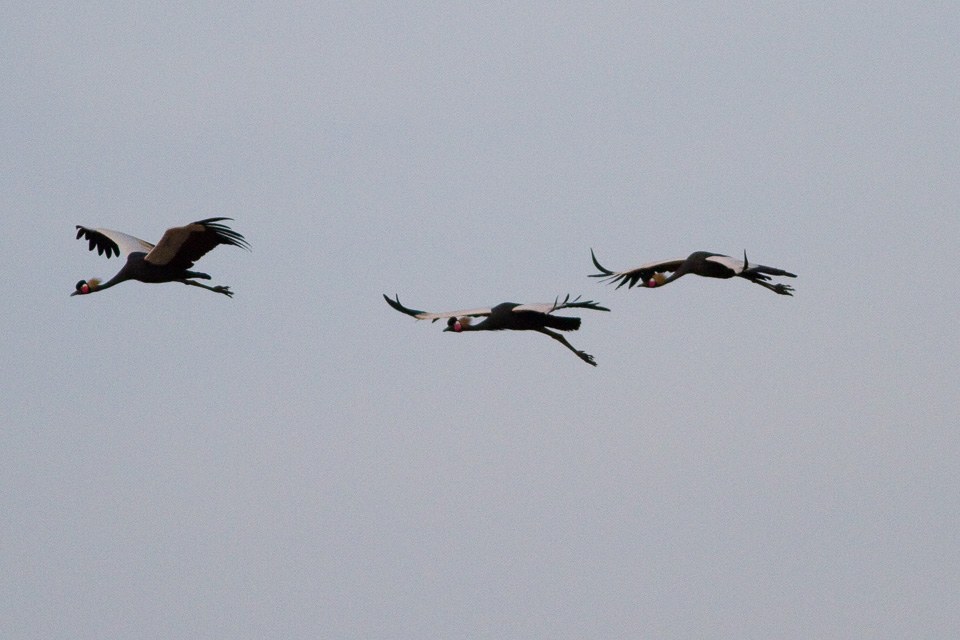
What Black Crowned Crane Feathers Look Like
The Black Crowned Crane is built like most true cranes — a tall wading bird with a mix of dark body plumage and striking pale wing patches — but its color palette is unusual. Body and neck contour feathers are slate-black to blackish-grey, dense and slightly glossy, running 4-9 cm long depending on where on the body they grew. The most distinctive feathers on the whole bird are the stiff, straw-gold bristly filoplumes of the crown, which form the crane's namesake "crown" — these are unlike normal contour feathers, being wiry, radiating strands rather than flat vanes, gold to buff in color, 3-6 cm long.
The wings carry the biggest surprise: primaries and primary coverts are black, but the secondary coverts are white, and a wide band of chestnut-buff feathers sits between the white and the black, so a shed wing feather can be pure white, buff-chestnut, or black depending on exactly where it came from. Flight feathers (primaries) are long — 20-28 cm — black with a slightly curved shaft, moderately stiff and asymmetrical like any flight feather. Tail feathers are shorter (12-18 cm), blackish-grey, straight-edged.
Step-by-Step: Is This Feather From a Black Crowned Crane?
- Measure it. Body contour feathers 4-9 cm; flight feathers 20-28 cm; crown bristles 3-6 cm and clearly wiry rather than flat.
- Check the texture of any pale gold feather. If it feels like stiff bristle or hair rather than a normal vaned feather, you likely have a crown feather — a very strong, near-diagnostic clue since almost nothing else in the same wetlands has this texture.
- Look at color zones on wing feathers. A crisp white feather next to a chestnut-buff one and a solid black one, all similar size, points strongly to this species' wing-covert pattern.
- Assess shaft color and stiffness. Flight feathers should be black with a pale-to-dark shaft, firm and slightly curved, consistent with a large wading/flying bird.
- Rule out overall size. Crane feathers are noticeably larger than most wetland birds except herons, storks, and other cranes — if the feather is small and delicate, it's not from this species.
Similar Species & How to Tell Them Apart
The closest look-alike is the Grey Crowned Crane, which shares the golden crown bristles but has a grey (not black) body and neck, plus a bare red throat wattle — if the surrounding contour feathers are grey rather than black, it's the grey species, not the black one. Herons and storks sharing African wetlands (like the Black-headed Heron or Saddle-billed Stork) lack any gold bristle feathers entirely and have proportionally longer, more pointed flight feathers without the crane's white-and-chestnut wing-covert banding. Vultures and other large black raptors have heavier, more deeply notched primaries and never show the buff/white covert band.
Where & When You'll Find Them
Black Crowned Cranes live in the Sahel belt of West and Central Africa, favoring seasonal marshes, floodplains, and wet grasslands rather than dense forest. Feathers turn up most often near shallow wetland edges, rice paddies, and grazing land where the cranes forage in pairs or family groups. Molt is gradual and not sharply seasonal, but worn body feathers are shed more heavily after the breeding season as adults replace plumage before the dry season; loose crown bristles and contour feathers are the most commonly found type, while long flight feathers are rarer finds since cranes molt these more cautiously to retain some flight capability.
Frequently asked questions
Why does one feather from this crane look completely white and another looks black?
The wing coverts are arranged in bands — white nearest the body, then chestnut-buff, then black at the flight feathers — so which section a feather fell from determines its color.
What's the wiry gold feather I found near a wetland?
If it's stiff and bristle-like rather than flat-vaned, it's likely a crown filoplume, the golden bristly plumes that form this crane's signature crest.
How do I tell this apart from a Grey Crowned Crane feather?
Check the contour feather color: Black Crowned Crane body feathers are blackish-grey, while Grey Crowned Crane body feathers are pale grey.
Are the flight feathers large?
Yes, primaries run 20-28 cm, solid black with a firm curved shaft, consistent with a large flying wetland bird.
When are feathers most likely to be found?
After the breeding season as adults molt worn body plumage, and near shallow marsh edges and floodplains where family groups forage.