
How to Identify Barnacle Goose Feathers
A guide to the strikingly graphic black, white, and barred grey feathers of the Barnacle Goose, and how they differ from other black-necked geese.
Read the full Barnacle Goose encyclopedia entry →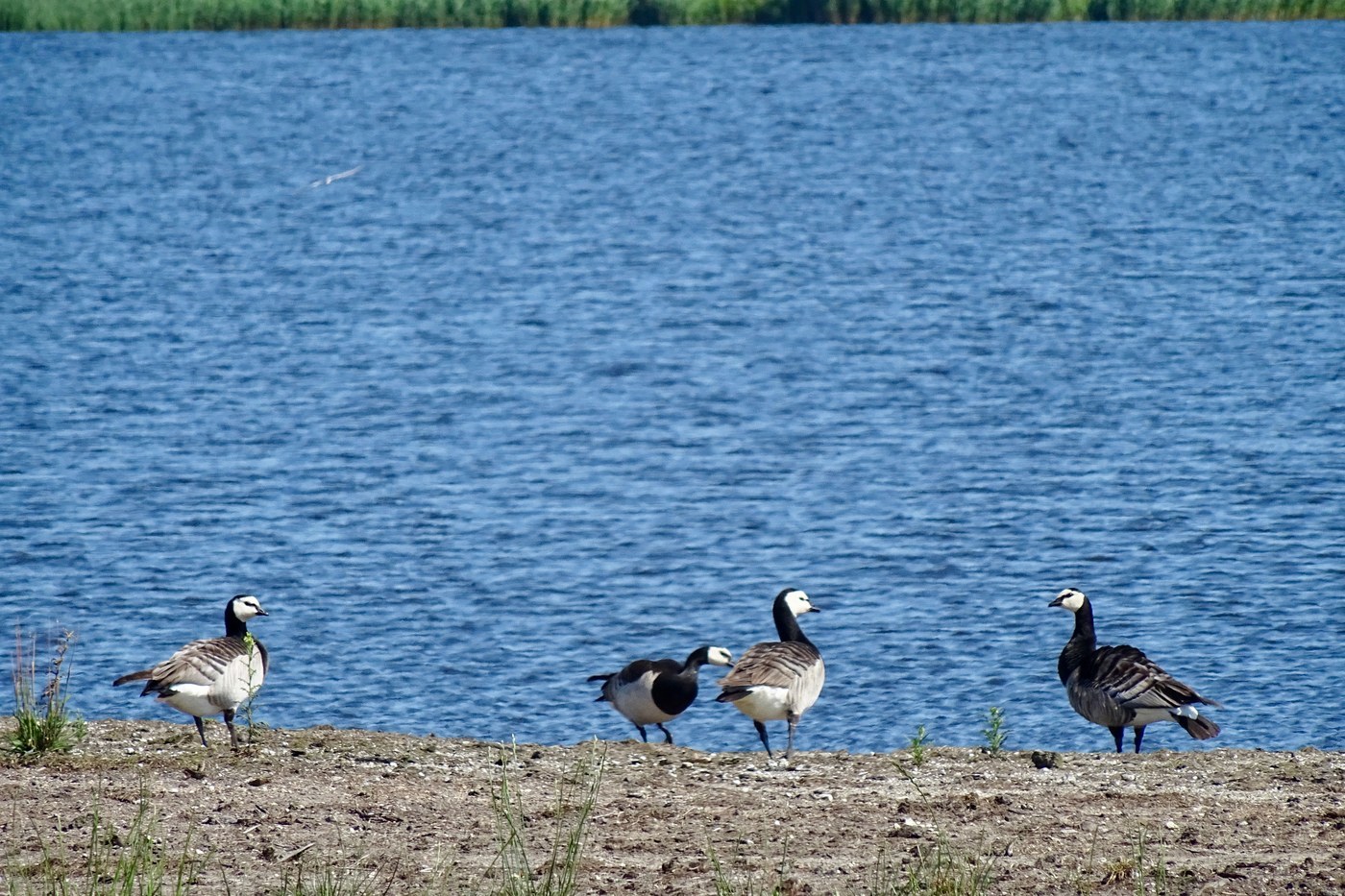
What Barnacle Goose's Feathers Look Like
Barnacle Goose feathers show one of the more strikingly graphic patterns among geese. Head, neck, and upper breast contour feathers are solidly black, sharply set off from a creamy white face, so a black neck feather paired with a stark white face feather from the same bird is a strong combination clue. Back and wing covert feathers are blue-grey with bold black-and-white barring near the tip of each feather - when many feathers overlap on the live bird this creates a distinctive scalloped, almost checkered look, and even a single covert feather will show a clean black subterminal bar followed by a white or pale grey fringe. The belly is white, contrasting with the black breast above it. Tail feathers are black. Flight feathers (primaries and secondaries) are blackish-grey, fairly broad and stiff as expected for a strong-flying goose.
Step-by-Step: Is This Feather From a Barnacle Goose?
- Sort by color zone - pure black (neck/breast/tail), stark white (face/belly), or grey-with-black-and-white-barring (back/coverts) - Barnacle Goose feathers fall cleanly into one of these three categories.
- Look for the barred pattern - covert feathers should show a crisp black bar plus pale fringe, not a diffuse brown-and-buff scaling.
- Check size - a mid-sized goose (55-70 cm), so feathers are substantial but smaller than Canada Goose or Greylag feathers.
- Confirm the black-white contrast - the face-to-neck transition is famously sharp and clean, unlike the softer transitions in most other geese.
- Assess feather stiffness - flight and tail feathers are firm and structured, typical of a strong-flying waterfowl species.
Similar Species & How to Tell Them Apart
Canada Goose shares a black neck and head but has a distinctive white chinstrap rather than an all-white face, and its body feathers are brown, not blue-grey and barred. Brant (Brent Goose) also has a black head and neck but lacks the white face entirely, showing only a small white neck patch, and its body feathers are darker sooty-brown rather than blue-grey. Snow Goose has all-white body feathers (in white morph) or blue-grey in blue morph, but never the sharply barred black-and-white covert pattern paired with a solid black breast.
Where & When You'll Find Them
Barnacle Geese breed in the Arctic (Greenland, Svalbard, Novaya Zemlya) and winter in coastal grasslands and estuaries of northwestern Europe, particularly Scotland, Ireland, and the Netherlands. Molt of flight feathers occurs on the Arctic breeding grounds in mid-summer when adults become flightless for a few weeks, so body feathers are more commonly found on wintering grounds - coastal fields and salt marshes - especially in late winter and early spring as geese loaf and preen before spring migration.
Frequently asked questions
What's the quickest way to distinguish this from a Canada Goose feather?
Look at the face - Barnacle Goose has an entirely white face, while Canada Goose shows only a white chinstrap on an otherwise black head.
Are the barred back feathers unique to this species?
The specific combination of blue-grey ground color with crisp black-and-white barring is fairly distinctive among common geese, though check against Brant and Cackling Goose if unsure.
Could this be a Brant feather?
Brant lacks the white face and barred grey back entirely, showing sooty-brown body feathers and just a small white neck patch instead.
When would I find a primary flight feather from molt?
Primarily on Arctic breeding grounds in mid-summer during the flightless molt period; feathers found in wintering areas are more likely to be contour or covert feathers shed during routine preening.
Do juvenile Barnacle Geese show the same pattern?
Juveniles are duller with less crisp barring and a slightly greyer face, but the same basic black-neck, white-face pattern is present from early in life.