
How to Identify Bar-tailed Godwit Feathers
How to identify Bar-tailed Godwit feathers by the fine dark bars crossing the tail, a white rump, and seasonal shifts between chestnut breeding and streaked grey-brown nonbreeding body feathers.
Read the full Bar-tailed Godwit encyclopedia entry →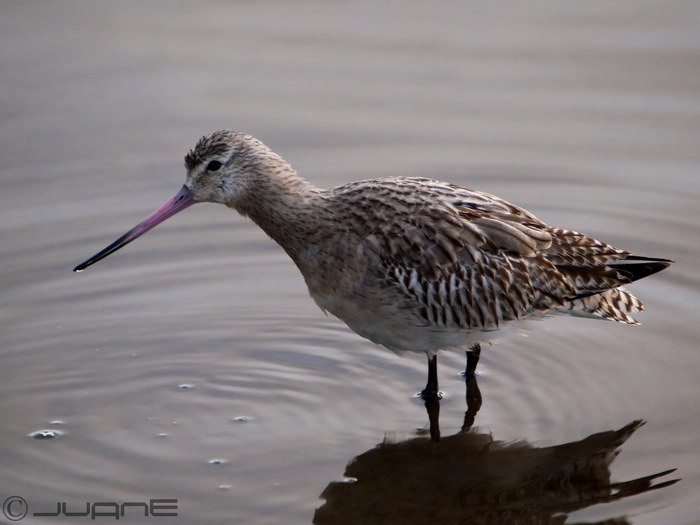
What Bar-tailed Godwit Feathers Look Like
The Bar-tailed Godwit is a long-distance migrant shorebird famous for record-breaking nonstop flights, and its feathers shift dramatically between breeding and nonbreeding seasons. In breeding plumage, body feathers on males especially turn a rich brick-red to chestnut, while nonbreeding birds show greyish-brown feathers with fine dark streaking, considerably plainer than the breeding look. The species' namesake feature is the tail: fine dark bars crossing a paler grey or white background, visible along the length of individual tail feathers rather than concentrated at the tip. The rump is white, and flight feathers are long, fitting the bird's build for extreme long-distance migration, with primaries often 12-14 cm.
Step-by-Step: Is This Feather From a Bar-tailed Godwit?
- Check the tail for fine barring. Multiple thin dark bars crossing a pale tail feather, rather than a single band or plain color, is the species' key diagnostic feature.
- Consider the season and color. A rich chestnut body feather suggests breeding plumage, while a greyish, streaked feather suggests nonbreeding or juvenile plumage - both are consistent with this species depending on timing.
- Look for a white rump. A plain white rump feather paired with barred tail feathers fits this species' pattern.
- Measure the feather. Long primaries in the 12-14 cm range fit a large, long-distance migrant shorebird rather than a smaller sandpiper.
- Weigh the coastal habitat. A matching feather found on tidal mudflats or estuaries strongly supports this species, which relies heavily on such habitat during migration and winter.
Similar Species & How to Tell Them Apart
- Black-tailed Godwit: Shows a solid black tail band rather than fine multiple bars, along with a bold white wingbar in flight that Bar-tailed Godwit lacks.
- Marbled Godwit: Found in a different range (the Americas) with warmer, more mottled cinnamon-buff body feathers throughout rather than the Bar-tailed's more streaked nonbreeding look.
- Hudsonian Godwit: Shows a dark underwing and a bolder black tail band, differing from the Bar-tailed's finer tail barring.
- Whimbrel: Shares similar habitat but has a strongly striped head pattern, with body feathers lacking the fine tail barring of the godwit.
Where & When You'll Find Them
Bar-tailed Godwits breed on Arctic tundra across northern Eurasia and Alaska, then migrate immense distances to winter on coastal mudflats and estuaries across Europe, Africa, Asia, and Australasia - some populations completing the longest known nonstop flights of any bird. Feathers are most likely found on tidal mudflats, sandbars, and estuaries where the species feeds and roosts in large flocks, particularly during migration stopovers and the wintering period. Molt timing varies by population, but many birds replace body feathers into nonbreeding plumage shortly after arriving on wintering grounds, making late autumn through winter a productive time to find the greyer, streaked feather type at coastal sites.
Frequently asked questions
What gives this species its name in feather terms?
Fine dark bars crossing a pale tail feather along its whole length, rather than a single solid band, is the namesake diagnostic feature.
Why do body feathers vary so much in color?
Breeding plumage turns a rich brick-red to chestnut, while nonbreeding and juvenile feathers are plainer greyish-brown with fine streaking - both fit this species depending on the season.
How is this different from a Black-tailed Godwit feather?
Black-tailed Godwit shows a solid black tail band rather than the Bar-tailed's fine multiple bars, plus a bold white wingbar the Bar-tailed lacks.
How long are the primaries?
Often 12-14 cm, fitting a large shorebird built for extreme long-distance migration.
Where and when should I look?
Tidal mudflats and estuaries during migration stopovers and winter, with late autumn through winter being productive for the greyer, streaked nonbreeding feather type.